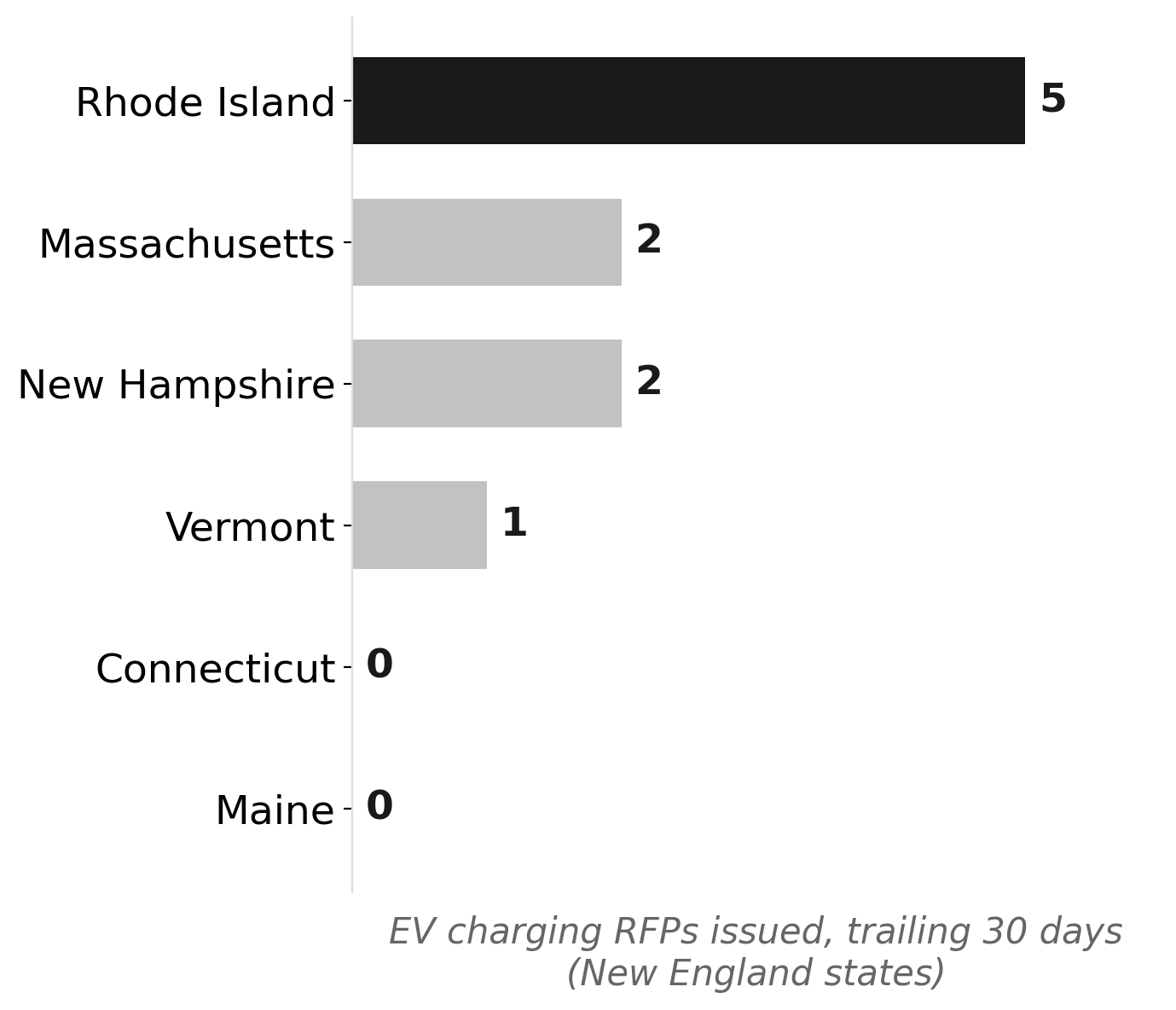
Rhode Island is issuing electric vehicle charging RFPs at 3.2 times its 12-month average rate, five bids in the last 30 days against a baseline of roughly 1.6 per month, and every single one comes from the same source: East Providence's Department of Planning and Economic Development, working off a single procurement (RFP EP26/27-01) for the purchase and installation of EV charging stations. The city refined terms and extended its bid deadline across five iterations between October 2 and 8, 2026. That flurry of paperwork is not redundancy. It is what a federal grant program looks like when the clock finally starts running.
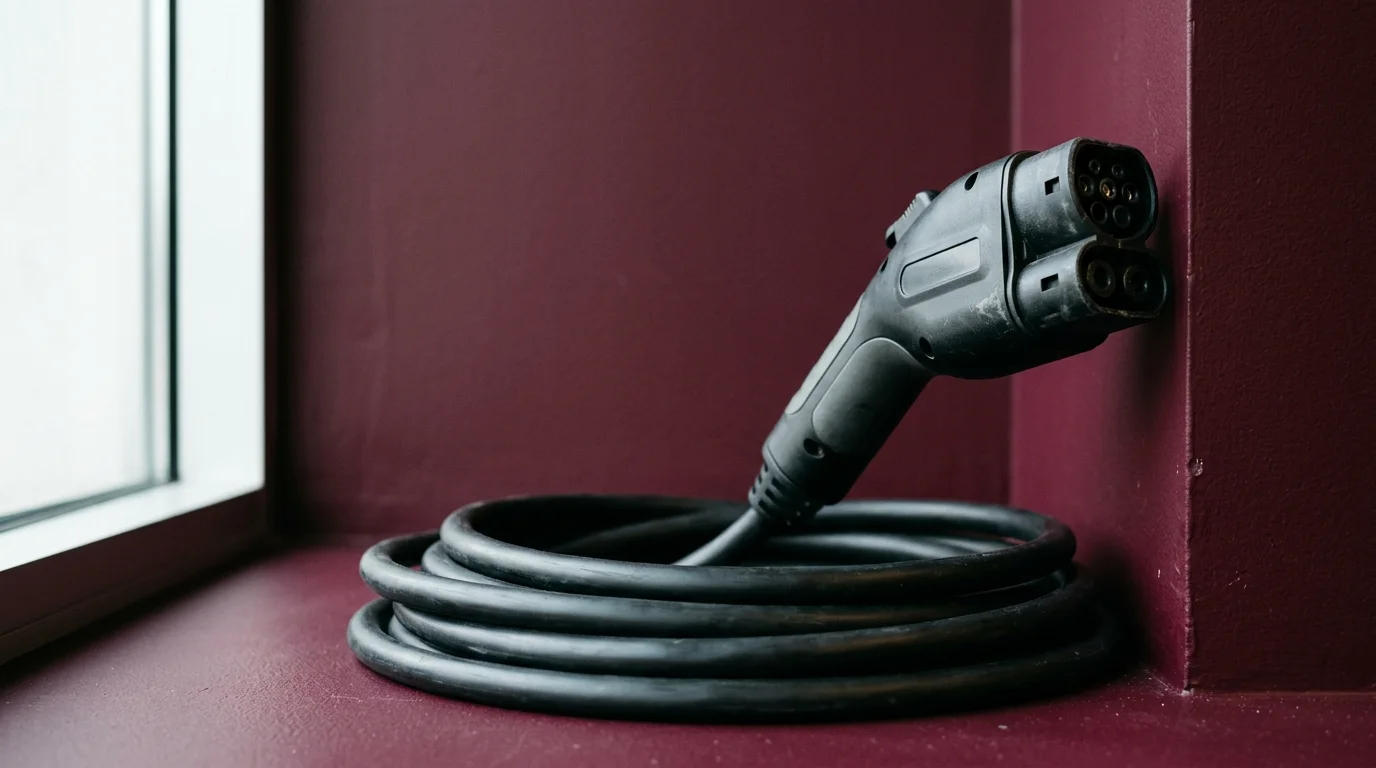
The trigger was a May 4, 2026 announcement from the Rhode Island Office of Energy Resources and RIDOT: 102 new EV charging stations and more than 200 ports across 18 municipalities, described at the time as the state's largest-ever investment in EV infrastructure and the culmination of its community-based NEVI deployment. East Providence was named among the 18 award recipients. U.S. Senator Jack Reed was quoted at the announcement. And then, for several months, nothing visible happened, because awards are not contracts, and contracts require procurement.
The urgency driving procurement now is fiscal. Rhode Island's FY26 State Plan commits the state to obligating all $13.2 million in remaining unobligated federal NEVI funds by the end of FY26. NEVI, the National Electric Vehicle Infrastructure Formula Program, created by the 2021 Infrastructure Investment and Jobs Act, provides formula grants to states for EV charging deployment, administered here through RIDOT and OER. The state has already obligated roughly $9.74 million to RIDOT through November 2028, but the remaining $13.2 million in FY24-FY26 funds must be committed on a hard deadline. That deadline is what East Providence's five October RFPs represent: a municipality that received a federal award in May and now has a fiscal-year clock ticking over its head.
Source: NationGraph.
Rhode Island's position in this race is unusual for a state its size. It was the first in the nation to complete NEVI Phase 1, fully certifying the Alternative Fuel Corridor along I-95, in July 2024, a milestone that unlocked flexibility to redirect remaining funds into community-based charging rather than highway corridors. On November 14, 2024, Governor McKee launched NEVI Phase 2 as the first state in the U.S. to do so, offering a competitive $10 million pool for publicly accessible charging at non-highway locations. The May 2026 community awards were the culmination of that Phase 2 process, making Rhode Island the first state in New England to fully exhaust its community-based NEVI allocation.
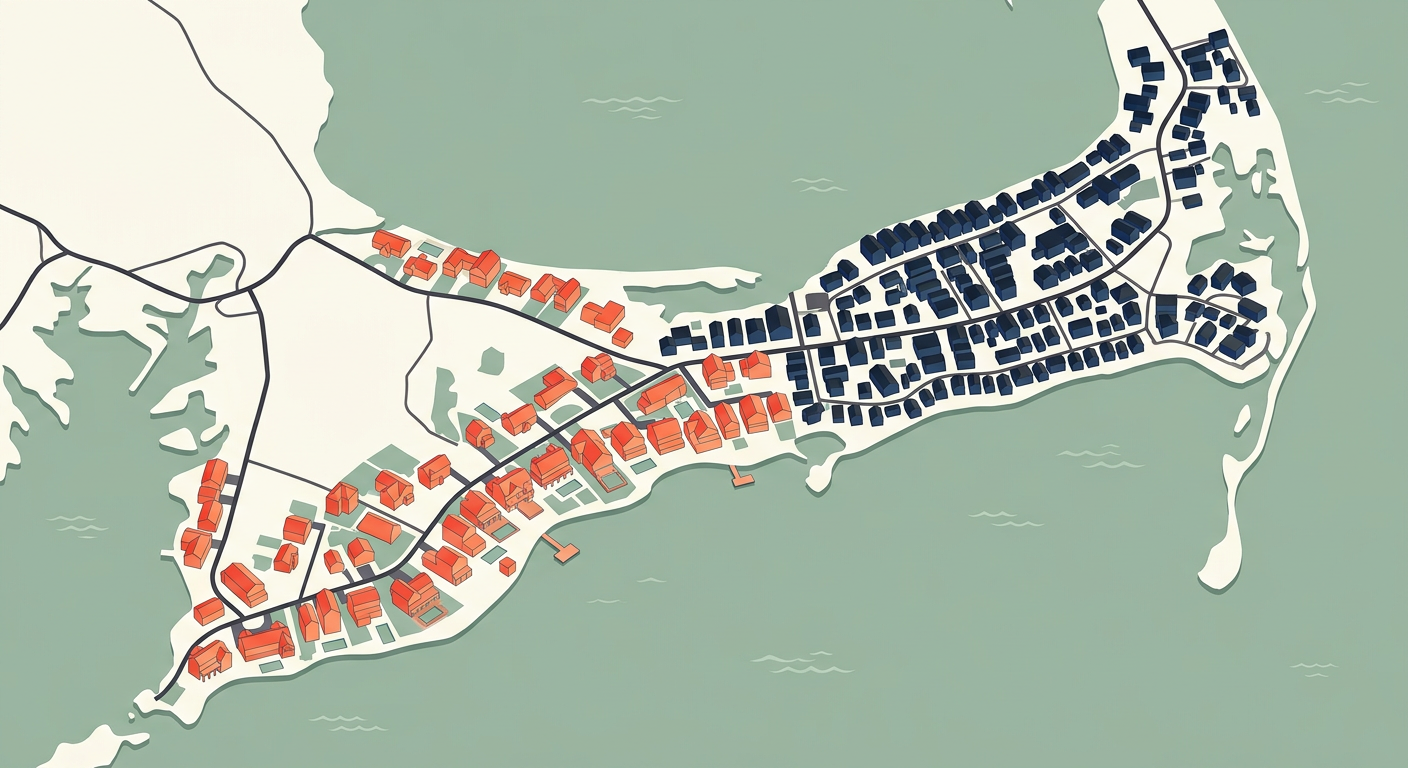
The state's compactness accelerated all of it. Rhode Island's entire designated Alternative Fuel Corridor fits on a single interstate. Its Phase 1 buildout was, structurally, simpler than any other state's. Phase 2 community deployment, 18 municipalities in a state where most of the population sits in Providence County, is similarly bounded. What takes years of corridor-by-corridor negotiation in a large state happened in Rhode Island through a single competitive award round. The result is that procurement is now hitting in a concentrated wave rather than dispersed slowly across a multi-year rollout.
October's surge is not the first such wave. The monthly time series shows two earlier spikes: May 2026, when the OER/RIDOT award announcement coincided with a Narragansett solar-and-EV procurement, produced five RFPs, and July 2025 produced seven. The October activity follows the same post-award pattern: announcements lead procurement by several months, then bids cluster as deadlines approach. Rhode Island currently leads all of New England in EV RFP volume over the trailing 30 days, ahead of Massachusetts (2) and New Hampshire (2).
One structural wrinkle municipalities must navigate: the state's parallel ChargeRI rebate program, which covers up to 80% of installation costs at non-NEVI sites, is explicitly off-limits for any location receiving a NEVI federal grant. The two programs are mutually exclusive at the site level. East Providence's October procurement is NEVI-funded, which means the city cannot also draw ChargeRI rebates for those same locations. Municipalities working through the 18-city community award must pick a lane and stay in it.
For residents of East Providence and the other 17 award municipalities, the practical question is when bid openings in mid-to-late October translate into installation contracts, and when installation contracts translate into working stations. Rhode Island currently operates about 400 public charging stations statewide, serving roughly 12,000 registered EVs. The 102 stations from the May award would represent a 25% expansion of that public network. Whether the fiscal-year obligation deadline produces signed contracts in time, and whether the stations that follow are operational before the NEVI grants expire in November 2028, is the next signal to watch.