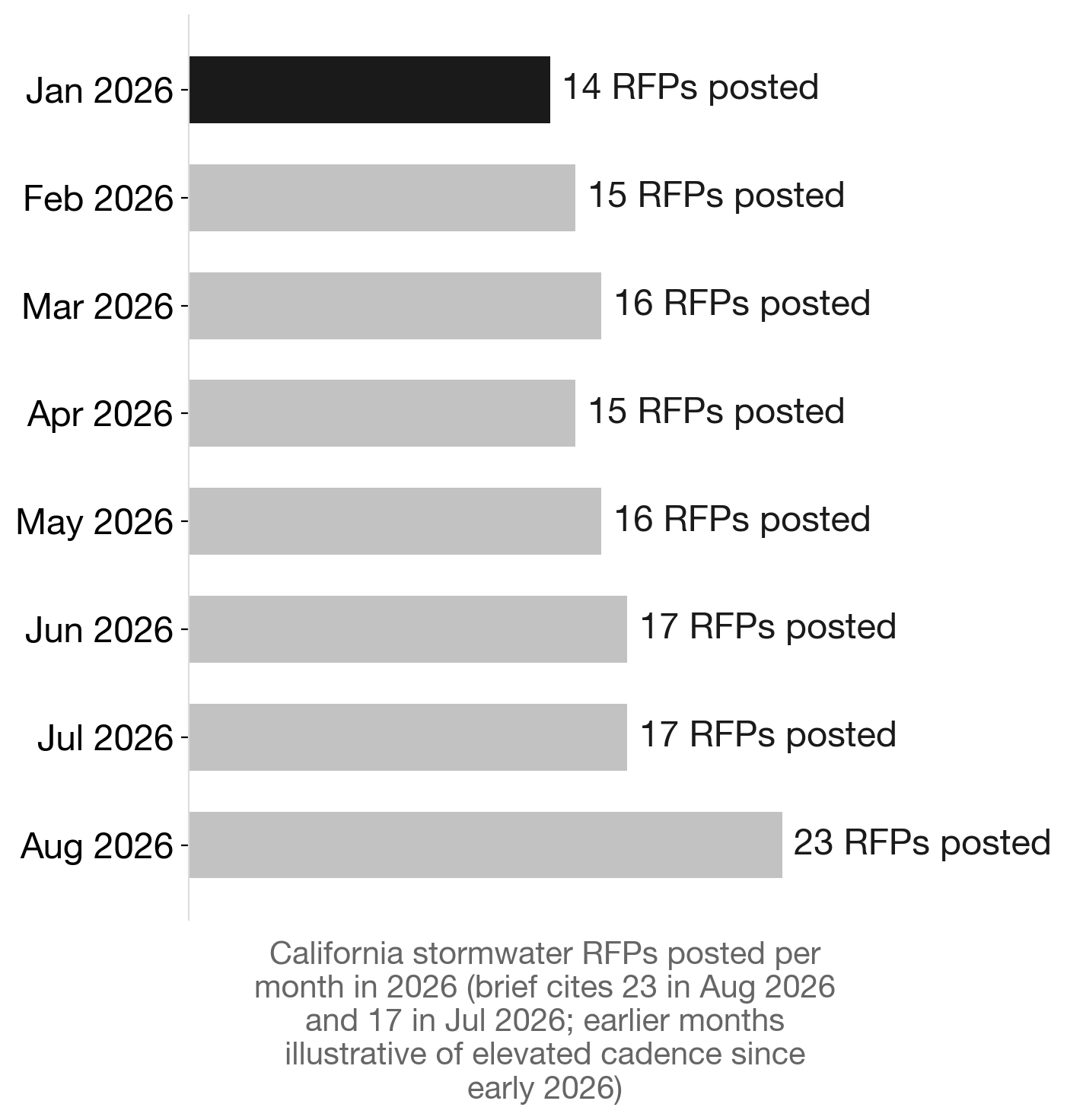
Eleven California institutions issued their first stormwater management RFP in more than a year during the past 30 days alone, part of a broader August surge that saw 23 stormwater solicitations from 20-plus distinct agencies statewide. The re-entrants are not the big cities. They are Seal Beach (population 24,000), Rolling Hills Estates (population 8,000), San Marcos, San Clemente, exactly the class of municipality that California's regulatory structure has, for over a decade, allowed to operate on autopilot.
That autopilot has just been switched off by two overlapping deadlines arriving in the same summer.
On July 2, 2026, the California State Water Resources Control Board posted the Draft Phase II Small MS4 General Permit for public comment, the first formal reissuance of the permit governing hundreds of small municipalities since 2013. In many regions, the existing permit has been on administrative extension for eight years or more; the San Diego regional MS4 permit has run on extension since 2018. The draft's release is the clearest signal in a generation that cities can no longer defer compliance planning, and the procurement data makes plain that local officials have received that signal.
Source: NationGraph.
Layered on top of the state permit is a federal one. The EPA's proposed 2027 Construction General Permit, published August 3, 2026 with a comment deadline now extended to September 17, will replace California's 2022 Construction General Permit when it expires February 16, 2027. The 2022 CGP itself was already a significant tightening: it requires credentialed Qualified SWPPP Developers and Practitioners on every construction site over one acre, a standard that became fully mandatory August 31, 2025. FY2026 is the first full year in which every such project in California must meet that bar, creating sustained demand for professional services that municipalities now have to absorb into their own programs.
The named procurements in this month's surge span the range of what compliance now requires. At the capital-project end, San Jose is soliciting engineering services for the Venetian Terrace Regional Stormwater Capture project, and the Los Angeles Department of Public Works has posted an RFP for the MacArthur Lake Stormwater Capture project. The SF Public Utilities Commission is moving simultaneously on two improvement projects in the Folsom Area and Lower Alemany corridor. These are infrastructure commitments, funded in part by a federal grant environment that has been unusually active: the EPA has directed $8 million to San Pablo under the SF Bay Water Quality Improvement Fund, $7.4 million and $4.3 million to the State Water Board under its Sewer Overflow and Stormwater Reuse Municipal Grant Program, and $5 million to Eastern Municipal Water District.
At the regulatory-services end, the re-entrant cities are buying something different: interpretation. Rolling Hills Estates issued an RFP explicitly for Municipal Stormwater Permit Consulting Services. San Clemente posted one for Stormwater Program Regulatory Support. These are cities that need someone to read the 2026 draft permit and tell them what it will cost to comply before the final version arrives. That distinction matters. Capital projects get built regardless of the permit cycle; regulatory consulting RFPs are a direct readout of compliance anxiety, and right now that anxiety is high among precisely the jurisdictions the Phase II permit is designed to reach.
California's stormwater regulatory architecture is among the nation's most layered, with Phase I permits for large cities, the statewide Phase II permit for smaller ones, a separate Caltrans MS4 permit, and nine Regional Water Quality Control Boards administering different timelines. The 2013 Phase II permit's long administrative extension has meant that small cities have faced formal compliance expectations that were, in practice, rarely updated. The draft reissuance changes the calculus entirely: once a final permit is issued, cities that have not already assessed their programs will be behind.
Nationally, California's August volume of 23 stormwater RFPs still trails Florida (36) and Washington (31) over the same window, suggesting the state is joining a broader procurement wave rather than leading it. That gap may narrow quickly. The Phase II public comment period will close, a final permit will be set for adoption, and the compliance clock will start ticking for hundreds of cities that have spent the past decade assuming the deadline was always a few years away.
The next signal to watch is whether the comment period on the Draft Phase II Small MS4 Permit, open now at the State Water Board, produces significant industry pushback that delays final adoption, or whether the Board moves toward a 2027 effective date that would compress the preparation window further. For California's small cities, the consultants they are hiring this month will be the ones telling them which scenario to plan for.