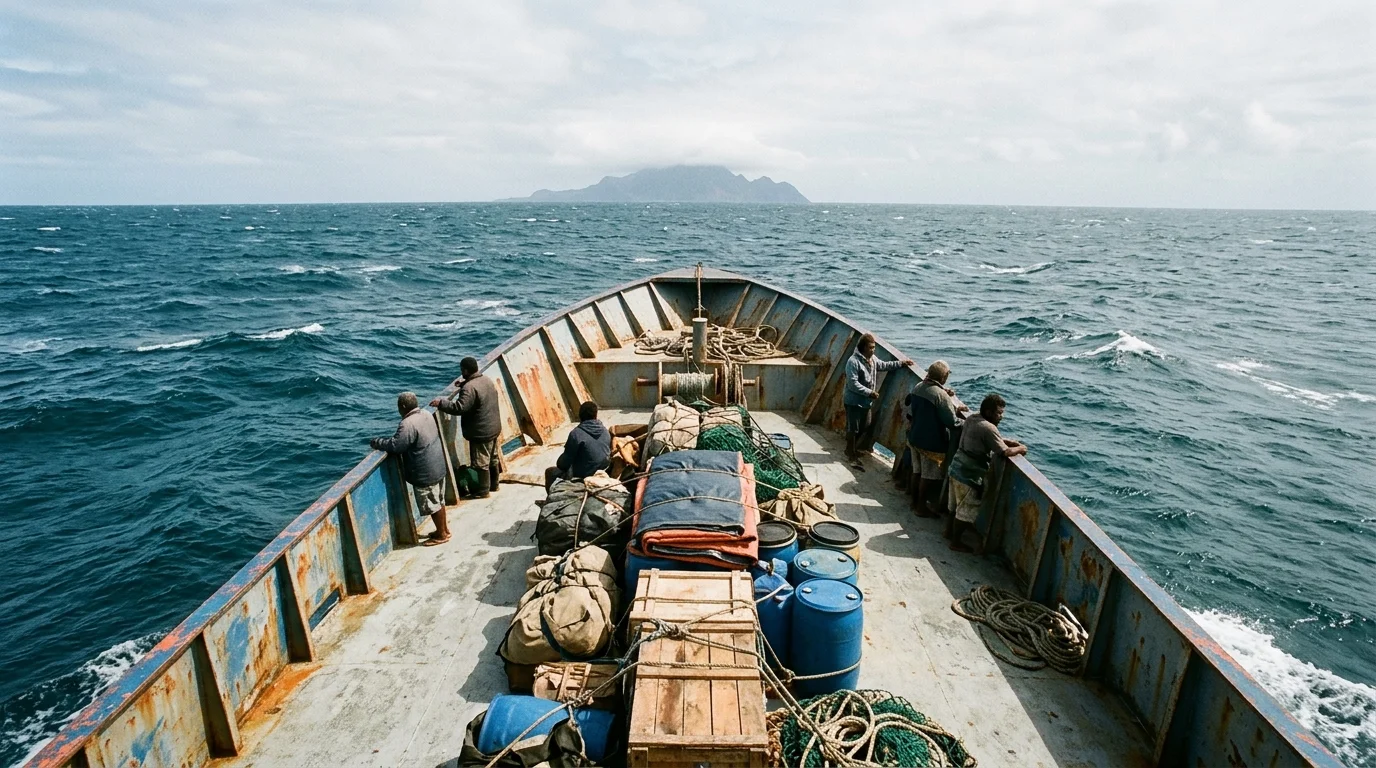
Federal transit grants to American Samoa have hit $22.7 million in the past 90 days, up from $1.5 million in the same window last year, a 1,411% increase driven almost entirely by a single obligation: $21.25 million from the Federal Transit Administration's Ferry Grant Program, formally committed to the American Samoa Department of Public Works on September 9, 2026.
The number is large. The context is more important. This is not a transit boom. It is the arrival, after nearly three years in a federal pipeline, of funding for two new low-emission catamaran ferries to serve the Tutuila-to-Manu'a route, the only regular public connection between the territory's main island and the outer islands of Ta'ū, Olosega, Ofu, and Aunu'u. Those islands have no paved roads and no airport with regular service. For residents, the ferry is not an amenity. It is how they get to a hospital.
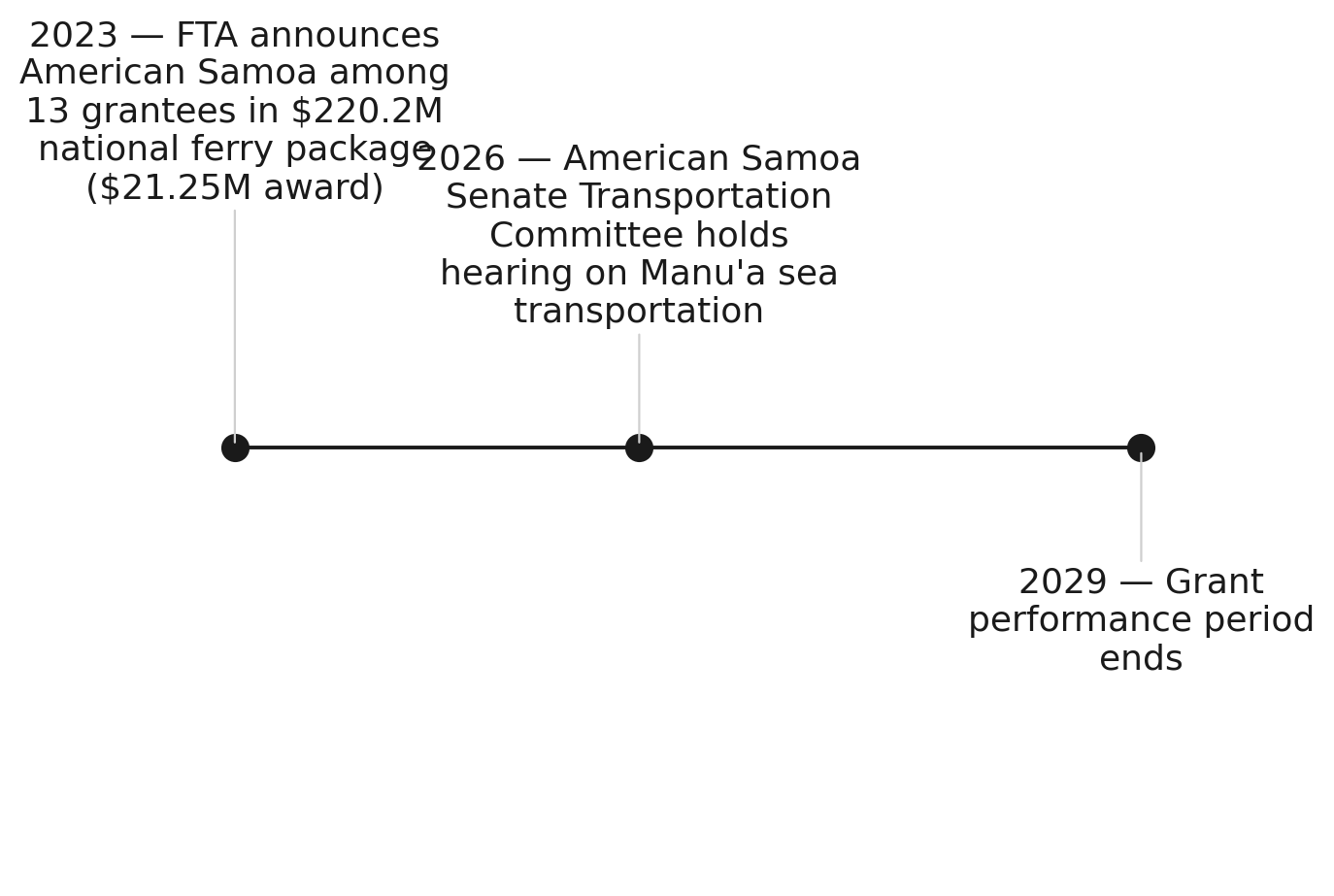
The FTA first selected American Samoa for a ferry award in November 2023, as part of a $220.2 million national package to modernize ferry systems across 13 grantees. Congresswoman Uifa'atali Amata and DPW Director Faleosina Voigt secured that selection notice, but formal obligation of the funds did not happen until this month, explaining why the year-over-year metric looks like a spike rather than a trend. The underlying investment was years in the making; the accounting calendar just caught up.
Source: NationGraph.
The urgency behind the grant became harder to ignore in early 2026. The MV Manu'atele, the existing vessel on the route, was forced out of service for weeks after a rudder component ordered from Canada was held at the border amid US-Canada tariff disputes. That a trade dispute between two large nations could strand a remote Pacific island community, cutting off cargo, medical transfers, and government services, illustrated exactly the vulnerability the new vessels are meant to address. American Samoa's Senate Transportation Committee held a hearing on Manu'a sea transportation in April 2026 to examine the ongoing problems with service reliability, with the Manu'atele's chronic maintenance issues at the center of the discussion.
The $21.25 million award, authorized under the Bipartisan Infrastructure Law's Ferry Service for Rural Communities and Electric or Low-Emitting Ferry Pilot programs (IIJA §§71102-71103), will fund procurement of two vessels from Dutch shipbuilder Damen. The new ferries are expected to arrive in American Samoa in 2028, within a grant performance period running through April 2029. Their most immediate practical effect: the Tutuila-Manu'a crossing, currently six to seven hours on the Manu'atele, is projected to drop to approximately two hours. According to the FTA's FY2026 selected projects list, American Samoa's award was part of a $664.8 million national ferry grant package announced August 21, 2026.
The remaining $1.44 million in the 90-day figure is a separate and unrelated program: a routine FY2024 formula allocation under FTA's Section 5311 rural transit program, supporting the territory's Dial-A-Ride service for seniors and people with disabilities. That grant recurs annually and represents American Samoa's baseline federal transit flow. The year-ago $1.5 million comparison figure was solely this formula grant, making the year-over-year jump a function of timing, not of any broadening of federal investment in the territory.
As a non-state US territory, American Samoa has no access to the urban formula transit funds (Section 5307) that flow automatically to American cities. Its federal transit resources come through rural formula allocations and one-time competitive wins, which means a single successful grant application can dwarf a decade of baseline funding. The $21.25 million ferry award is more than 14 times the territory's annual Section 5311 allocation. That structural dynamic is worth understanding: when federal transit numbers in American Samoa move sharply, it almost always means a competitive grant cleared, not that transit investment has broadly deepened.
What changes for Manu'a residents in the near term is limited. The Manu'atele remains in service while procurement proceeds. The Damen vessels will not arrive until 2028 at the earliest, and commissioning and crew training will follow. The grant's performance period through April 2029 reflects a realistic, multi-year capital timeline for a remote Pacific territory ordering ocean-going vessels from Europe.
The next signal to watch is procurement progress. DPW's contract with Damen should produce construction milestones over the next 18 months, and any delays in delivery will determine whether the April 2029 performance deadline holds. Whether the territory's port infrastructure on Ta'ū and Tutuila can accommodate the new high-speed catamarans is also an open question the grant period will have to answer.