California agencies issued 44 wildfire-related RFPs in the last 30 days, more than double the 12-month monthly average of 18.8 and enough to account for 82 percent of all wildfire solicitations across eight major western states in the same window. This is a policy-driven surge, not a weather-response scramble. The starting gun was February 9, 2026, when the state finalized emergency Proposition 4 Forest Resilience Grant Program regulations, converting the $1.5 billion wildfire slice of California's $10 billion climate bond from a voter promise into spendable grant authority.
The procurement math explains why the spike is so concentrated. Proposition 4 passed in November 2024. AB 100, signed in April 2025, appropriated the first-year tranche: $3.5 billion for Prop 4 implementation overall, with $598 million earmarked for wildfire categories. But grant regulations take time, and agencies cannot solicit contracts against funds that lack a legal framework. The February regulations closed that gap, and fiscal year deadlines are now doing the rest. Agencies racing to obligate Year 1 funds before the close of the fiscal cycle are responsible for the compression visible in the data.
The issuer list runs from Sacramento to the Sierra to the southern coast. CAL FIRE has posted three Forest Health Research Program RFPs under the Prop 4 California Climate Bond. The Sierra Nevada Conservancy opened its 2026 Wildfire and Forest Resilience Directed Grant Program at roughly $15.9 million. The San Diego River Conservancy has issued its own Prop 4 wildfire solicitations. Truckee Fire Protection District is procuring forestry labor. The city of Temecula is seeking vendors for a Community Wildfire Protection Plan. The breadth reflects how Prop 4 was designed: funds flow simultaneously to state conservancies, local fire districts, universities, and tribal entities, so the procurement wave looks less like a single agency spending spree and more like an entire sector going active at once.
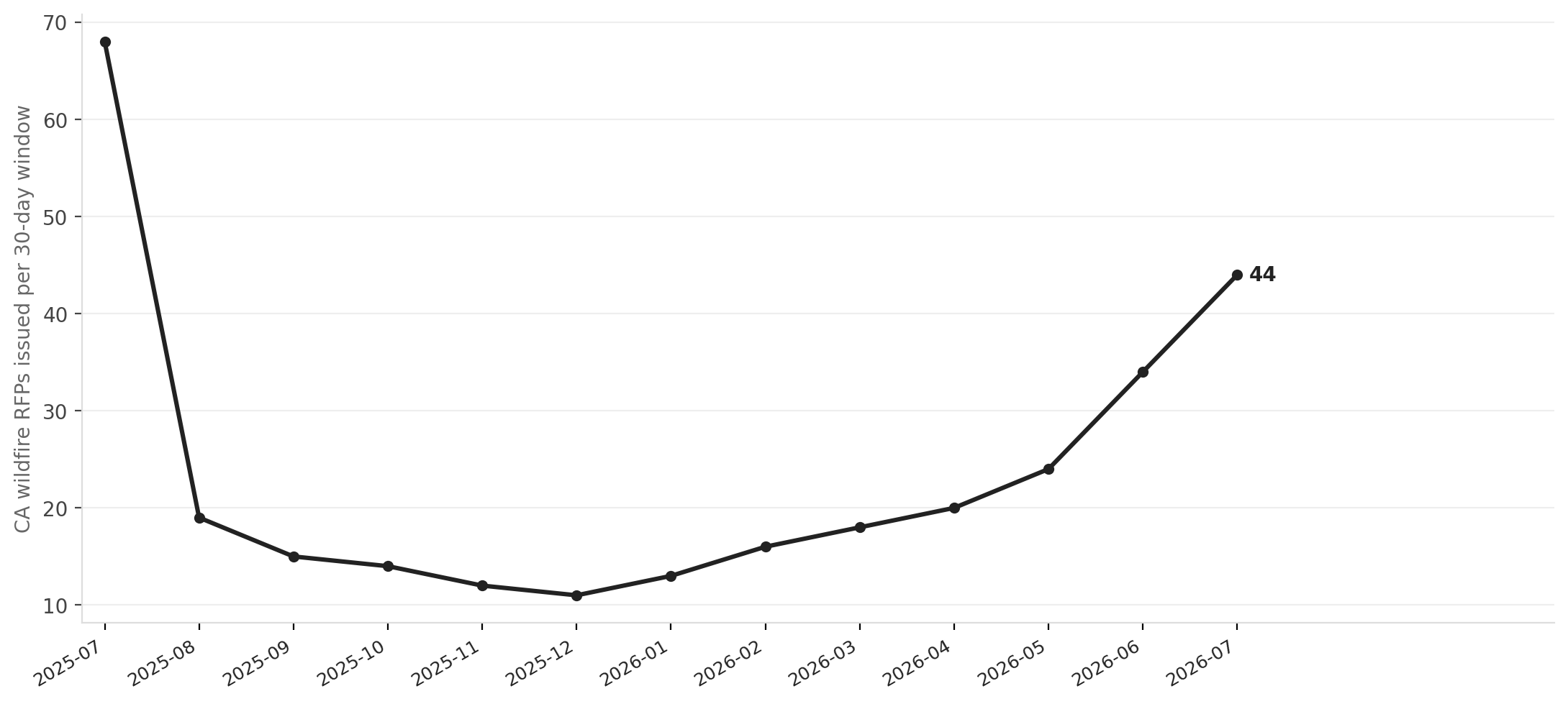
Source: NationGraph.
That breadth also explains why California so thoroughly dominates the regional picture. The other seven western states combined generated 10 wildfire RFPs in the same 30-day window. This is not a regional fire-weather response. Arizona, Nevada, Oregon, and Washington face the same forecast conditions California does. What they lack is a freshly operationalized $1.5 billion authorization and a governor's executive order cutting project approvals to as little as 30 days. Governor Newsom's EO N-25-25, signed March 2025, fast-tracked wildfire-safety project approvals and by December 2025 the state's Wildfire Task Force reported 198 projects across roughly 36,000 acres already cleared through the streamlined process.
The urgency behind the spending is not manufactured. CAL FIRE's 2026 season forecast warns of above-normal large fire activity by July and August, driven by persistent Southern California drought, historically light Sierra snowpack, and high grass fuel loads from wet winters. AccuWeather projects 5.5 to 8 million acres burned nationally this year. And as wildfire experts have flagged, federal wildland firefighting staffing has contracted since early 2025, pushing more of the suppression and prevention burden onto state and local capacity. California's active federal wildfire grant portfolio stands at 304 grants totaling $460.6 million obligated, but only $57.5 million of that has actually been disbursed. The gap between committed capital and deployed capital means the procurement velocity visible today will not dissipate quickly.
For residents in fire-prone communities, the near-term consequence is a labor and contractor market under real strain. Forestry crews, fuel-reduction specialists, environmental consultants, and aerial detection vendors are being solicited simultaneously by agencies from Redding to San Diego. That competition could slow individual projects even as the aggregate number of awards rises. The California Fire Foundation's $13.8 million Prop 4 allocation, directed specifically to local fire departments, adds another layer of demand for the same workforce.
The next signal to watch is how many of these 44 RFPs convert to signed contracts before the fiscal year closes, and whether a second regulatory tranche for Prop 4's remaining wildfire categories arrives in time to sustain the pace into fall. The July–August peak season will arrive before most of the current solicitations are awarded. The bet embedded in this procurement surge is that the contracts signed now translate to crews, equipment, and cleared fuel loads ready for the following season, not this one.