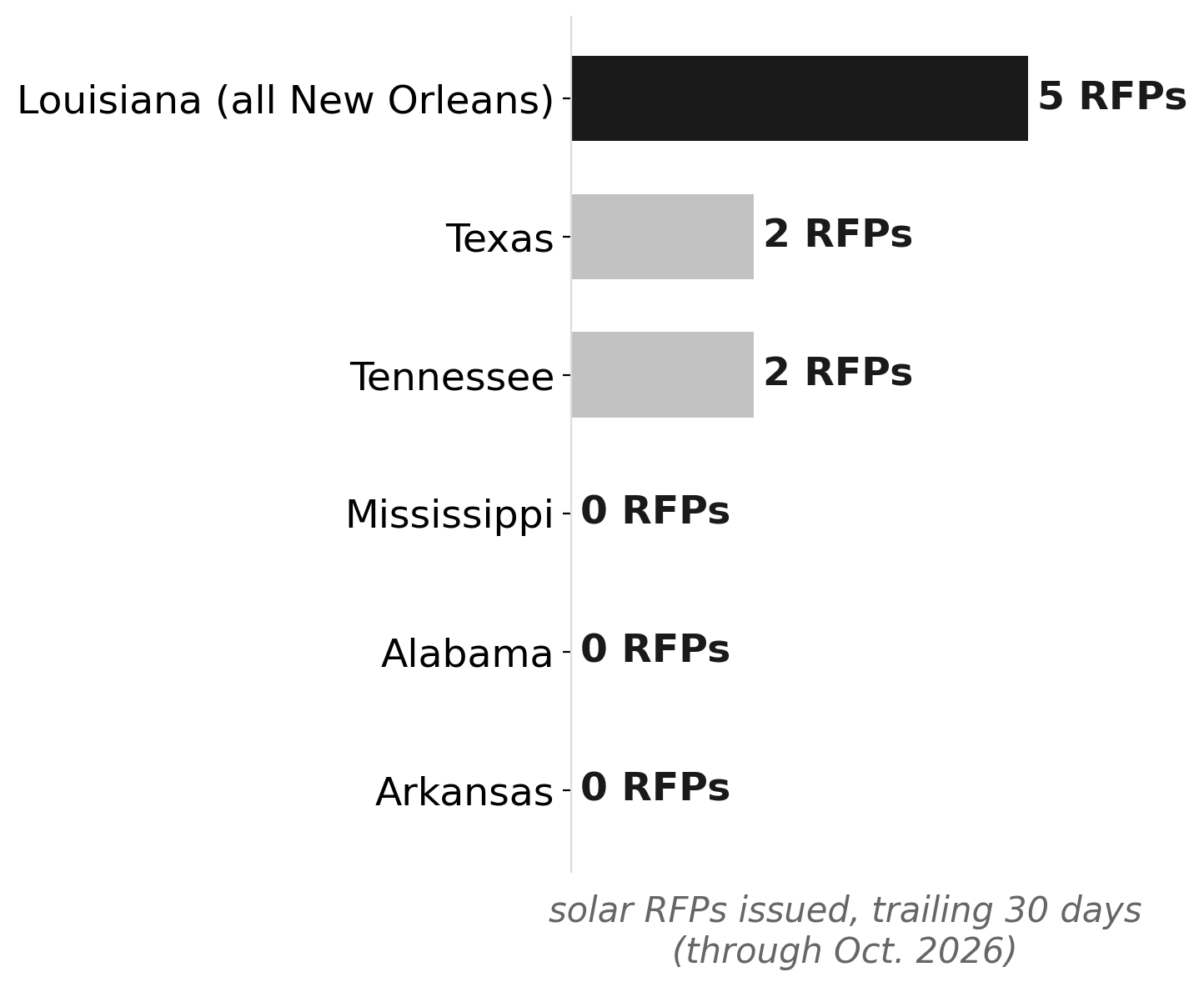
Five solar RFPs have come out of Louisiana in the last 30 days, double the 12-month monthly average of roughly 2.5, and every single one originated from a single city: New Orleans. That concentration is not a coincidence. It is procurement as legal hedge.
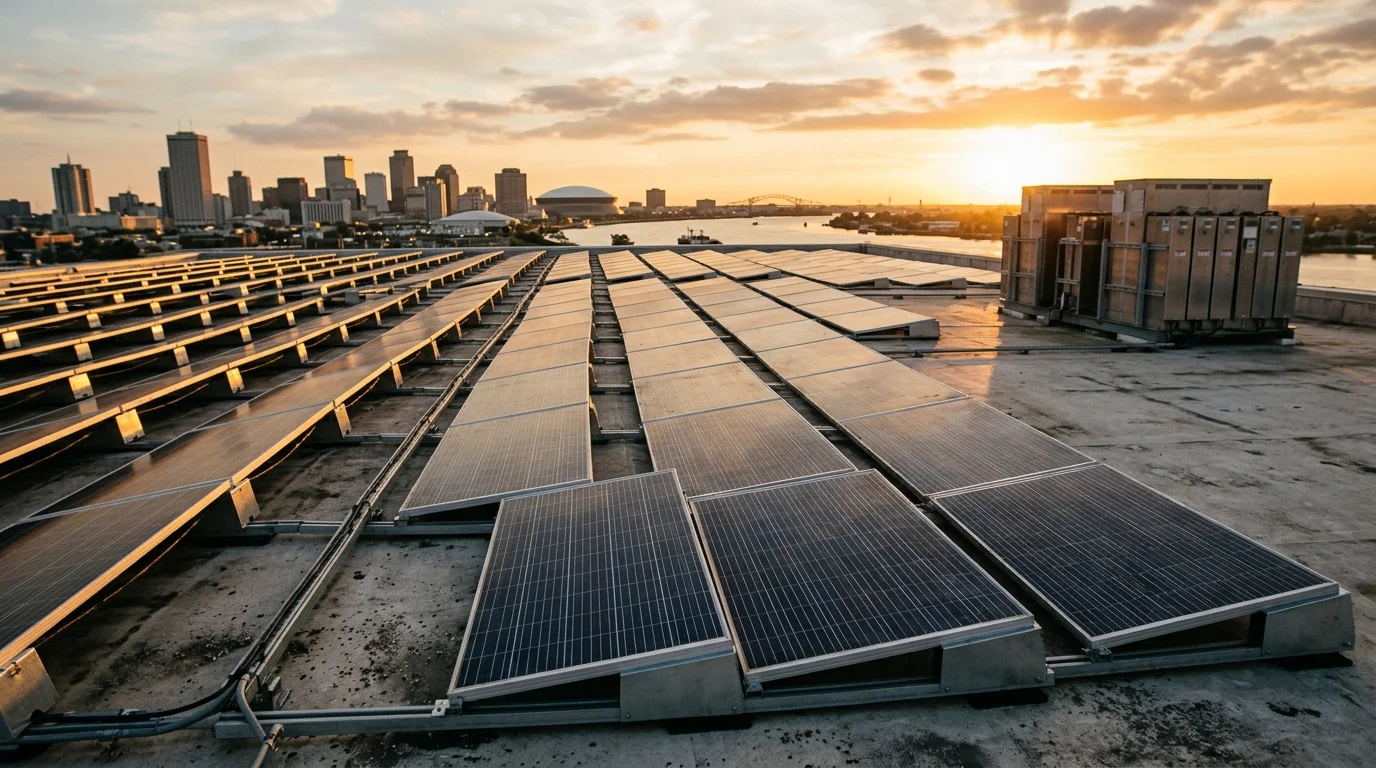
The issuing bodies are Louisiana State University New Orleans (two RFPs covering 1,000 solar panels and a battery energy storage unit), the University of New Orleans (two RFPs for solar panel and battery installation), and the City of New Orleans (one RFP for solar development at an Agriculture Street site). Adjacent Gulf South states issued a combined four solar RFPs in the same window; Mississippi, Alabama, and Arkansas issued none. This is a New Orleans story, not a regional one.
The timing is not accidental. In September 2026, federal courts in Rhode Island and Washington, D.C., ruled that the EPA had acted unlawfully when it froze the Solar for All program in August 2025, a program that forms one piece of New Orleans's $49.97 million EPA Climate Pollution Reduction Grant, awarded in July 2024 under the Inflation Reduction Act. As of early October, neither the EPA nor the city had announced a restart of the frozen household-subsidy component. The legal victory is real but fragile: an appeal could reimpose the freeze, and the clock on the grant's 2029 deadline keeps running. The rational move, for any institution with deliverables tied to that grant or to aligned local funding, is to issue RFPs now, while the window is open.
Source: NationGraph.
Three parallel but legally distinct funding tracks are driving the surge, and they should not be confused with one another. The City of New Orleans's CPRG grant, described by Mayor LaToya Cantrell as the city's largest-ever climate investment, is a federal grant disbursed directly to the city and targets 14 municipal solar installations alongside a $5,000-per-household subsidy for 1,400 low-to-moderate-income households. The Agriculture Street RFP draws on local levy funding with a 35% disadvantaged business enterprise requirement and sits outside the frozen Solar for All component entirely. The university RFPs are a third thread: UNO's procurement is the next phase of a $27 million campus energy infrastructure partnership with Bernhard that produced a 3,330-panel solar array completed in early 2024, funded through state appropriations and campus capital budgets, not the CPRG.
All five RFPs pair solar panels with battery storage. That pairing is the clearest signal of what New Orleans institutions are actually buying: not just clean energy credits, but operational independence from a grid that has failed them before. The memory of Hurricane Ida's extended outages in 2021 runs through every infrastructure conversation in this city, and both university campuses sit on the lakefront, where storm vulnerability is not theoretical. Grid resilience and climate finance happen to be pointing in the same direction here, which is part of why procurement is moving across institutional lines at once.
A regulatory unlock is also contributing. Louisiana's Department of Energy and Natural Resources finalized rules under Act 279 (HB 459) in the July 2026 Louisiana Register, resolving permitting requirements for large-scale solar projects above 75 acres that had been in legal ambiguity since the bill's passage in 2025. Act 279 does not fund anything, and the campus and municipal projects in these RFPs are sub-75-acre installations not directly governed by it. But the finalization of those rules removed the last major regulatory cloud over solar development in the state, signaling to developers and institutional procurement officers alike that Louisiana is open for solar business. Senate Resolution 174, passed earlier this year, also recreated a state task force on energy infrastructure and microgrids, citing surging demand from data centers as the immediate pressure. The institutions issuing RFPs this month are operating in a more permissive regulatory environment than they were 18 months ago.
What changes for a New Orleans resident watching this unfold depends on which track materializes. The municipal solar installations on city-owned properties are the most certain near-term outcome; those deliverables are written into a federal grant with a 2029 deadline and are not part of the frozen component. The 1,400-household subsidy program is the most uncertain: the city has confirmed the program required reworking after an anticipated state match did not materialize, and the Solar for All freeze, even if ruled unlawful, has not been lifted in practice. A resident hoping for a $5,000 solar subsidy is waiting on both federal litigation and a new financing structure.
The next signal to watch is whether the EPA moves to appeal the September rulings or negotiates a restart of the Solar for All disbursements. If the courts hold and the agency reopens the program, New Orleans could accelerate the household track on top of the municipal and campus work already in motion. If a further freeze is imposed, the city will have at least locked in hardware orders on the portions of its climate agenda that do not depend on Washington to stay consistent.