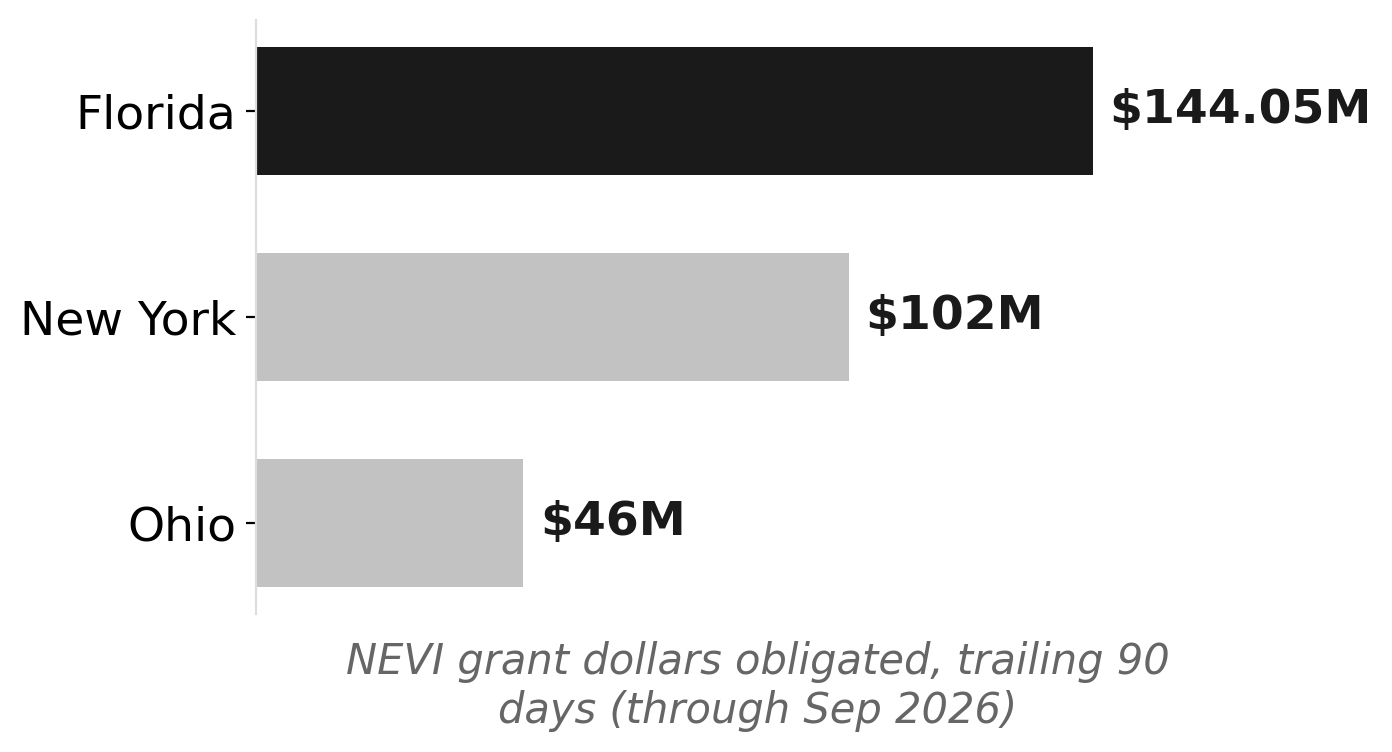
Florida's federal electric vehicle grants jumped from $23 million in the prior year to $145 million in the last 90 days, a 528 percent increase. Every dollar of that surge traces back to a single date: September 23, 2026, when the Florida Department of Transportation obligated $144.05 million in NEVI Formula Program grants across ten awards. That makes Florida the largest single NEVI obligator in the country over the trailing 90-day window, ahead of New York ($102 million) and Ohio ($46 million). The project titles, however, do not describe charging stations. They describe SunTrax.
SunTrax is FDOT's 775-acre Advanced Air Mobility testing campus in Auburndale, in Polk County. It appears by name in two of the ten September 23 awards. The other named sites, including Polk Parkway Infield, I-4 Truck Parking at County Line Road, and Orange County Truck Parking, map precisely to locations in FDOT's 2025 Deployment Plan for a statewide "Aerial Highway Network" of 32 electric vertical takeoff and landing vertiports, priced at roughly $5.6 million each. The NEVI program, created by the Bipartisan Infrastructure Law, was written to deploy public EV charging along designated Alternative Fuel Corridors. Florida's proposed use is something the program has never funded before.
Two separate events had to occur in sequence to make this possible. The first was legal. On January 23, 2026, U.S. District Judge Tana Lin issued a final judgment in Washington v. USDOT, ruling that the Trump administration's February 2025 freeze of NEVI funds violated the Administrative Procedure Act and ordering FHWA to restore state access. Florida had spent exactly zero dollars of its $198 million NEVI allocation before that ruling. It had also stayed quiet during the freeze, declining to join the 16-state coalition that brought the lawsuit. That restraint left Florida holding the largest unspent NEVI balance in the nation, while Congressional rescission during FY2026 appropriations clawed back $44.6 million, reducing its available pool to roughly $153.4 million.
Source: NationGraph.
The second event was political. In June 2026, President Trump signed an executive order directing the FAA to run a flying-car pilot program. FDOT was selected as one of eight state agencies to lead testing, and Governor DeSantis announced the state would cover the required 20 percent match. That selection gave FDOT federal political cover for what its own 2025 Deployment Plan, obtained by WUSF via records request, had already made explicit: the state would not spend NEVI money on "everyday passenger vehicles."
The court order unlocked the money. The flying-car executive order provided the destination. They are not the same mechanism, and conflating them obscures how the redirect was engineered.
FHWA supplied the regulatory opening. Under updated NEVI rules, a state whose highway corridors are already fully built out with EV chargers can apply to redirect funds to alternative eligible uses. FHWA reviewed Florida's corridor inventory and agreed it is sufficiently covered, clearing a formal prerequisite for the redirect. That determination, combined with the SunTrax pilot designation, forms the basis for FDOT's pending request for final federal approval to reorient the full allocation toward the vertiport network. All ten September 23 awards carry end dates of September 2032 and show zero outlays, confirming the money is newly committed but not yet flowing. The redirect remains pending final FHWA approval.
The state's position is paradoxical in ways that predate this moment. Florida has the highest EV sales share of any large state, nearly one in ten vehicles sold. It ranks 16th per capita in public charging access. The gap between adoption and infrastructure is not abstract: Florida EV drivers already contend with some of the longest median distances between public chargers in any high-adoption state. The $144 million now committed to vertiport infrastructure does not close that gap.
FDOT and the Governor's office have argued that eVTOL infrastructure qualifies under NEVI's "electric vehicle supply equipment" language and that vertiport charging pads are functionally analogous to ground-based chargers. Critics, including several of the states that sued to unfreeze the funds, read the statute differently and have signaled they are watching Florida's request closely. The Sierra Club and allied groups, which backed the original litigation restoring NEVI access, have flagged Florida's redirect as a potential APA violation of the same kind that froze the program in the first place.
The signal to watch is FHWA's formal response to Florida's redirect application. If approved, it establishes a precedent that other states with built-out corridors could replicate, potentially converting a portion of the $5 billion NEVI program into a general aviation infrastructure fund. If denied, FDOT faces a compressed timeline to spend $153 million on ground-based chargers before the 2032 obligation deadline, in a state whose governor has publicly opposed doing exactly that. Initial eVTOL test flights at SunTrax are planned by end of 2026. FHWA has not announced a decision date.