Federal EV grants flowing into New York hit $106.5 million in the past 90 days, a 145% jump from the $43.4 million the state received in the same window a year ago. That number is not a policy victory. It is a fiscal backlog: six months of frozen federal money hitting New York's books in eight weeks, because NYSDOT was racing to lock in obligations before the political situation around the program could shift again.
The mechanics are specific. The Federal Highway Administration froze all new National Electric Vehicle Infrastructure (NEVI) Formula Program obligations on February 6, 2025, halting a program created by the 2021 Bipartisan Infrastructure Law and putting roughly $3 billion in apportioned state funds in limbo nationwide. New York was one of 16 states that sued, and a federal court issued a preliminary injunction in June 2025 restoring access to the frozen dollars for plaintiff states. DOT Secretary Sean Duffy followed with revised interim final NEVI guidance on August 11, 2025, stripping Biden-era requirements on rural community engagement and minority-business contracting while giving states 30 days to resubmit their deployment plans. NYSDOT's updated plan cleared FHWA review in September 2025, and the agency moved immediately: 21 individual NEVI grant awards were obligated between August 24 and September 21, 2026, covering specific highway-corridor charging sites across the state.
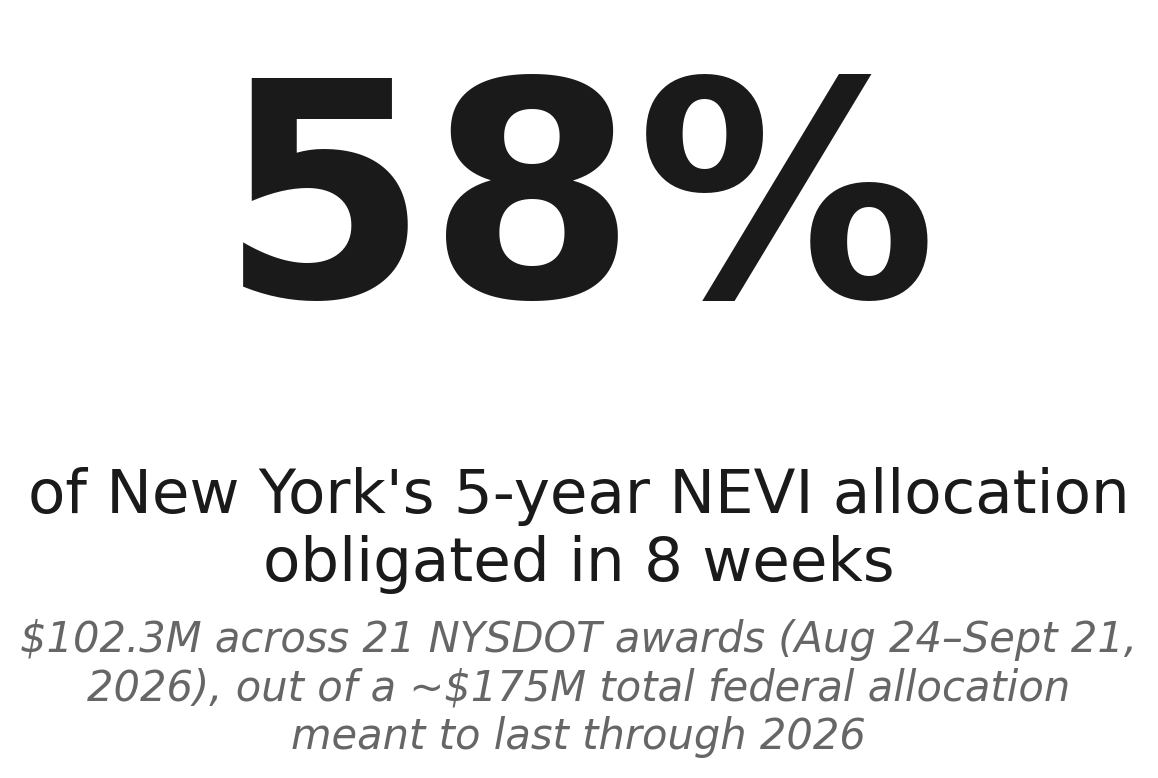
Those 21 awards account for $102.3 million of the $106.5 million 90-day total, 96% of the surge, with individual site awards ranging from roughly $200,000 to $6.6 million per corridor location. Each award carries a performance period running through 2035 or 2036, meaning these are real infrastructure commitments, not planning grants. New York's total five-year NEVI allocation under the Bipartisan Infrastructure Law is approximately $175 million; the state has now obligated roughly 58% of that figure in under two months.
Source: NationGraph.
To understand the compression, consider what the prior-year comparison window looked like: zero NEVI awards. The $43.4 million New York received in the same 90-day period a year ago consisted entirely of transit formula grants. The year-over-year surge is not a function of EV policy accelerating in New York; it is a function of the program having been legally paralyzed and then abruptly unchained, with NYSDOT positioned to move faster than most states because its plan was already approved.
The new NEVI guidance issued by FHWA on August 11 did not change the program's core technical requirements: stations must still deliver at least 150 kilowatts across four ports, and Buy America manufacturing requirements remain in place. What changed was state discretion over siting, spacing, and community-benefit conditions. For NYSDOT, whose corridor plans were already drafted around the technical minimums, the new guidance reduced friction rather than redirecting strategy.
The secondary recipients in the trailing-90-day window tell a different story. Broome County and Ulster County each received approximately $1 million through the Low or No Emissions bus program, a separate federal grant funding zero-emission transit buses for public agencies. Cornell University collected $1.8 million in NSF research grants tied to EV technology. These are modest, unrelated to NEVI, and do not reflect any similar backlog dynamic. They are included in the statewide total but carry no connection to the NEVI dam-break thesis.
Nationally, New York ranks second in trailing-90-day EV grant receipts, behind only Florida at $145.7 million. That Florida leads is itself informative: both states moved quickly once the injunction cleared, both had plans positioned for fast resubmission, and both are now booking the bulk of their NEVI allocations in a compressed window rather than the steady annual draw the program was designed to support.
For New York drivers and communities along the state's designated Alternative Fuel Corridors, the practical effect is that a large share of the highway fast-charging network the state was supposed to build over five years is now under contract simultaneously, with completion targets in the 2035-2036 range. Whether the projects deliver on that timeline depends on supply chains, permitting, and whether the NEVI program survives further legal or administrative disruption, all of which remain open questions.
The immediate signal to watch is whether FHWA's August 2025 guidance holds. The revised rules are still subject to legal challenge from the other direction: environmental and civil rights groups have argued that stripping the disadvantaged-community requirements violated the Administrative Procedure Act. A successful challenge could complicate obligations already on the books. NYSDOT has booked its position, but the program's legal footing has not been stable for the better part of two years, and there is no obvious reason to assume it is now.