
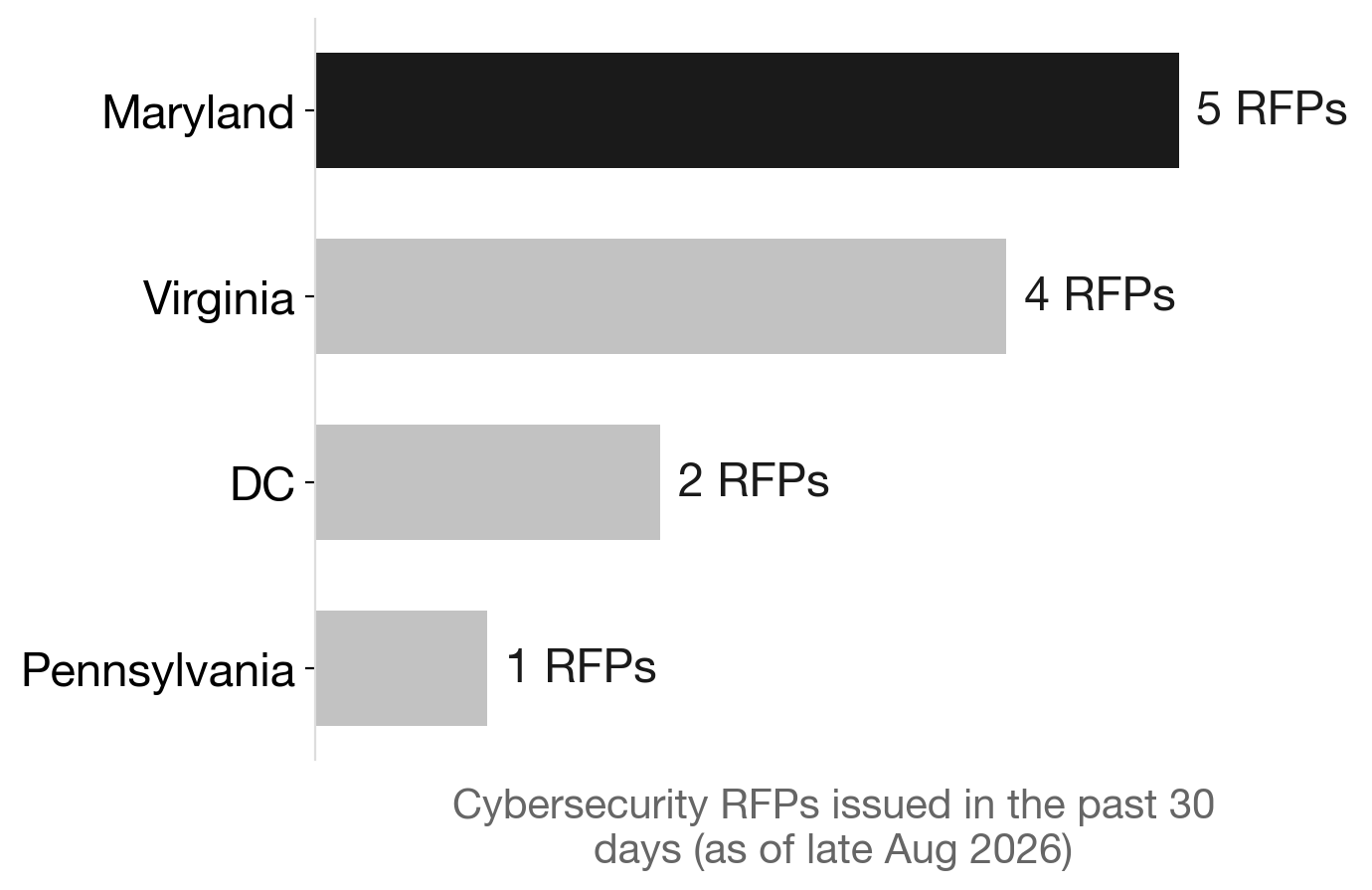
Maryland issued five cybersecurity RFPs in the past 30 days, more than double the 2.4-per-month baseline it had maintained across the previous 12 months. The spike is not coincidental. July 1, 2026 was the effective date of SB0601, a law signed by Governor Wes Moore on April 14 that mandates cybersecurity compliance certification and biennial maturity assessments for every local school system in the state. On July 1, cybersecurity stopped being a recommendation for Maryland agencies. It became a legal requirement.
The procurement surge spans four agencies and covers nearly every layer of government exposure. The Maryland Department of General Services put out a statewide cybersecurity resources contract. The Maryland Department of Labor issued two SecurityScorecard software license RFPs in the same week. A federal campus at FDA's Silver Spring facility advertised for next-generation cyber engineering and AI services. And the Maryland State Board of Elections has now updated or re-issued its Managed Security Services Provider RFP four times between May and August 2026, each iteration reflecting the agency's struggle to lock down a vendor before the next election cycle puts its systems under scrutiny.
The driver behind this acceleration is the compliance cliff created by SB0601. Before the law, agencies could treat cybersecurity investment as discretionary. After July 1, school systems and state authorities must certify adherence to state minimum standards, and that certification has to be renewed every two years. That schedule converts a one-time procurement into a recurring, auditable commitment, which is why so many agencies are moving at once: the first deadline under the law is already running.
Source: NationGraph.
The financial architecture reinforces the urgency. Maryland currently holds $32.5 million in obligated federal cybersecurity grants across 19 active awards, but only $6.6 million has been disbursed. The bulk of that federal money is still mid-flow, meaning agencies face simultaneous pressure to demonstrate compliant spending before grant administrators can ask uncomfortable questions about what the funds have actually purchased. The largest single tranche, a State and Local Cybersecurity Grant Program award of $4.98 million running through December 2028, flows through the Maryland Department of Emergency Management and is directly tied to the compliance planning SB0601 requires.
A June 2026 federal executive order directing CISA to expand cybersecurity tool access to state and local governments added another layer of urgency. As the Maryland Association of Counties noted, the order creates new opportunities for county governments to access federal cybersecurity services, which effectively expands the universe of vendors Maryland agencies can reach while also adding another compliance framework to satisfy. Agencies that had been waiting to see how the federal picture developed now have a clearer runway.
Maryland's position in this moment is unusual. The state is home to NSA headquarters at Fort Meade, major university cybersecurity programs at UMBC and Morgan State, and a Cybersecurity Council that includes the State Board of Elections, the Maryland State Police, and the Attorney General's office. That infrastructure gives the Moore administration a standing technical capability that most states cannot draw on. It also means the RFP market here is being watched by vendors who understand that Maryland tends to set procurement precedents that neighboring states follow. In the past 30 days, Maryland's five RFPs outpaced Virginia's four, the District's two, and Pennsylvania's one.
The administration also has a policy credibility argument that most governors cannot make. Secretary of Commerce Harry Coker Jr., who served as U.S. National Cyber Director from 2023 to 2025, now oversees Maryland's commercial and technology policy. His presence gives the Moore administration an unusually direct line between federal cyber doctrine and state procurement decisions, and it signals that cybersecurity is being managed as both a governance priority and an economic development strategy simultaneously.
That dual framing is visible in the 2026 legislature's companion move: SB0025 raised the Buy Maryland Cybersecurity Tax Credit cap from $200,000 to $1,000,000 through 2030. The compliance mandate in SB0601 creates the demand; the expanded tax credit steers that demand toward in-state vendors. Together, the two bills function as a coordinated industrial policy, not just a regulatory update.
The next signal to watch is the State Board of Elections MSSP contract. Four revisions in three months suggest the agency has not yet found a vendor that satisfies its requirements, and midterm election cycles impose a hard operational deadline that no amount of administrative revision can move. If that RFP closes cleanly, it will indicate the vendor market has caught up with the state's new compliance posture. If it slips again, it will suggest the gap between what Maryland now legally requires and what the market can readily deliver is wider than the law's drafters anticipated.