Eight Florida institutions issued water infrastructure RFPs in the last 30 days for the first time in over a year, and three of them, Escambia County, Santa Rosa County, and Manatee County, had never appeared in the water infrastructure procurement record at all. For context: monthly new-institution entry into Florida's water infrastructure RFP space ran between one and five per month from August 2025 through July 2026. A single-month cluster of three first-timers, all in the Gulf Coast and Panhandle corridor, is an outlier.
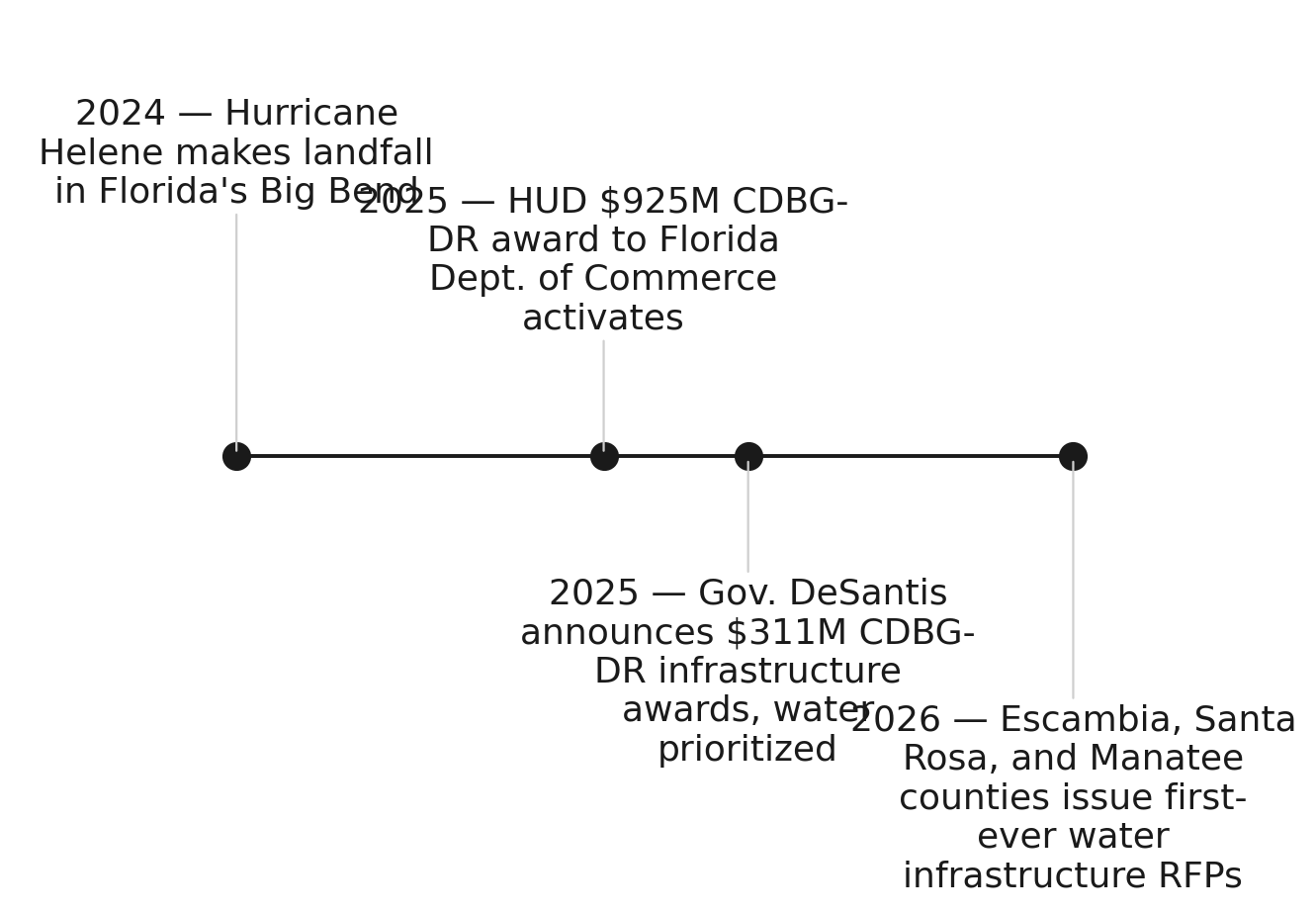
The storms that made this necessary hit in fall 2024. The money to pay for repairs was announced in December 2025 and January 2026. The contracts are going out now. That 18-to-24 month lag between disaster and procurement is not a failure of urgency, it is how federal disaster recovery capital actually moves.
Two distinct federal pipelines are driving the RFP surge, and they should not be confused with each other. The first is HUD's CDBG-DR Infrastructure Repair Program, a direct federal block grant administered through Florida's Department of Commerce. Governor DeSantis announced $311 million in CDBG-DR awards in December 2025 to communities impacted by Hurricanes Idalia, Debby, Helene, Milton, and the 2024 North Florida Tornadoes, with water infrastructure named as the priority investment. A follow-on $167.5 million round came in January 2026 for 34 more rural communities, including specific water system projects: a new well and pumping equipment for Jackson County, water main replacements for Big Bend Water Authority. The full HUD award to Florida's Department of Commerce reached $925 million and activated in August 2025, running through 2031. CDBG-DR money flows directly to local governments for specific disaster-recovery projects, with local procurement required.
Source: NationGraph.
The second pipeline is separate in structure and purpose. Florida DEP's EPA-capitalized Drinking Water State Revolving Fund provides subsidized loans and principal-forgiveness grants to local governments for water system construction and upgrades. The FFY2025-2026 DWSRF Intended Use Plan includes a dedicated SAHM-W tranche, Storm and Hazard Mitigation for Water, targeting systems damaged by Hurricane Helene, with no state match required. Florida's active DWSRF obligations now total $1.29 billion, with grants running through 2030-2032. Counties drawing on this pipeline apply to the state for financing and then procure their own contractors. The EPA announced $7.2 billion nationally for SRF programs in FY2026, drawing on both annual appropriations and the Infrastructure Investment and Jobs Act.
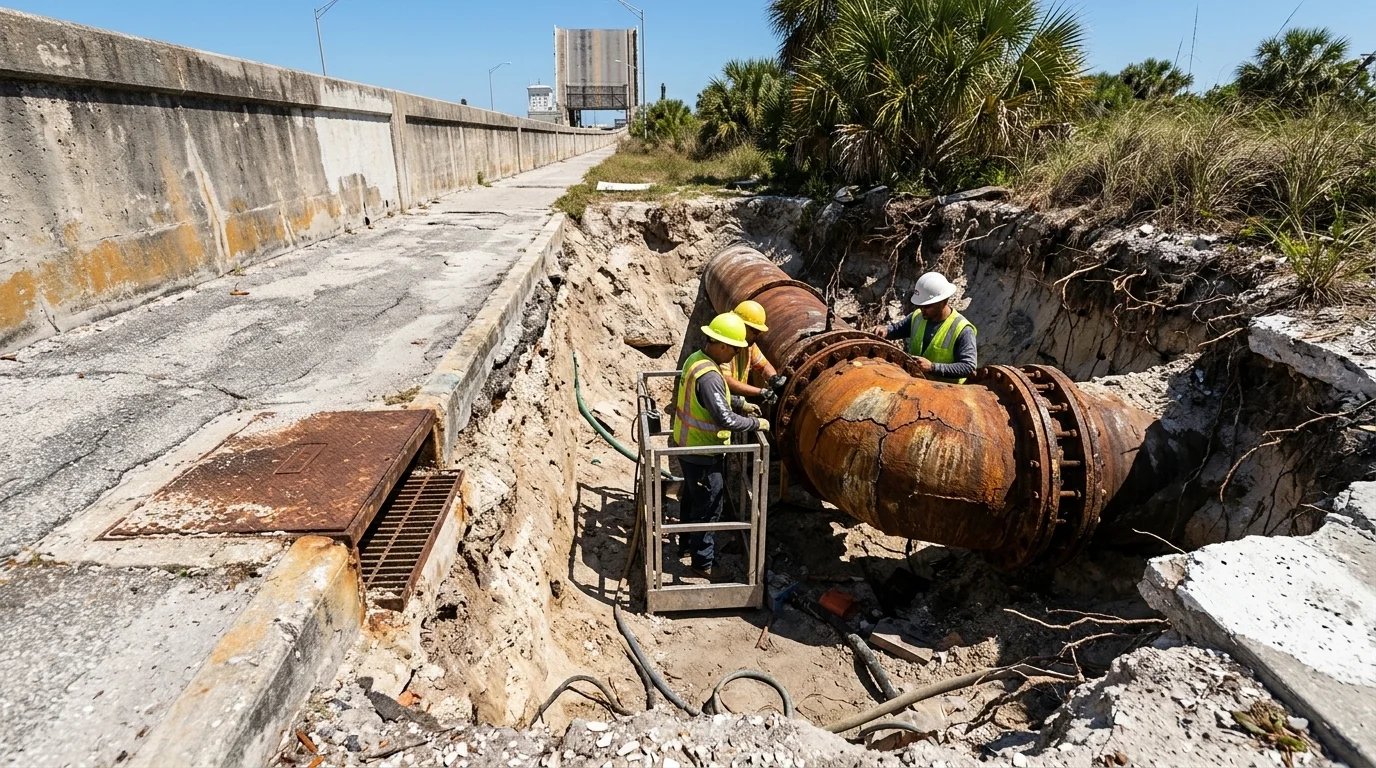
The three first-ever RFP counties illustrate how both pipelines produce procurement activity. Escambia County's RFP is explicitly tagged CDBG-DR, the federal block grant, flowing from HUD through Florida's Department of Commerce to the county. Manatee County's solicitation, a design-build contract to replace an aging 42-inch diameter potable water transmission main, notes it carries "some or all State funding," pointing toward the DWSRF revolving fund structure rather than the direct CDBG-DR grant. Santa Rosa County, extending a 12-inch water main with 37 fire hydrants for drinking water access and fire safety, also carries a state-funding notation. Same disaster, same approximate timeline, different federal instruments.
The geography of the RFP surge maps almost exactly onto the geography of the 2024 storm damage. Escambia and Santa Rosa counties are Pensacola-area communities that absorbed severe storm surge. Manatee County, which encompasses Bradenton, took up to nine feet of storm surge and 120 mph wind gusts during Milton. These are not small jurisdictions with limited administrative capacity, they are mid-size counties ranging from roughly 94,000 to 196,000 residents. The common thread is that the capital required for water system repair exceeded what any of them could fund independently, and the federal dollars took the better part of a year to move from announcement to the point where local contracts could go out.
For residents in these counties, the practical effect is that construction timelines are now compressing. Manatee County officials publicly committed at a September 2025 joint meeting to moving major water and wastewater projects into design and procurement over the following 18 months, that window is now closing. Engineering firms working in the Gulf Coast corridor are likely to see concentrated demand for water infrastructure design services through mid-2027, as the counties that issued first-ever RFPs this month work through design phases and move toward construction awards.
The open question is sequencing. The CDBG-DR program requires communities to complete procurement and begin construction within defined performance periods tied to the August 2025 activation date. The DWSRF loans carry their own obligation deadlines. Whichever counties are still working through project scoping have less runway than the calendar suggests, the next Atlantic hurricane season is already underway, and the infrastructure being repaired is meant to withstand the one after that.