The federal government pulled $62.45 million in solar financing out of Hawaii in August 2025, and by the time the dust settled, the state's own agencies were already writing new procurement contracts anyway.
The EPA formally terminated Hawaii's Solar for All grant on August 7, 2025, a program that had been awarded to the Hawaii Green Infrastructure Authority in May 2024 to expand rooftop solar and storage access for low-to-moderate income households. Only $463,000 of that $62.45 million had been disbursed at termination. Six weeks later, the One Big Beautiful Bill Act, signed July 4, 2025, eliminated the 30% residential solar tax credit for systems installed after December 31, 2025. As the Hawaii Tribune-Herald reported, the termination alone abruptly eliminated savings options for an estimated 2,000 low-to-moderate income households in the state.
What happened next is the more instructive part. The Department of Hawaiian Home Lands issued a solar charging station RFP in July 2026 for installations on Hawaiian Home Lands in Kapolei, updated through September 2026. The Department of Land and Natural Resources issued solar panel procurement RFPs for state parks in May 2026 and solar lighting RFPs in August 2026. These are not continuation grants or redirected federal dollars. They are agency capital budget procurements, drawn from state appropriations, moving on their own timelines.
Source: NationGraph.
Three distinct programs are funding Hawaii's solar activity right now, and collapsing them into one story misses the point. The EPA Solar for All grant was a demand-side subsidy: federal money loaned through HGIA to let low-income households install rooftop solar. That program is gone. The DOE's $16.25 million Grid Infrastructure Deployment grant to the Department of Business, Economic Development and Tourism, awarded October 2024 and running through December 2030, is a grid-side infrastructure program focused on utility-scale grid-forming solar technology, different purpose, different population, and still active with roughly $1.55 million outlayed. The Hawaii Green Energy Market Securitization program, funded by a $100 million state Legislature appropriation in 2023, is a state green bank lending program that predates and outlasts the federal pullback entirely. HGIA's 2025 Annual Report to the Legislature cited both the Solar for All termination and the elimination of the residential clean energy credit as disruptions that negatively impacted Hawaii, but the same report noted HGIA is in active discussions with developers on seven community solar projects statewide totaling 15.45 megawatts, financed through the surviving GEMS state program.
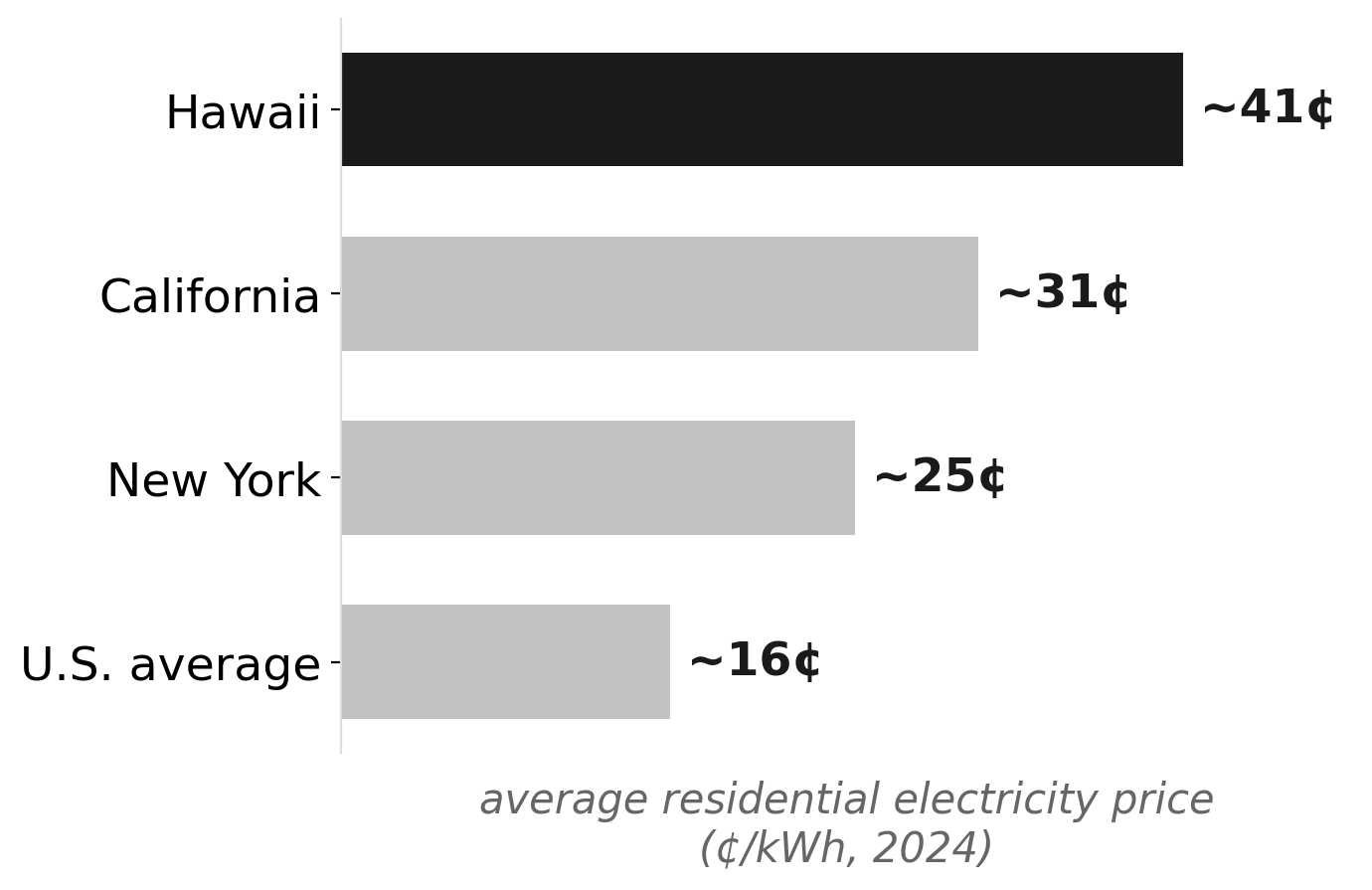
Hawaii's structural position explains why state procurement keeps moving even when federal support contracts. The state has the highest electricity rates in the country, a statutory mandate for 100% renewable electricity by 2045, and a historical near-total dependence on imported petroleum. Solar here is a cost-of-living issue as much as a climate one. That combination gives state-funded solar programs political durability that comparable programs in lower-cost states don't have. An agency director in Hawaii defending a solar charging station RFP doesn't need to invoke climate policy; the economics carry the argument on their own.
For commercial and utility-scale developers, the federal picture is more complicated. The One Big Beautiful Bill Act set a July 4, 2026 construction-start deadline for projects seeking to lock in the Section 48E investment tax credit safe harbor through 2030. Projects that missed that deadline must be placed in service by December 31, 2027 to retain the 30% credit. As tax advisers have noted, the safe harbor rules require meaningful physical work or a 5% cost incurrence, and the deadline pressure accelerated permitting and construction decisions across the industry in the first half of 2026.
For households that can no longer count on the residential tax credit or a Solar for All loan, the picture is harder. HGIA filed a dispute within the 21-day window following its termination letter and worked with the state attorney general's office on an appeal, but the authority has not publicly confirmed a reversal. The GEMS state lending program can serve some of those households, but at $100 million in total capitalization it is a fraction of what the federal program was designed to mobilize.
The clearest signal to watch is what HGIA reports to the Legislature in its next annual cycle: whether the seven community solar projects under GEMS discussion advance to executed contracts, and whether the state moves to recapitalize the green bank in response to the federal gap. The DLNR and DHHL procurements are real, but they are agency-scale. The low-income household financing gap that Solar for All was meant to close is a different order of magnitude, and the state program designed to fill it is still in negotiation.