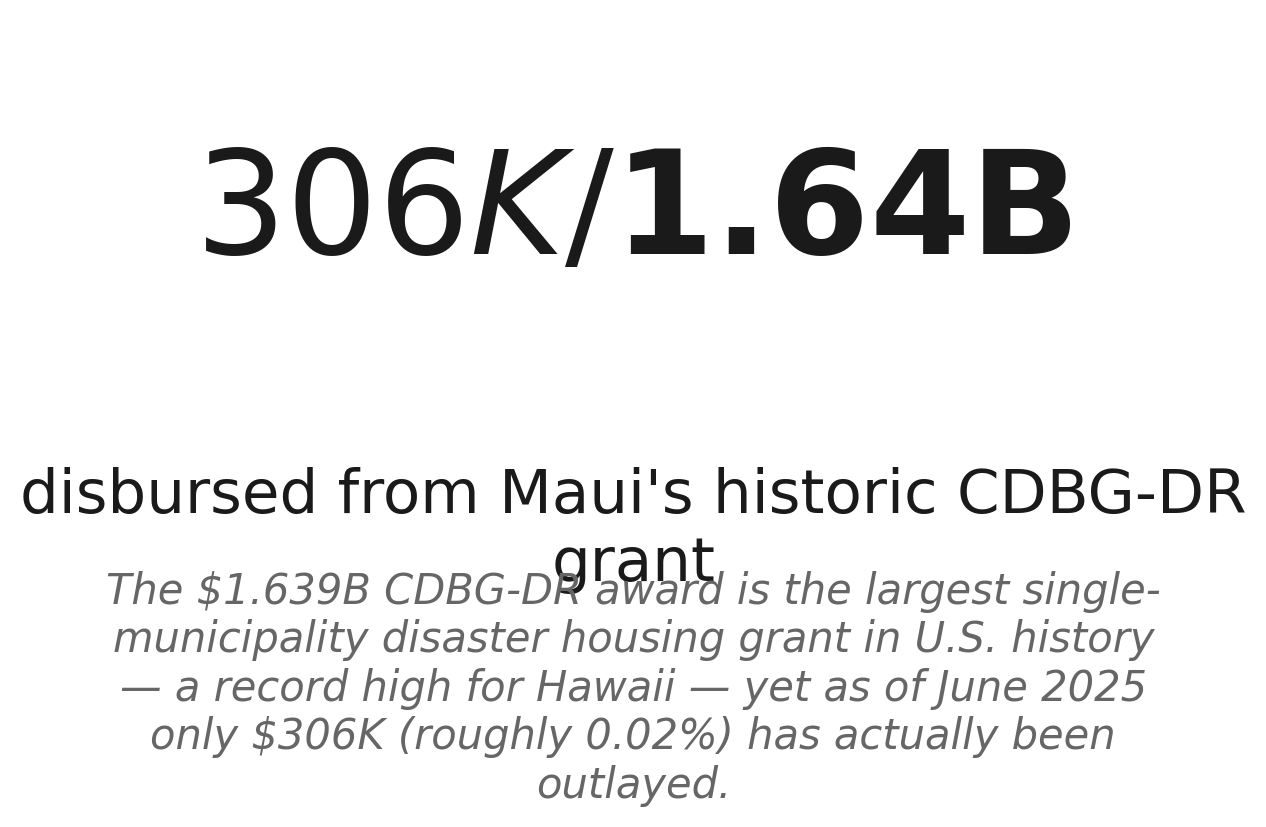
Hawaii has more housing money committed right now than at any point in its history, and almost none of it has been spent. The $1.639 billion CDBG-DR grant that HUD formally executed with Maui County on June 20, 2025, the largest single-municipality disaster-recovery housing award in U.S. history, had disbursed roughly $306,000 as of last summer. That is less than two-hundredths of one percent of the obligation. The pledge phase is over. The execution phase, with all its difficulty, is what comes next.
The Maui grant is only one of three funding streams now converging on Hawaii's housing market at the same moment. The state Legislature's 2022 Act 279 appropriation, $600 million in state money directed at the Department of Hawaiian Home Lands, has enabled DHHL Chair Kali Watson to target approximately 2,600 homestead leases awarded in 2026 alone, against a historical rate of roughly 100 per year. That 26-fold acceleration is backed by $511 million earmarked for infrastructure, $52.8 million for land acquisition, and $36 million for beneficiary financing, all flowing to a waitlist that currently holds more than 29,000 Native Hawaiian families, some of whom have been waiting for generations. Simultaneously, Governor Josh Green issued his 21st consecutive emergency housing proclamation on September 8, 2026, a rolling series of executive orders that continue to suspend state land-use and permitting laws to accelerate affordable housing construction across all islands. The proclamations are not a funding instrument, they speed the deployment of the money that already exists.
These are three distinct programs with different legal authorities, different beneficiary populations, and different administering agencies, and they should not be read as a single coordinated plan. The CDBG-DR dollars are geographically restricted to Maui and legally tied to the 2023 Lahaina wildfire disaster declaration. DHHL's homestead sprint, funded by Act 279 and supplemented by two active federal Native Hawaiian Housing Block Grants totaling $44.6 million, serves only beneficiaries with at least 50 percent Hawaiian blood, statewide. Governor Green's emergency proclamations apply to everyone and everywhere. What they share is timing: all three are entering their active execution windows in 2025 and 2026, at the same time Hawaii faces what the governor described in his January 2026 State of the State address as a structural deficit of 50,000 housing units and rents that have risen 17 percent since December 2022.
Source: NationGraph.
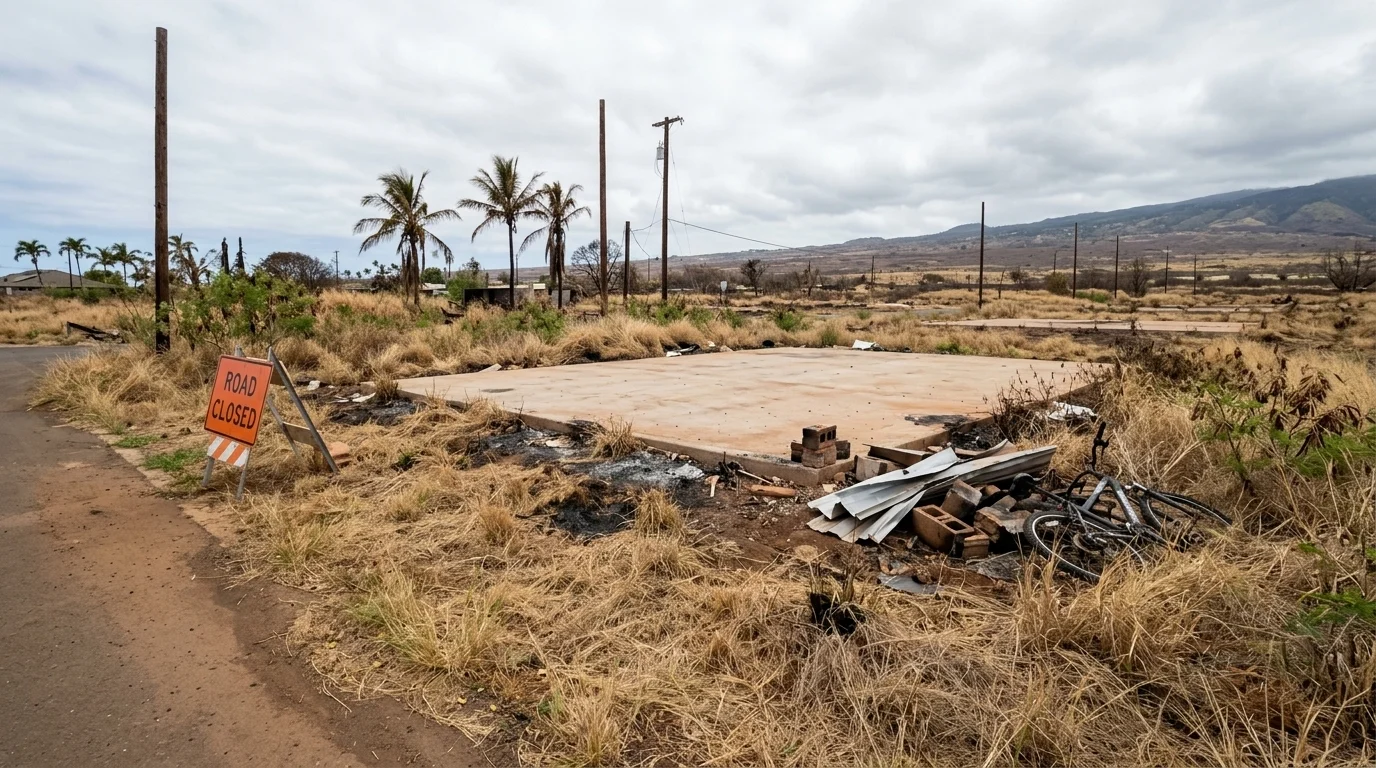
The Maui deployment challenge is the most acute. Maui County is administering the largest per-capita disaster recovery obligation in the CDBG-DR program's history with the administrative infrastructure of a mid-sized county government. The county's Ho'okumu Hou programs, which opened applications for single-family reconstruction, reimbursement, and first-time homebuyer assistance in August 2025, are the primary vehicles for getting money from the federal ledger into the hands of wildfire survivors. The grant's period of performance runs through May 2031, which sounds like a long runway until you consider the scope: reconstruction of an entire community, on an island, in a construction labor market that is already stretched.
The DHHL acceleration is more legible on paper but carries its own execution risk. The Hanapepe Phase 2 project on Kauai, recently approved by the DHHL board, will deliver 82 homestead units, including 30 structured as rent-with-option-to-purchase with Low Income Housing Tax Credit financing. DHHL has also authorized up to $39 million in Hula Mae multifamily bonds through the Hawaii Housing Finance and Development Corporation for affordable rental homes at 30 to 60 percent of area median income. These are capital stack structures that require coordination across multiple state agencies, federal tax credit allocators, and private lenders, and they must close in a market where Honolulu's 100 percent AMI for a family of four sits at roughly $152,000, making the affordability math unusually complex.
On Oahu, the city is recruiting private partners for public land it controls along the Skyline rail corridor. Honolulu's August 2026 request for information on mixed-income housing development, and the earlier selection of EAH Housing as preferred negotiating partner for the former Dee Lite Bakery site in Kalihi, signal a transit-oriented development strategy that depends on the rail line reaching full operation and on the 2026 Legislature passing HB 1727, which would add up to $100 million to the Rental Housing Revolving Fund's mixed-income subaccount.
Green reported more than 6,500 affordable units delivered since taking office and a pipeline of 250-plus projects totaling 62,000 units. The pipeline number is the one to watch skeptically: a project in a 62,000-unit pipeline is not a unit someone can live in. The gap between committed capital and disbursed dollars on the Maui grant is a precise illustration of how wide that space can be.
The signals to watch in the coming months are the Ho'okumu Hou outlay figures in Maui County's next quarterly performance report, the pace of DHHL lease awards against Watson's 2,600-unit target, and whether HB 1727 clears the 2026 Legislature with its mixed-income funding intact. Hawaii has assembled the largest housing investment in its history. Whether the islands can absorb and build at a scale they have never attempted is the question the next two years will answer.