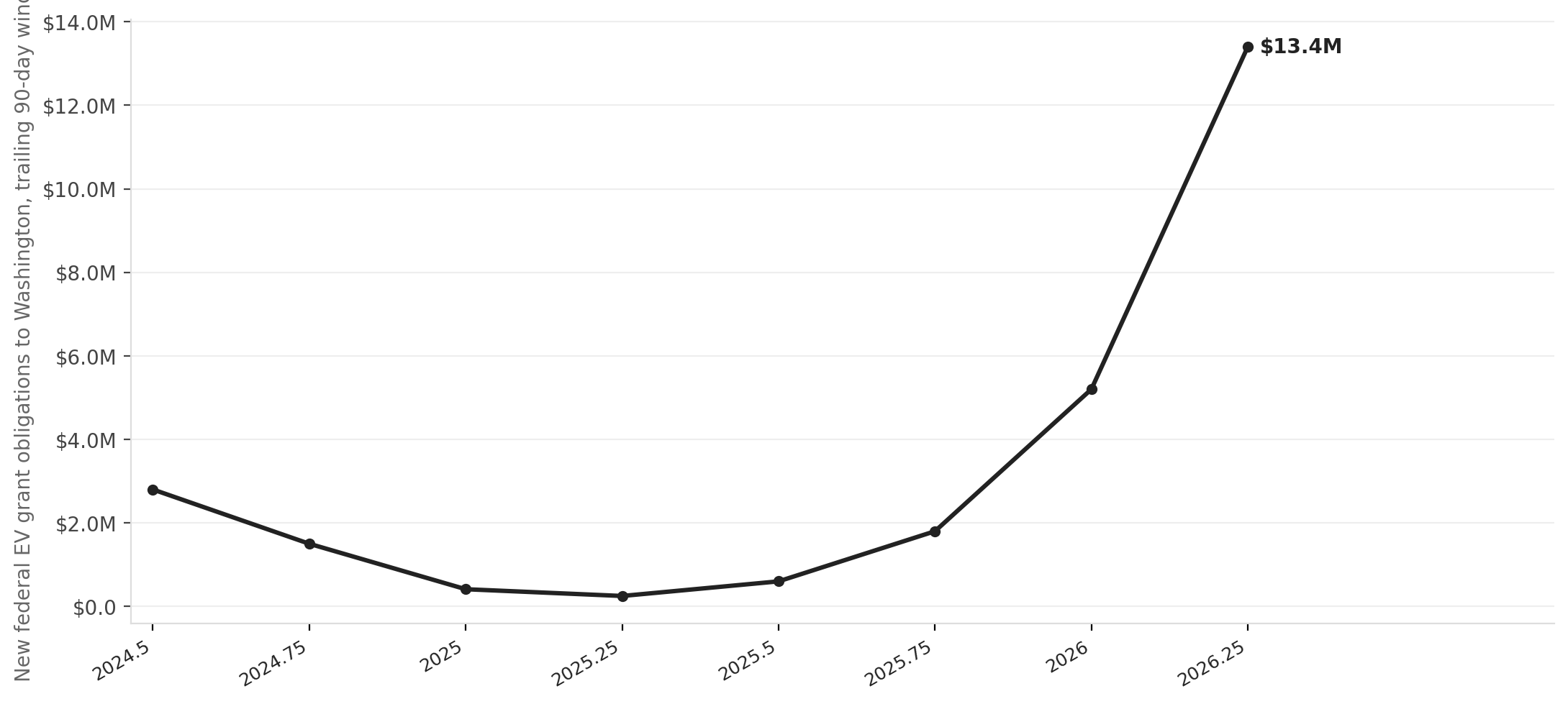
Federal EV grants newly obligated to Washington state have hit $13.4 million in the last 90 days, a 3,154% increase over the $411,795 committed in the same window a year ago. The state did not simply benefit from a policy shift. It engineered one.
On January 23, 2026, U.S. District Judge Tana Lin, sitting in the Western District of Washington, ruled that the Trump administration's February 2025 freeze of the NEVI Formula Program violated the Administrative Procedure Act. Her summary judgment in *Washington v. U.S. Department of Transportation* (Case No. 2:25-cv-00848) declared the freeze "arbitrary, capricious, and in excess of statutory authority" and issued a permanent injunction barring the Department of Transportation and the Federal Highway Administration from withholding funds. Washington had led a 20-state coalition in bringing the case. Six days after the ruling, WSDOT announced $12.16 million in NEVI Round 1 awards to five companies for 14 DC fast-charging stations along I-90, US 97, US 195, and US 395.
The two largest grants in the current 90-day window underscore how quickly the post-ruling pipeline is moving. The Port of Bremerton received a $9.4 million DOT award in April 2026 for a harbor infrastructure project that includes EV charging components, running through February 2029. Washington State DOT received a separate $4 million grant under the Low or No Emissions bus program in March 2026 for EV rolling stock and charging infrastructure, also extending to early 2029. Together they represent the leading edge of what had been a nearly silent year of frozen commitments.
Source: NationGraph.
The freeze had been particularly damaging for Washington because WSDOT had already advanced corridor planning to the procurement stage before FHWA rescinded its program guidance in February 2025. That guidance was pulled following a January 20 executive order pausing Infrastructure Investment and Jobs Act disbursements nationwide. As a federal court analysis documented, states with approved NEVI plans found themselves unable to obligate funds they had spent months preparing to deploy. Washington was among the hardest hit: the valley in its monthly grant time series runs from late 2024 through mid-2025, with a sharp rebound beginning in late 2025 and accelerating after Judge Lin's January ruling.
State Attorney General Bob Ferguson, who shepherded the case, said after the preliminary injunction in June 2025 that the federal government "cannot simply pause a program Congress explicitly authorized and funded." The final ruling validated that position, and the NEVI Round 1 recipients, including Electric Era, Energy Northwest, EV Gateway, EVgo, and Tesla, are now building toward actual station openings along four major Washington corridors.
The urgency is not purely legal. Washington has adopted California's Advanced Clean Cars II rules, requiring 100% zero-emission vehicle new-car sales by 2035. It operates the largest state ferry system in the United States, making EV charging a transit infrastructure question, not just a climate one. The state already counts more than 2,900 public charging stations, but the NEVI corridors are intended to close rural and highway gaps that the existing network does not cover. Washington's total active federal EV grant portfolio now runs to roughly $113 million in currently live commitments, most of it traceable to IIJA-era awards for highway planning, clean ports, and NEVI. The new money is landing on top of a substantial foundation.
But the NRDC noted after the final ruling that the legal victory alone does not secure the funds indefinitely. A pending FY2026 appropriations bill in Congress would transfer $503.8 million in NEVI formula grants and $300 million in NEVI competitive grants into general Federal Highway Administration programs. That maneuver would not technically violate Judge Lin's injunction, which addressed executive-branch withholding rather than congressional appropriation, but it could effectively drain the dedicated EV infrastructure pipeline that Washington spent more than a year in court defending. FHWA has apportioned $885 million in NEVI funds for FY2026 nationally; states with approved plans are now opening new rounds. Whether those rounds survive intact depends on what Congress does next.
For Washington residents, the immediate signal is that charging station construction along major interstate and US highway corridors is now financially authorized and moving toward contracts. The longer signal to watch is the FY2026 budget vote. If the NEVI line items survive as dedicated EV funds, the state's legal gamble will have paid off in hardware. If they are folded into general highway spending, the courtroom win and the grant surge it produced may mark the high point of what the IIJA era delivered.