Federal school safety grants newly committed to Texas totaled $16.6 million in the trailing 90 days, up 53% from $10.9 million in the same window a year ago, making Texas the top recipient of DOJ school safety dollars among all major states. The runner-up isn't close: Illinois drew $5.9 million in comparable DOJ grant volume since 2024, California $4.7 million, New York $4.0 million. Texas is lapping the field, and the reason is not that the state has figured out school safety. It's that Texas demonstrably hasn't.
The engine behind the surge is a compliance gap created by House Bill 3, signed in June 2023, which mandated one armed security officer on every Texas school campus. The state paired that mandate with a safety allotment of $10 per student and $15,000 per campus annually, an amount superintendents across the state called unworkable almost immediately. A Texas Tribune investigation published in February 2025 found that more than half of Texas districts still did not meet the armed-officer requirement as of January 2025. When a mandate is real but the money isn't, districts go looking elsewhere. For Texas ISDs, that means Washington.
The federal program they're competing for is the COPS School Violence Prevention Program (SVPP), administered by the Department of Justice. The SVPP offers competitive grants of up to $500,000 for security hardware, access control systems, emergency notification technology, and law enforcement training. In FY2026, $73 million is available nationally. The program was already significant before the Uvalde shooting, but the Bipartisan Safer Communities Act, signed in June 2022 in direct response to the massacre, injected $300 million in supplemental school safety funding over five years, adding $40 million per year to the COPS STOP School Violence program and $20 million per year to the SVPP. That expansion made the federal pipeline significantly wider, and Texas districts, facing a mounting compliance clock, rushed to get in line.
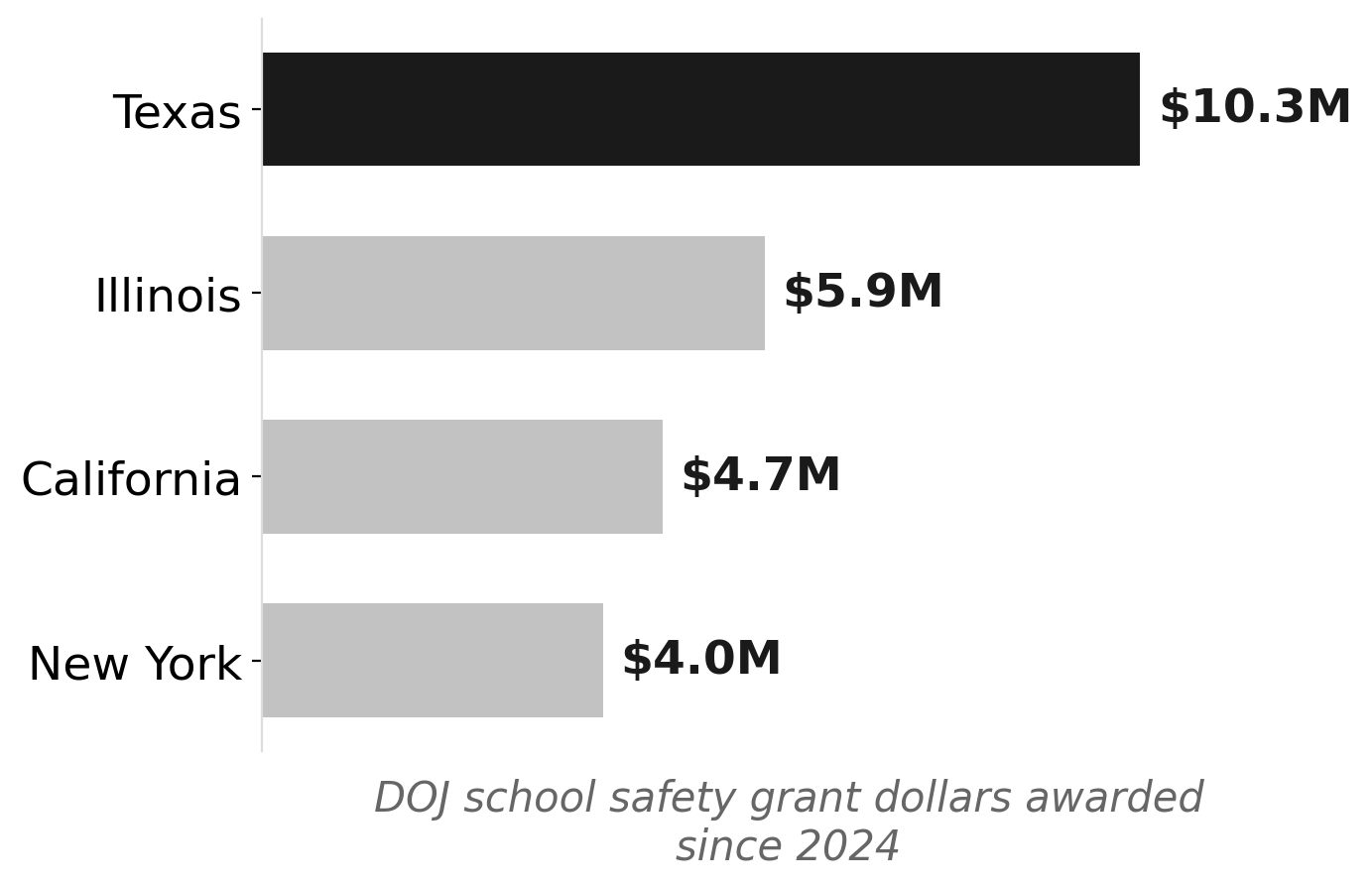
Source: NationGraph.
The individual awards in the current data tell the story concretely. Uvalde CISD, the symbolic center of this entire national conversation, received a $1 million STOP School Violence grant. Harlingen CISD and El Paso ISD each drew $1 million. Mesquite ISD received $923,000. Region VII Education Service Center, which coordinates resources across dozens of East Texas districts, was awarded $999,000. Texas State University received $1.39 million as a training and coordination node, a sign that federal dollars are now funding the infrastructure needed to absorb and deploy school safety capacity at scale, not just individual campus upgrades.
The pattern isn't limited to large urban districts. Nationally, 76% of COPS SVPP awards go to rural jurisdictions, a structural feature that advantages Texas specifically, because the state has an unusually large universe of small rural ISDs. Districts like Big Sandy ISD, Bartlett ISD, and River Road ISD appear in recent award data. These are the districts least able to fund an armed officer out of their own budgets, and therefore the most motivated to compete for federal grants that can cover technology and training costs and free up local dollars for personnel.
The 2025 Legislature acknowledged the gap. The $8.5 billion school funding bill, HB 2, signed in June 2025, doubled the state safety allotment to $20 per student and $33,540 per campus. Governor Abbott had called for $500 million in additional school safety investment in his February 2025 State of the State address; the Legislature approved roughly $400 million in additional funding for the 2026-27 biennium. District leaders say even the higher allotment falls well short of the roughly $100 per student that a fully staffed, fully compliant security program actually costs. The federal grant competition is likely to remain intense regardless of what Austin appropriates.
At the procurement level, that intensity is already showing up in vendor contracts. Humble ISD has issued multiple rounds of requests for proposals for school safety products and services through 2026, with an application deadline extended to November 2026, a leading indicator that awarded grant dollars are moving into actual purchasing decisions. Federal grants won in 2025 are becoming security cameras, door access systems, and threat assessment software in 2026.
The next data point to watch is Q4 2026. The FY2026 SVPP application window closed August 11, 2026, meaning a new cohort of awards is likely to post before year's end. Given Texas districts' demonstrated appetite and the structural advantages that favor rural ISDs, there is no obvious reason the state's lead position at the federal grant window will shrink. The more durable question is whether the state allotment ever reaches a level where districts stop needing to compete for it.