California collected $6.01 million in newly-started federal EV charging grants in the trailing 90 days, a 1,231% jump over the $451,000 that cleared in the same window a year ago. Seven awards came through in roughly eight weeks. The state didn't get lucky. It sued for the money, won, and then moved faster than almost any other state to obligate funds before the political window closes again.
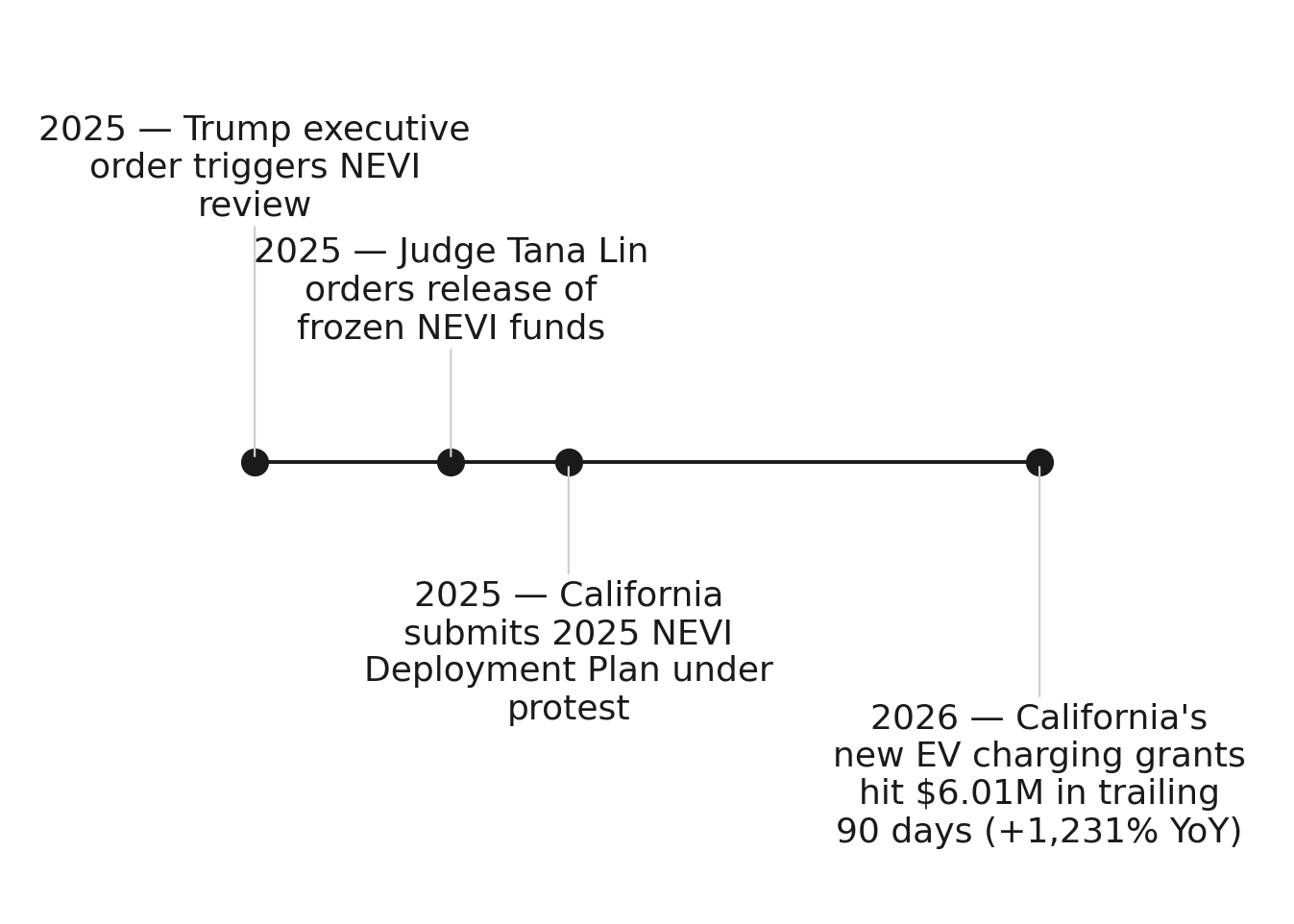
The story behind the surge begins on January 20, 2025, when President Trump signed an executive order titled 'Unleashing American Energy,' which halted spending across federal clean energy programs. FHWA followed on February 6, rescinding all existing guidance for the $5 billion NEVI Formula Program and freezing state allocations nationwide. California, which had been running the most active NEVI deployment pipeline in the country, found its corridor charging buildout stopped mid-stride.
What happened next was unusual. California joined a 16-state coalition and sued the federal government directly, not to protest a policy, but to recover its own congressionally-appropriated allocation. The GAO weighed in, ruling that the suspension constituted an unlawful deferral of funds. U.S. District Judge Tana Lin issued an injunction in June 2025 ordering the freeze lifted. The Department of Transportation declined to appeal. FHWA issued Interim Final Guidance on August 11, 2025, effective August 13, and the money began moving.
Source: NationGraph.
California submitted its 2025 NEVI Deployment Plan in September 2025 under explicit legal protest, reserving its rights in the event of any future federal reversal. Caltrans began obligating funds almost immediately. The grant surge concentrated in August and September 2026 tracks that cadence almost exactly.
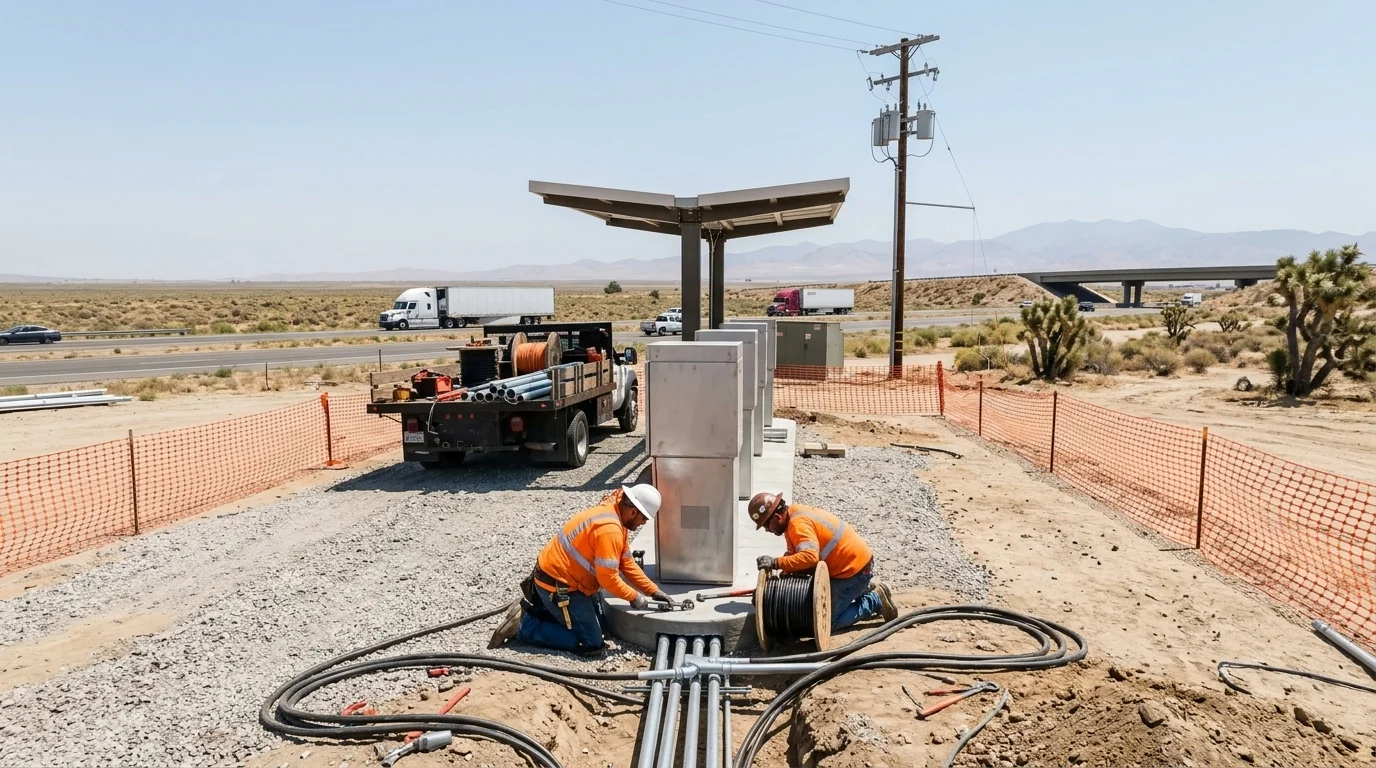
The largest new awards flow through Caltrans's Highway Planning and Construction program: $2.83 million and $1.47 million, both NEVI-backed, aimed at deploying DC fast chargers along Alternative Fuel Corridors. A separate cluster of four awards under the DOT Carbon Reduction Program, a distinct federal-aid highway program funding transportation emissions reductions, totals $1.11 million and runs through Caltrans as well. The two programs are mechanically separate and serve different statutory purposes; the Carbon Reduction Program is not part of NEVI and was not subject to the same freeze. A $600,000 Caltech NSF research grant on charging infrastructure rounds out the cohort.
The new activity sits on top of an existing portfolio that already exceeds $100 million in active California EV charging awards: $38.8 million from the EPA's Clean Heavy-Duty Vehicles Program, $29.3 million from the Clean School Bus Program, and a $7.9 million South Bay Truck Charging Hub from the state Transportation Commission. Those programs largely continued through the freeze because they ran through EPA rather than FHWA. The $6 million surge reflects NEVI and Carbon Reduction dollars coming back online, not a wholesale expansion of the broader portfolio.
California's five-year NEVI allocation is approximately $384 million, of which relatively little has been fully obligated. The California Energy Commission opened a $79 million solicitation (GFO-25-602) for highway DC fast chargers in late 2025, with applications due in March 2026. The CEC has also shifted its NEVI focus toward medium- and heavy-duty vehicle electrification, meaning highway corridor fast chargers and fleet charging infrastructure are moving in parallel rather than sequentially.
The urgency is real. The CFI discretionary grant program, a separate competitive federal charging program, remains paused as of mid-2026. Congress redirected some unobligated NEVI funds through the Consolidated Appropriations Act of 2026, narrowing what states can still capture. Every dollar Caltrans obligates now is a dollar that cannot be redirected later.
On the demand side, California is also compensating for the expiration of the federal $7,500 EV tax credit at the end of 2025. Governor Newsom has proposed $200 million in state ZEV rebates for FY2026-27 as a point-of-sale replacement for income-qualified buyers. That proposal is a state appropriation with a different mechanism and a different purpose than the infrastructure grants; it targets consumer demand rather than charging supply. But the two efforts share a political logic: California is building out what the federal government built and then tried to dismantle, using every available instrument to do it.
The next signal to watch is what the CEC does with the $79 million GFO-25-602 solicitation as award decisions come out, and whether Congress takes further action on unobligated NEVI balances before the program's five-year authorization window closes. California has the largest EV market in the country and a $384 million federal allocation it spent the better part of a year fighting to access. The question now is how much of it can be locked in before the rules change again.