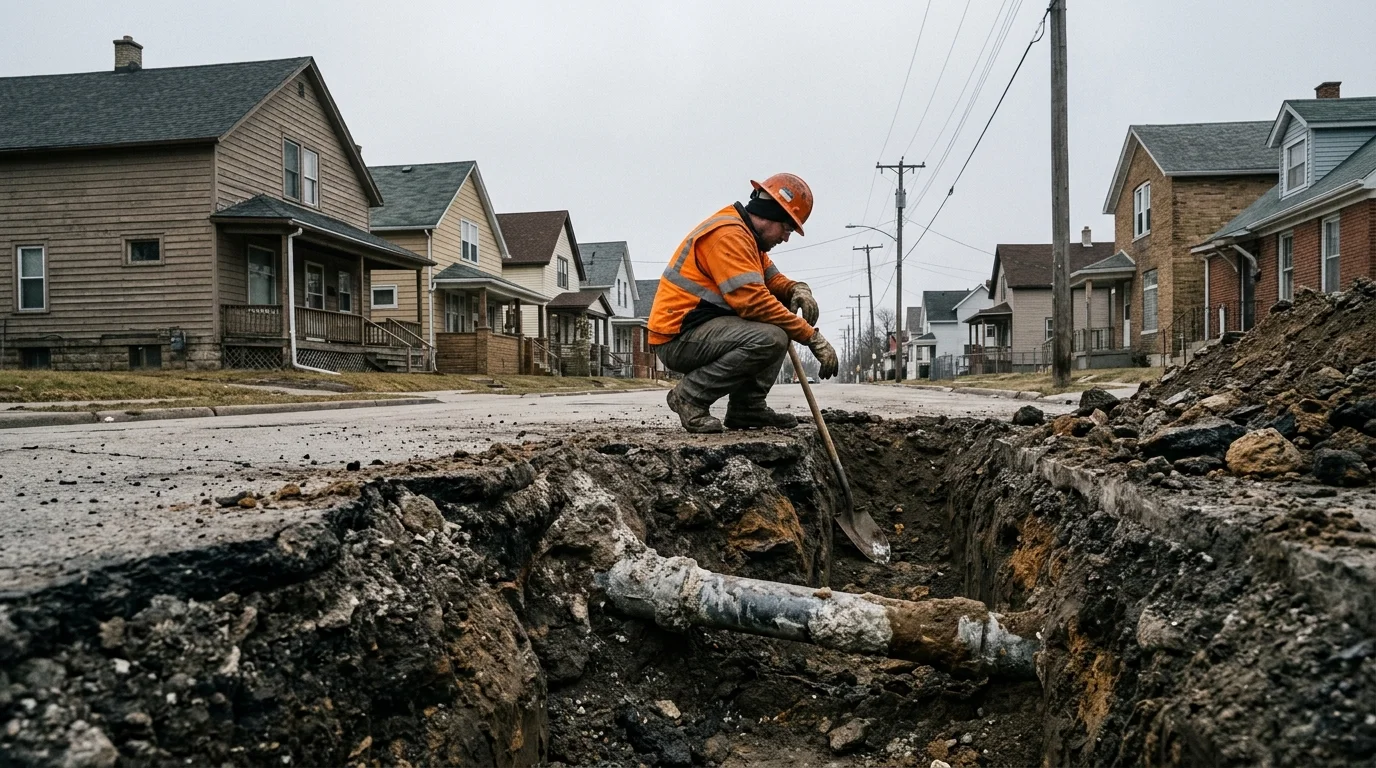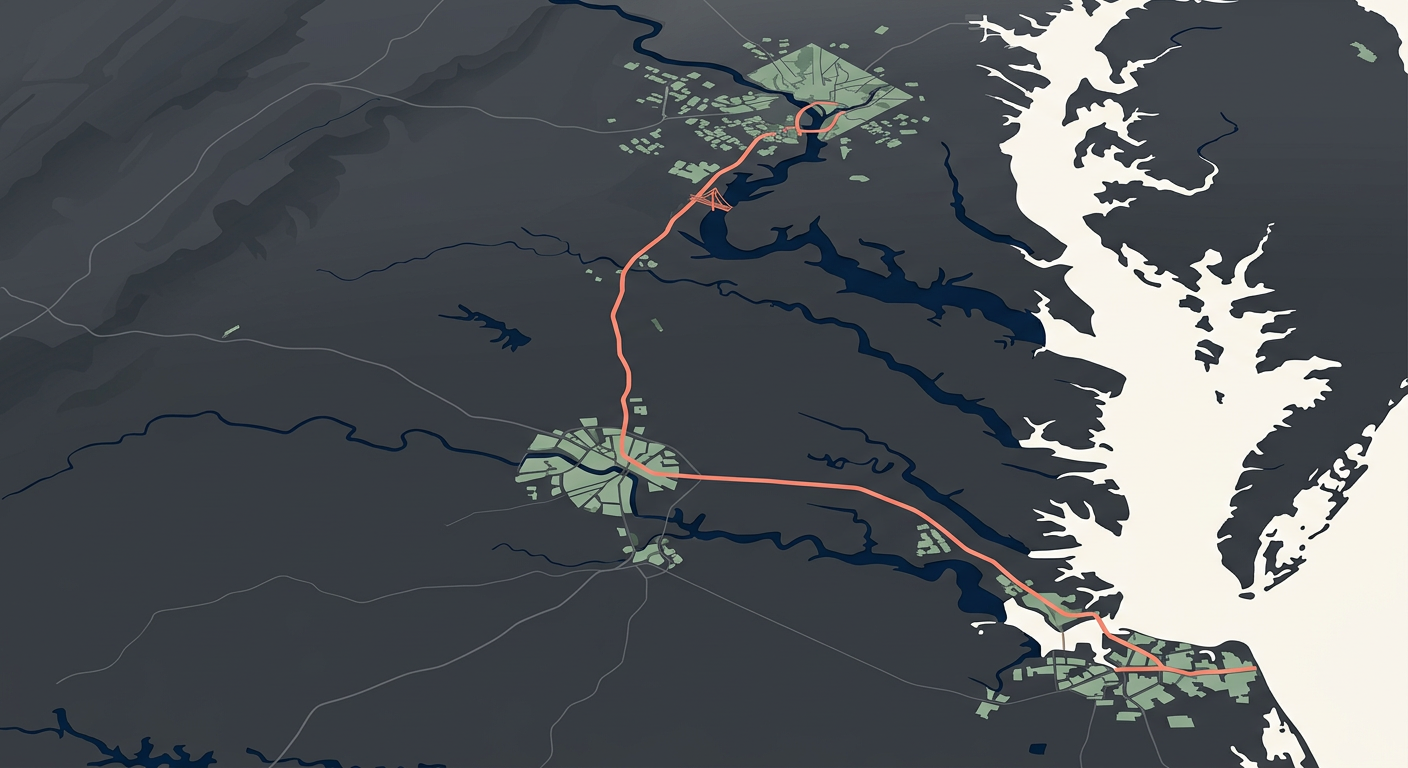
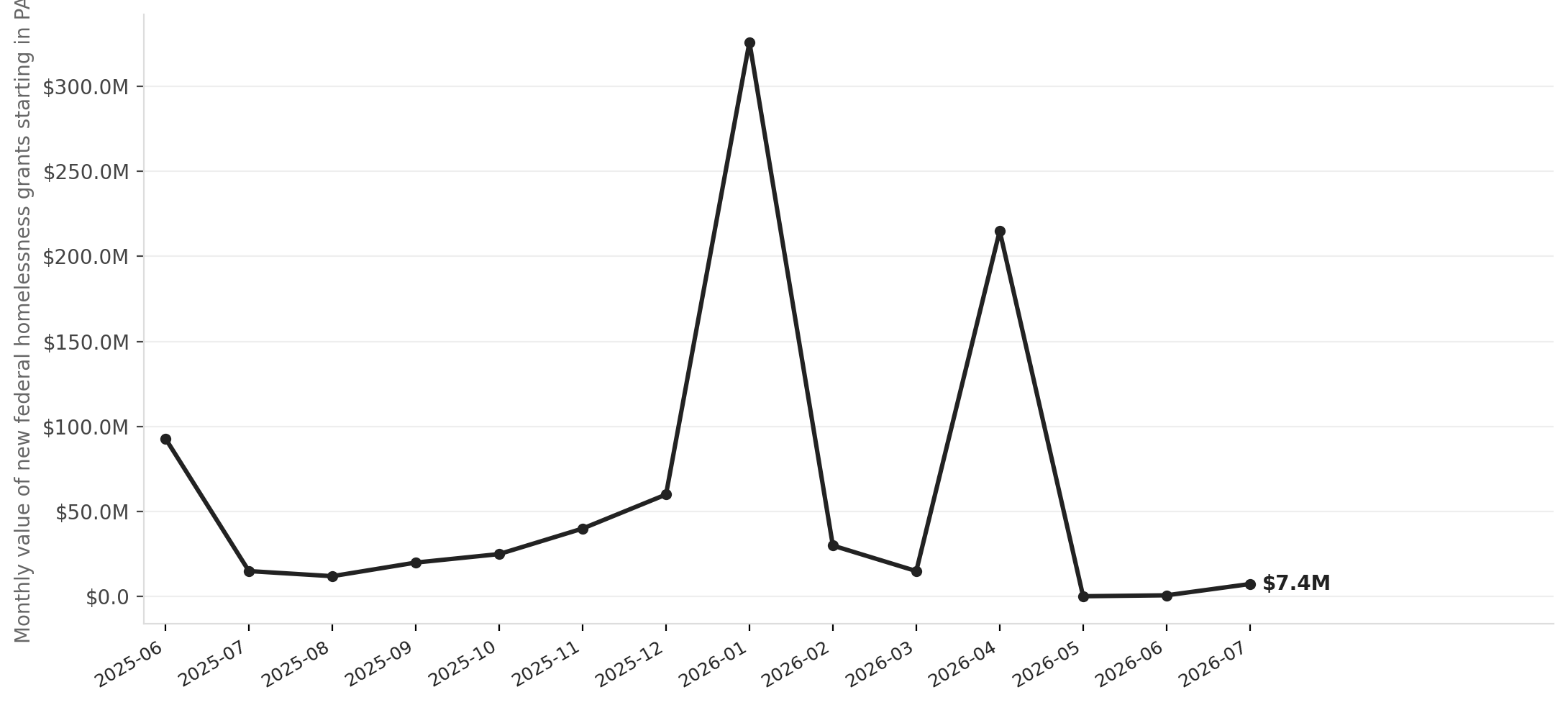
New federal homelessness grants starting in Pennsylvania have totaled just $8.4 million over the past 90 days, down from $470.7 million in the same window a year ago. That is a 98% collapse, and it is not a Pennsylvania problem.
The same cliff appears in virtually every high-volume state. California is down 99.9%. Washington is at zero. New Jersey and Ohio are each down 99.9%. At least 18 states have seen near-total cessation of new homelessness grant starts in recent months. The numbers point to a systemic freeze inside the U.S. Department of Housing and Urban Development, not any shift in Pennsylvania policy or need.
Three overlapping federal actions explain the timing. First, the Trump administration's DOGE initiative reportedly targeted HUD's Office of Community Planning and Development, the unit that processes Continuum of Care and housing voucher grants, for an 84% staff reduction, the largest in the agency. Fewer staff means slower grant agreement processing and slower reimbursements, even for awards that already exist on paper. Second, HUD's FY2025 CoC Notice of Funding Opportunity was delayed, legally challenged, and ultimately abandoned in favor of the Biden-era framework, pushing billions in annual renewal awards six or more months behind schedule. HUD issued only $349 million in emergency CoC renewal funds on March 31, 2026, against a normal annual volume closer to $3.6 billion. Third, the administration's FY2026 budget request, released May 30, 2025, proposes $32.9 billion in HUD cuts, including a proposal to effectively end the Housing Choice Voucher program and replace it with state block grants. That proposal alone is enough to chill new commitments while Congress decides whether Section 8 as a federal program will exist in two years.
Source: NationGraph.
The contrast inside Pennsylvania's own grant record is stark. A year ago, the Philadelphia Housing Authority received a single $92.9 million Section 8 voucher grant. The largest single award in the current 90-day window is a $7.4 million grant to Bucks County housing authorities. Philadelphia's largest new start in the same period is $514,000. Pennsylvania ranked sixth among all states in homelessness grant volume in the prior-year window; today it is essentially at idle.
None of this means Pennsylvania's homelessness infrastructure has collapsed yet. The state's active, currently running grant portfolio still totals roughly $460 million or more, anchored by a $264.5 million HHS cooperative agreement running through July 2027 and about $31 million in active CoC program funds. Allegheny County's Pittsburgh-area CoC held a $27 million prior-year award. Philadelphia's CoC office administers one of the largest continuous-care systems in the mid-Atlantic. Those commitments are still paying out.
The problem is what comes next. Multi-year grants expire. Voucher funding cycles end. The pipeline that would normally replenish those commitments, the annual CoC NOFO, the Section 8 renewal process, the HUD grant agreements that convert awards into disbursable dollars, has effectively stopped producing new starts. HUD published the FY2026 CoC NOFO on June 1, 2026, but awards are not expected until late 2026 at the earliest, leaving Pennsylvania's 13 Continuum of Care regions, including high-need systems in Philadelphia and Pittsburgh, in a gap with no clear fill date.
The National Low Income Housing Coalition has warned that 57,000 Emergency Housing Voucher households nationally face loss of assistance as EHV funding depletes in 2026. Congress has passed no FY2026 HUD appropriations bill that addresses the shortfall. As Shelterforce reported earlier this year, nonprofit housing providers have described a state in which awards exist in HUD systems but no one at the agency has the staff capacity to execute the grant agreements that release the money.
For Pennsylvania housing authorities and CoC administrators, the immediate task is managing on existing commitments while watching two clocks. The first is the late-2026 CoC award timeline, if HUD issues FY2026 grants on schedule, agencies can begin bridging the gap before prior-year grants expire in 2027 and 2028. The second is the congressional budget process: a full-year FY2026 appropriations bill that restores normal HUD funding levels would matter more than any single grant award. Neither clock has a guaranteed end point.
What the data makes plain is that the funding cliff is not today's emergency. Agencies are still drawing down the prior administration's commitments. The cliff is next year's emergency, arriving in slow motion while Washington debates whether the federal government's core rental assistance architecture should exist at all.