Federal grants tagged to homelessness in North Dakota totaled $5.28 million in the trailing 90 days, up 239% from $1.56 million in the same window last year. The number looks like a policy surge. It is not, exactly. Strip out a single $3.33 million Interior Department grant to a 117-student tribal boarding school in Wahpeton, and the underlying picture is a shelter network that came within weeks of losing its funding entirely this winter and is now entering the most competitive renewal cycle in its 30-year history.
The dominant driver of the headline figure is a Bureau of Indian Education grant to Circle of Nations Wahpeton Indian School, an inter-tribal off-reservation boarding school chartered under the Sisseton-Wahpeton Dakota Oyate and serving students in grades 4 through 8, all of them Indigenous and 97% economically disadvantaged. The grant, routed under the McKinney-Vento Act's Education for Homeless Children and Youth program, covers school year 2026-27. The prior-year equivalent was a $334,000 Department of Education grant to the North Dakota state DOE, a different agency, a different grantee, and nearly one-tenth the size. The shift reflects a structural change in how BIE-affiliated schools access McKinney-Vento funds, not a sudden investment in the state's homeless population broadly. These two grants are not interchangeable parts of the same program: one funds tribal school operations through a federal education authority; the other flows through state government to local districts.
The remaining $1.95 million in the trailing 90 days comes from two unrelated programs. Section 8 Housing Choice Voucher tranches, administered by more than 13 county and city housing authorities across the state, account for roughly $1.73 million, up from $821,000 in the prior-year window, reflecting routine federal allocation cycles rather than a coordinated homelessness initiative. A $300,000 Projects for Assistance in Transition from Homelessness (PATH) grant to the North Dakota Department of Human Services funds outreach and mental health services for people with serious mental illness; that figure is consistent with prior years. These programs do not share a mechanism, a grantee, or an oversight structure. The 239% headline is the arithmetic sum of unrelated funding cycles landing in the same 90-day window.
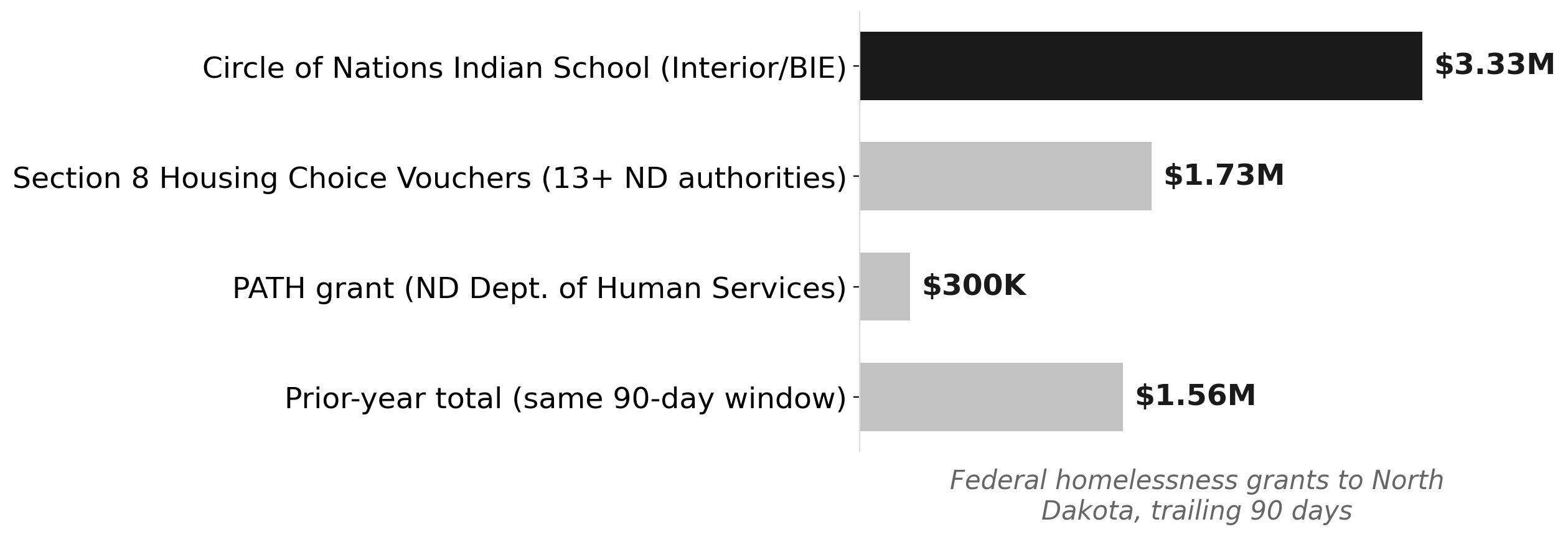
Source: NationGraph.
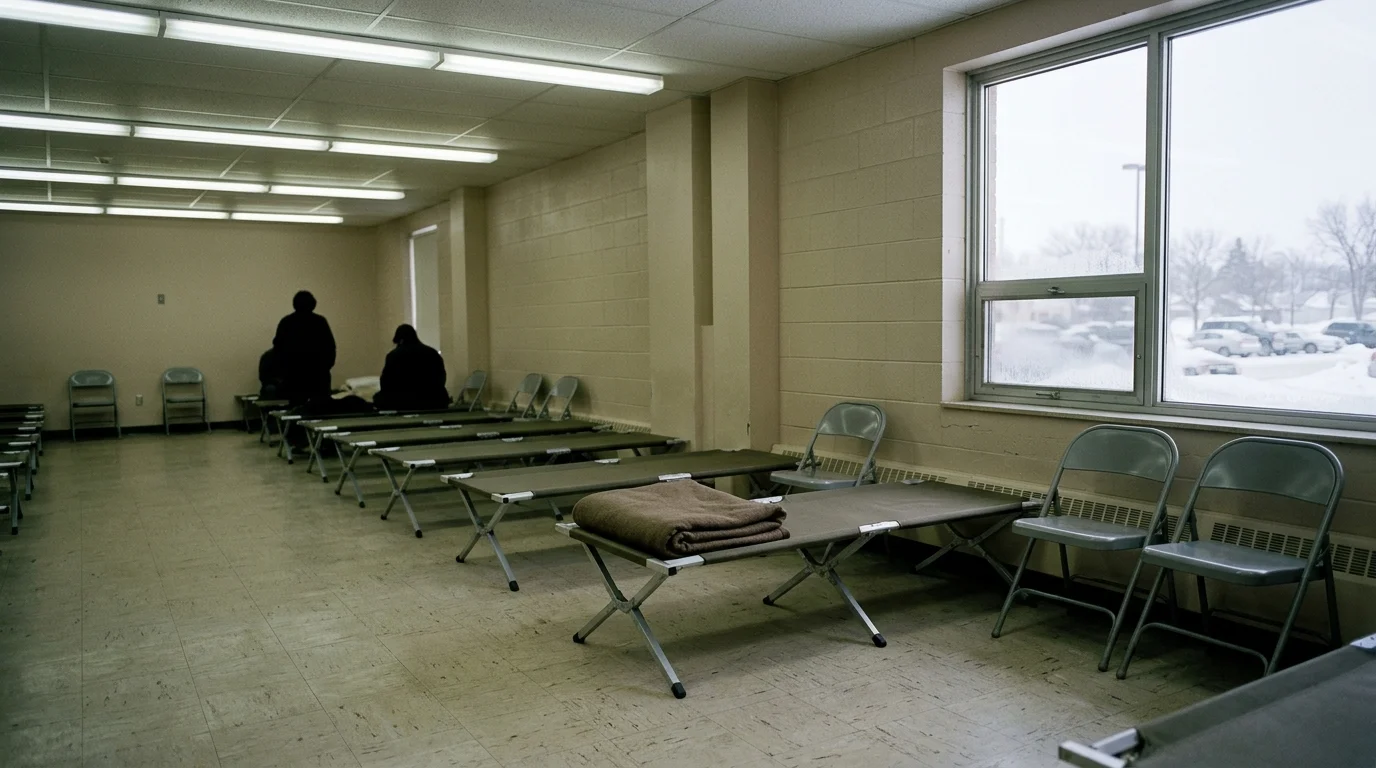
Beneath the headline number, the state's primary homelessness infrastructure spent the winter in genuine jeopardy. HUD's Continuum of Care program, which funds roughly $3.3 million annually in North Dakota, supporting approximately 1,600 shelter beds at organizations including YWCA Cass Clay and Fraser Ltd. in Fargo, the Abused Adult Resource Center in Bismarck, and the Domestic Violence and Rape Crisis Center in Dickinson, faced a last-minute threat of non-renewal in late 2025. Twenty state attorneys general sued, and a court paused the action. Sen. John Hoeven, drawing on his seat on the Senate Transportation-HUD Appropriations Committee and what he has described as a particularly direct conversation with YWCA Cass Clay CEO Erin Prochnow, wrote mandatory renewal language into the Consolidated Appropriations Act, 2026. North Dakota advocates called the outcome a relief, but the fix was a one-cycle patch, not a structural resolution.
The next cycle brings fresh uncertainty of a different kind. HUD's FY2026 Continuum of Care Notice of Funding Opportunity, released June 1, 2026, restructures the competition significantly: the share of program funds protected as tier-1 renewals, previously around 90%, meaning longtime providers faced minimal competitive pressure, drops to roughly 30%. Organizations that have operated on near-automatic renewals for three decades now face fully competitive re-application. North Dakota applications are due August 26; awards are not expected until December 1, 2026. That gap matters for providers that cannot bridge months of uncertainty with reserves.
The context is specific to North Dakota's geography. Homelessness here is concentrated in Fargo, the state's only urban center, but disproportionately involves Native American residents traveling from rural reservations to access services that do not exist in their home communities. YWCA Cass Clay has noted that roughly 36% of families in Fargo shelters are Native American. The $3.33 million BIE grant to Circle of Nations addresses a real and documented need, an off-reservation boarding school where students are classified as homeless under federal education law, but it does not add a single shelter bed to the network those families depend on.
The VA separately awarded $1.9 million to Community Action Partnership of North Dakota for veteran homelessness services in FY2026, and NDHFA Executive Director Brandon Dettlaff is running a July 2026 competitive round for HOME, Low-Income Housing Tax Credit, and Housing Trust Fund dollars. Those programs represent real capacity, but they arrive on separate tracks from the CoC system whose December decision will determine whether the state's shelter infrastructure looks the same in 2027 as it does today.
The 239% number is real. What it measures is harder to read than it appears.