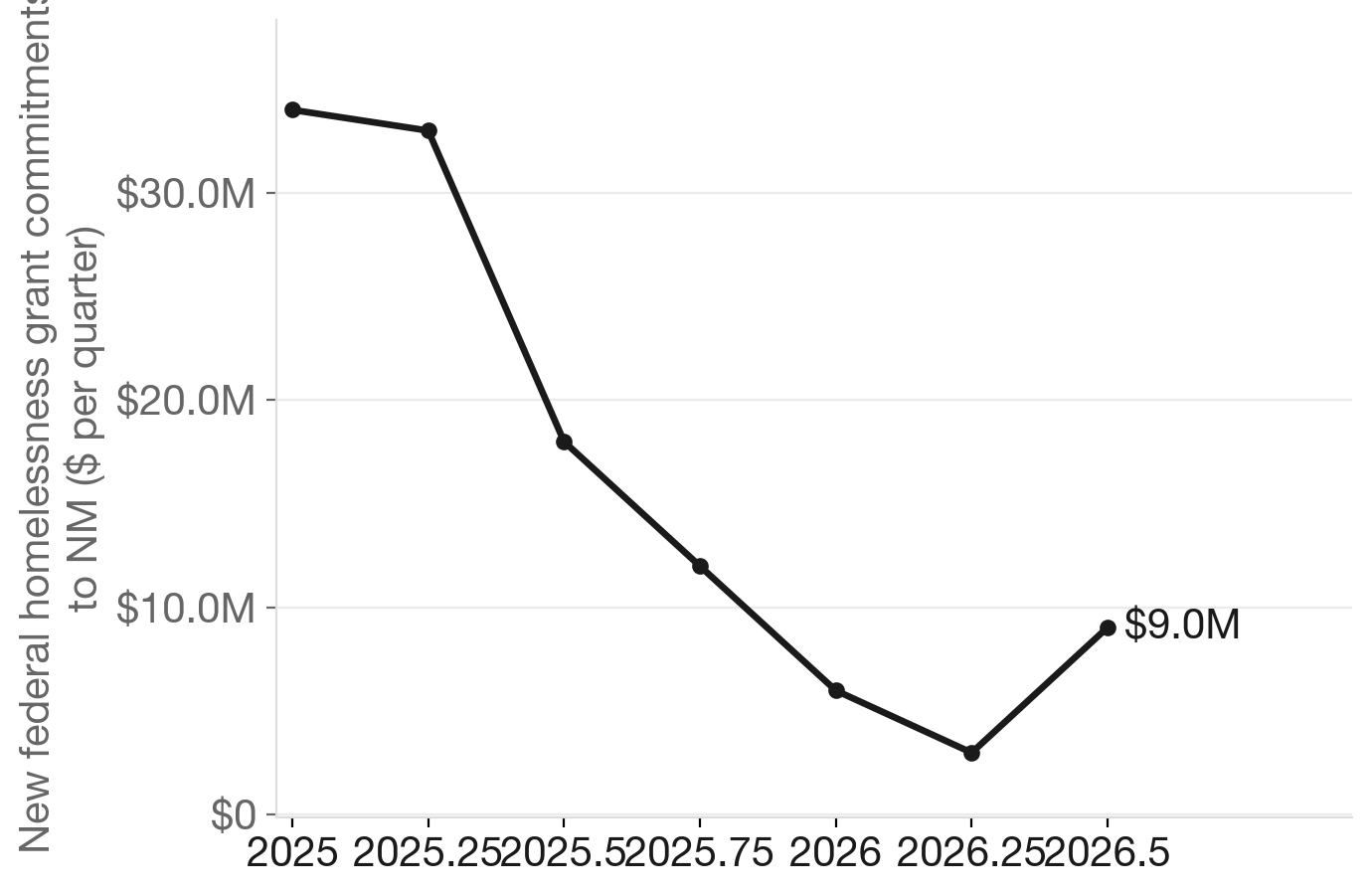
New federal homelessness grant commitments in New Mexico have fallen to $9.04 million over the trailing 90 days, down 65% from $25.98 million in the same window a year ago. The state's homelessness infrastructure has not collapsed. The pipeline that funds it has.
The drop traces directly to a single legal event. On December 23, 2025, a federal court issued a preliminary injunction blocking HUD from enforcing its November 2025 Continuum of Care Notice of Funding Opportunity, which would have capped permanent supportive housing awards at 30% of available CoC funds. HUD responded by announcing it would not award any CoC funds while litigation continues. That decision froze the grant pipeline that supplied the bulk of New Mexico's prior-year homelessness spending in a single stroke.
The scale of what stopped is visible in the numbers. The prior-year same window was defined by dense waves of HUD Section 8 Housing Choice Voucher renewal batches flowing to more than a dozen New Mexico housing authorities. Albuquerque Housing Authority and Bernalillo County Housing Authority alone took in more than $50 million in new starts between January and April 2025. Eastern Regional Housing Authority and eight other local public housing agencies joined that cadence. In mid-2026, those renewal batches are essentially absent.
Source: NationGraph.
What remains in the current window are two grants with no connection to HUD at all. The Ramah Navajo School Board received $5.1 million and the Ch'ooshgai Community School Board received $4.0 million, both Education for Homeless Children and Youth awards administered through the Department of the Interior. Together they account for virtually all of the $9 million flowing into the state right now. Without them, the number would be close to zero.
The stakes for New Mexico are concrete. In January 2026 testimony before the state Senate Finance Committee, New Mexico Workforce Solutions Secretary Sarita Nair warned that the proposed CoC restructuring threatened $16.7 million in annual rent payments to roughly 1,000 landlords serving approximately 8,000 voucher-dependent households. Rep. Gabe Vasquez, whose district covers southern New Mexico, formally demanded HUD reverse the CoC changes, warning they risked pushing nearly 200,000 Americans into homelessness nationally. Congress acknowledged the urgency: the FY2026 Consolidated Appropriations Act, signed February 3, 2026, increased HUD's total funding to roughly $77.3 billion and required CoC renewal on a defined schedule. Award processing has not resumed.
New Mexico enters this standoff from a structurally exposed position. The state has one of the highest per-capita unhoused populations in the Southwest and a comparatively thin state safety net, making it more dependent on federal voucher flow than most of its neighbors. That dependency also means the freeze hits harder here than almost anywhere else in the region. And yet New Mexico still leads its regional peers in new homelessness grant commitments this period: $9 million against Arizona's $4 million and Texas's $2.4 million. The regional comparison underscores that this is not a New Mexico policy failure. It is a federal pipeline problem distributed unevenly across states, with New Mexico absorbing a larger share of the damage in absolute terms.
The active portfolio offers some cushion. First Nations Community Health Source holds a $30 million health-center-for-homeless grant running through 2030, and prior-year voucher batches continue to support households already housed. But active grants eventually expire, and the renewal machine is what keeps people in place. National homelessness rose 18% between 2023 and 2024 according to the National Alliance to End Homelessness. A freeze in new commitments, sustained long enough, works against every tool the state has deployed to hold that number down.
The question now is when litigation resolves and whether HUD moves quickly once it does. The injunction does not cap the federal court's timeline, and HUD has given no public signal on when it expects to resume CoC awards. New Mexico's housing authorities, landlords, and the roughly 8,000 households whose voucher renewals are pending are waiting on a docket they cannot read.