Federal school safety grants flowing into Louisiana have surged to $10 million in the last 90 days, a 6,663 percent jump from the $148,000 that landed in the same window a year ago. The number is striking, but the story behind it is more complicated: much of that money is racing toward a cliff edge, and a new state law is adding compliance costs that the federal programs were never built to cover.
The central pressure point is the Bipartisan Safer Communities Act's Stronger Connections Grant Program, which allocated $21.35 million to Louisiana for school safety and climate improvements at high-need districts. As the U.S. Department of Education outlines, those funds must be obligated by September 30, 2026, a hard deadline that is now weeks away, not months. Superintendent Cade Brumley directed Louisiana's share toward single-point-of-entry physical hardening: controlled access vestibules, perimeter fencing, reinforced entry points. Districts that have not yet committed those dollars to contracts or purchase orders will lose them.
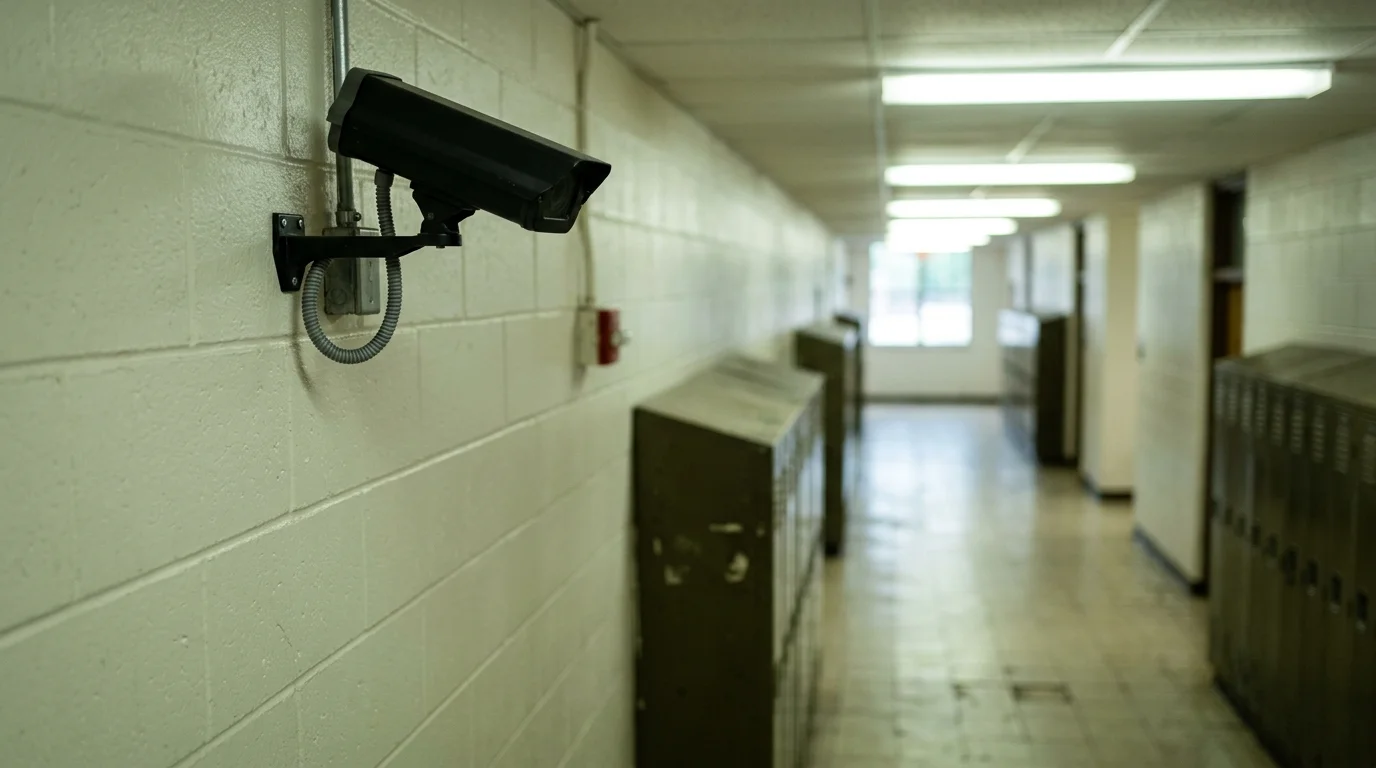
The spend-down pressure is real, but it arrives alongside a separate and unfunded obligation. Louisiana Act 479, passed in June 2025 and effective February 1, 2026, requires cameras in every public special education self-contained classroom statewide. The law is universal, it applies to every district regardless of wealth or federal grant status, and none of the federal programs now flooding into Louisiana cleanly cover it. The BSCA Stronger Connections program targets high-need LEAs on a competitive basis; the separate COPS School Violence Prevention Program funds security technology but requires its own competitive application. Districts scrambling to meet the Act 479 camera requirement have no dedicated funding stream to draw from, and their procurement offices are simultaneously managing BSCA spend-down paperwork.
Source: NationGraph.
Caddo Parish School Board, headquartered in Shreveport, sits at the center of this collision. The district holds a $2.89 million Department of Education "School Safely National Activities" grant running January through December 2026, with $1.83 million already disbursed, the largest single active school safety award in the state. Caddo is not an outlier chosen arbitrarily: the district's own grant application describes Shreveport as ranking in the top 10 U.S. cities for violent crimes per capita, with 8,361 crimes reported in 2023 alone, including 1,471 violent offenses. That context is why Caddo has cultivated a multi-year federal relationship, dating to a 2020 DOJ STOP School Violence award and a fiscal year 2024 renewal, that few Louisiana districts can match. The administrative infrastructure to absorb federal dollars is itself a competitive advantage.
Elsewhere, the picture is more modest. Winn Parish School District received a $484,000 COPS SVPP award in October 2025 for evidence-based security technology upgrades, covering access control, cameras, and visitor management systems, funds that run through September 2028 and are not subject to the BSCA deadline. Tulane's administrator entity holds a $999,000 DOJ Stop School Violence grant for New Orleans charter schools through September 2027, focused on training and mental health linkages rather than physical hardening. These are distinct programs with distinct purposes: physical perimeter security, security technology, and violence prevention training are three different federal policy mechanisms, authorized under different statutes and administered by different agencies. They are converging on Louisiana school systems in 2026 for independent reasons.
The state has also layered in its own dollars. The Louisiana budget includes $8.9 million in school safety appropriations: $5 million for surveillance cameras and safety training, and $1.6 million for teacher panic buttons, a requirement codified under the Louisiana School Safety Act of 2023, which also established the Louisiana Center for Safe Schools within the Governor's Office of Homeland Security. The Center is now the coordinating body for all of these overlapping streams, a role it has held for less than three years.
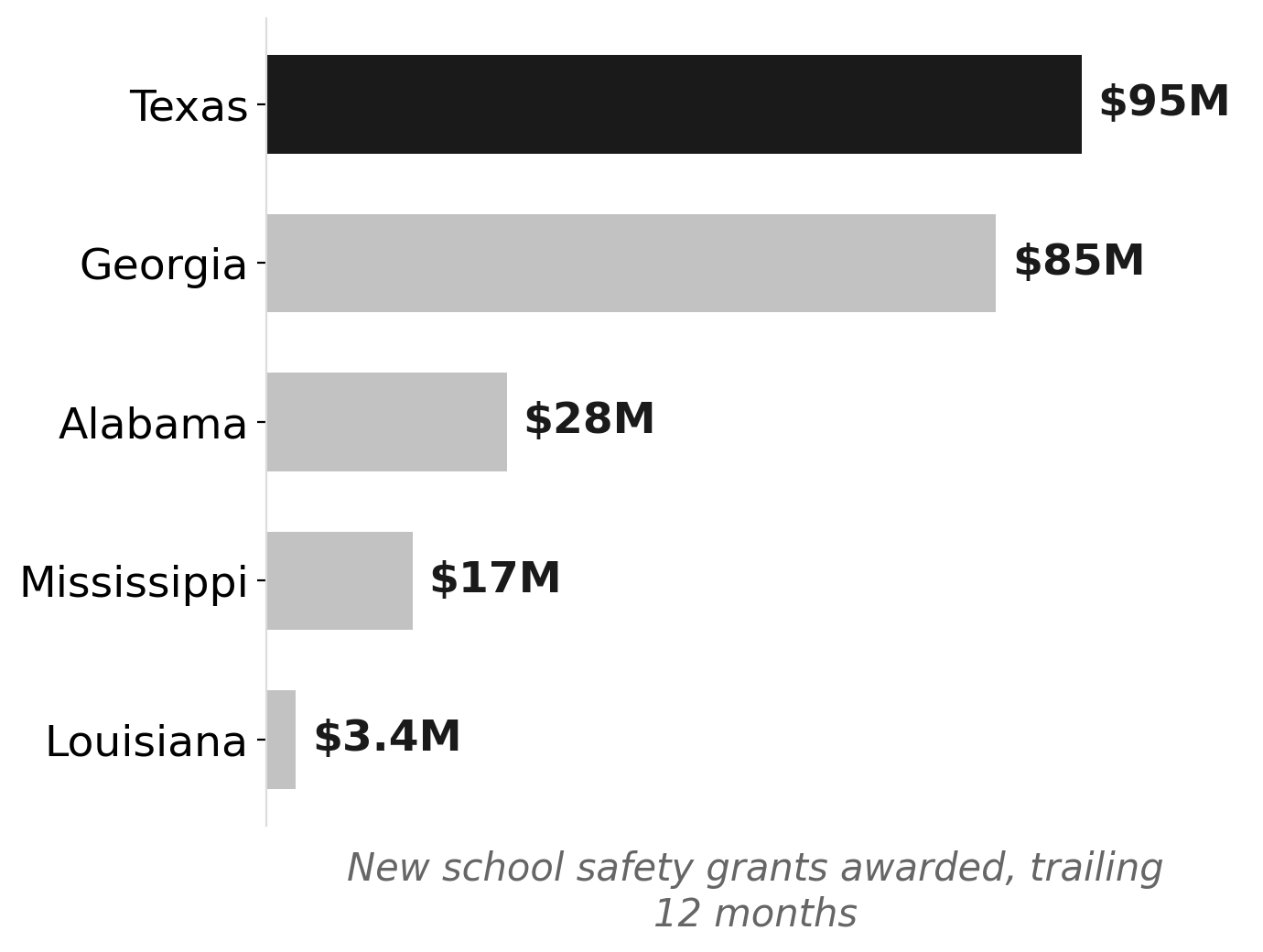
Nationally, Louisiana's position is instructive. The state captured roughly $3.4 million in new school safety grants over the trailing 12 months, trailing Texas ($95 million), Georgia ($85 million), Alabama ($28 million), and Mississippi ($17 million). The 6,663 percent surge in the most recent 90-day window suggests Louisiana is catching up, but the state remains a modest participant in what is a nationally aggressive federal funding environment. A separate Department of Education School Safety Enhancement Program offered $93 million nationally in fiscal year 2026, with awards expected by December 31, 2026. The FY2026 COPS SVPP cycle, with $73 million available nationally, closed applications on August 11, 2026; Louisiana applicants in that round would not see awards until late 2026 or early 2027.
The question facing district administrators right now is narrower: contracts tied to BSCA Stronger Connections dollars must be obligated before September 30. For Caddo and the handful of other districts that competed successfully for those subgrants, the next few weeks are a procurement sprint. For the majority of Louisiana districts that did not receive BSCA subgrants, the Act 479 camera mandate sits on their balance sheets without a federal offset in sight. Whether the Louisiana Center for Safe Schools can coordinate both problems simultaneously, spend-down compliance and unfunded mandate relief, is the operational test the state's relatively new school safety infrastructure now faces.