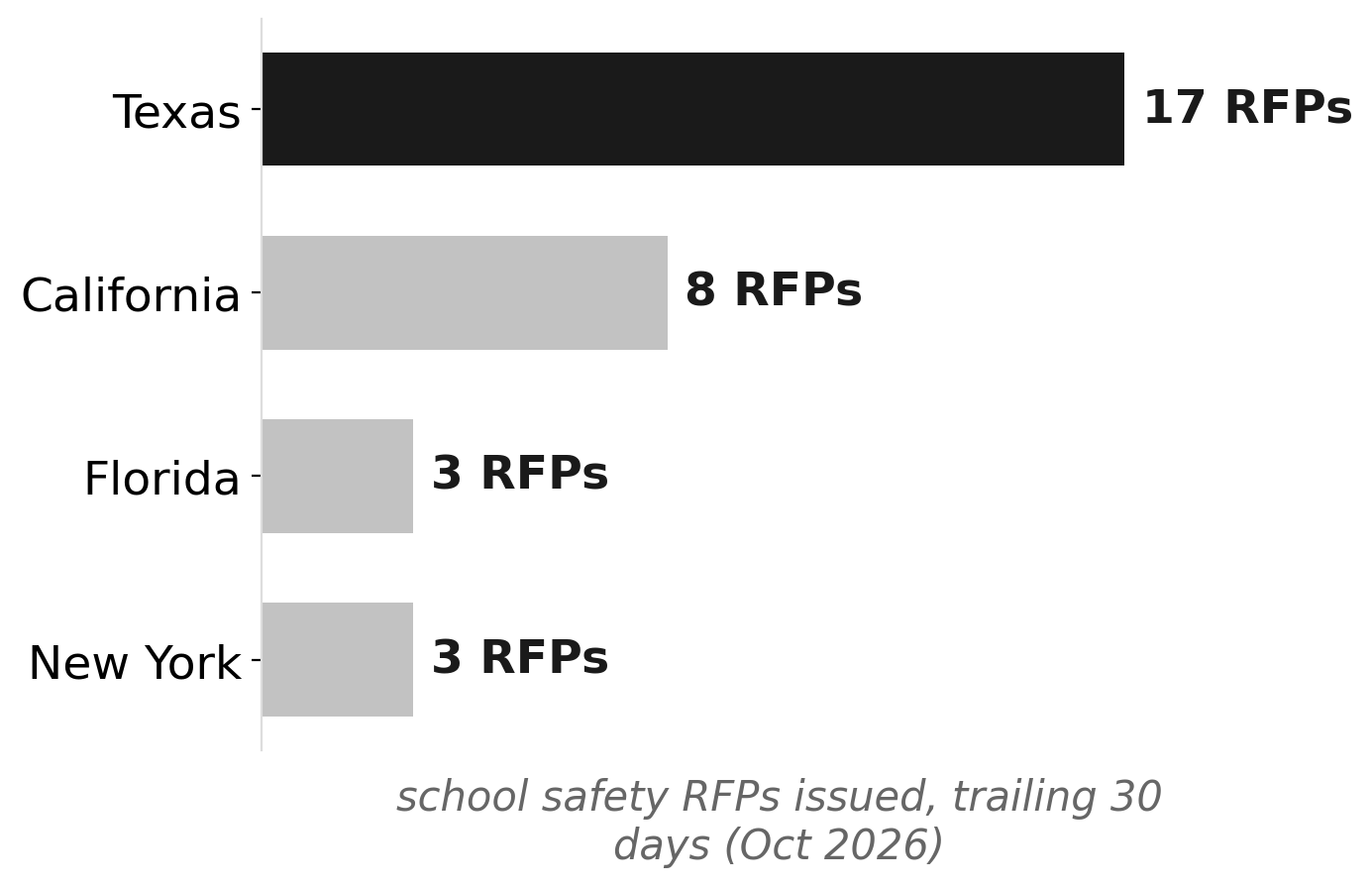
Texas school districts issued 17 school safety RFPs in the last 30 days, a 3.8x surge over the prior 12-month average of about 4.5 per month, and the number tells a story that starts not in October 2026 but in 2023, when the state told its 1,200 districts to arm their schools without giving them enough money to do it.
The procurement surge is what catching up looks like.
For two years after HB 3 passed in 2023, requiring one armed security officer per campus, more than half of Texas districts remained non-compliant. A January 2025 Senate Education Committee report confirmed the deadlock. Districts weren't ignoring the law; they were waiting for the state to make it financially possible to follow it. That changed on September 1, 2025, when two complementary laws from the 89th Legislature took effect simultaneously.
Source: NationGraph.
The first, SB 260 embedded in the school-finance omnibus HB 2, is a funding mechanism. It nearly doubled the per-student safety allotment from $10 to $21.10 per student in average daily attendance and raised per-campus allotments from $15,000 to $33,540, totaling roughly $430 million statewide across approximately 5.5 million students and 9,000 campuses. The second, HB 33 (the Uvalde Strong Act), is a mandate mechanism. It specifies what districts must physically acquire: one ballistic shield and one breaching tool per campus, standardized active-shooter protocols embedded in each campus emergency operations plan, and a security review triggered by any new construction or renovation. These are distinct laws doing distinct things. SB 260 does not require any specific purchase. HB 33 does not provide any money. But together, as the Texas Tribune reported after HB 2's passage, they resolved the political deadlock that had paralyzed school safety spending since 2023.
The result is a procurement pipeline that no other state is currently running at the same scale. California, the next-highest state in the same 30-day window, issued 8 school safety RFPs. Florida and New York each issued 3. Texas's count is more than double California's and nearly three times the combined total of the other two large states.
Humble ISD leads all districts with 5 RFPs explicitly titled "School Safety Products and Services", a cluster that suggests the district is running parallel procurements across multiple campuses or categories rather than consolidating into a single contract. San Antonio ISD issued a district-wide surveillance and access control upgrade covering its high schools. Mesquite ISD embedded safety infrastructure in two elementary school renovation packages, the kind of procurement that HB 33's construction-review requirement directly triggers: when a district breaks ground on any campus project, a security audit follows, and unmet equipment requirements come due.
The timing of the current surge also fits a two-wave pattern in the data. February 2026 saw 18 RFPs, a spike consistent with the moment FY2026 budgets first activated the new allotment levels, giving district finance offices the appropriated funds to begin procurement. October 2026 is the second wave, consistent with end-of-calendar-year procurement cycles and the ongoing compliance audit timeline that the TEA and Texas School Safety Center are monitoring. Districts that held back in the spring, waiting to see how compliance enforcement would develop, appear to be moving now.
As the Texas Tribune noted in February 2025, the original 2023 armed-officer mandate was widely described by district officials as an unfunded mandate. Gov. Greg Abbott's February 2025 State of the State address called for an additional $500 million for school safety, signaling the legislative direction months before the session concluded. Sen. Joan Huffman authored SB 260; Abbott signed HB 33, the Uvalde Strong Act, on June 20, 2025. The TEA's July 17, 2025 guidance letter notified all district administrators that the new allotment levels and compliance requirements were active for the 2025-2026 school year.
For the roughly 600-plus districts that were still non-compliant with the armed-officer requirement as of early 2025, the practical question is no longer whether to spend but how fast. The HB 33 equipment mandates, ballistic shields, breaching tools, are per-campus requirements across a system of more than 9,000 campuses. Even at relatively low unit costs, the statewide procurement volume is structurally large in ways that smaller states cannot replicate.
What to watch: the TEA and Texas School Safety Center have compliance-monitoring authority under HB 33, and their first systematic audit cycle will signal how aggressively non-compliant districts will be pressured. Districts mid-renovation are the clearest near-term pipeline, every construction project that triggers a security review under §37.1087 becomes a potential RFP. If the February and October spikes are the pattern, a third wave around the close of the state fiscal year in August 2027 is the next signal worth tracking.