Texas hurricane-tagged procurement solicitations hit 20 in the last 30 days, against a 12-month monthly average of roughly 5.9, a 3.4-fold spike. No new wave of federal dollars triggered it. The money driving this sprint has been sitting, largely unspent, since Hurricane Harvey made landfall nine years ago.
The immediate cause is a single administrative action: on September 28, 2026, Texas General Land Office Commissioner Dawn Buckingham granted a one-year deadline extension on all Harvey-era HUD Community Development Block Grant recovery and mitigation funds, explicitly described as a one-time reprieve with no further flexibility. For local governments already running out of time, that extension was a starting gun.
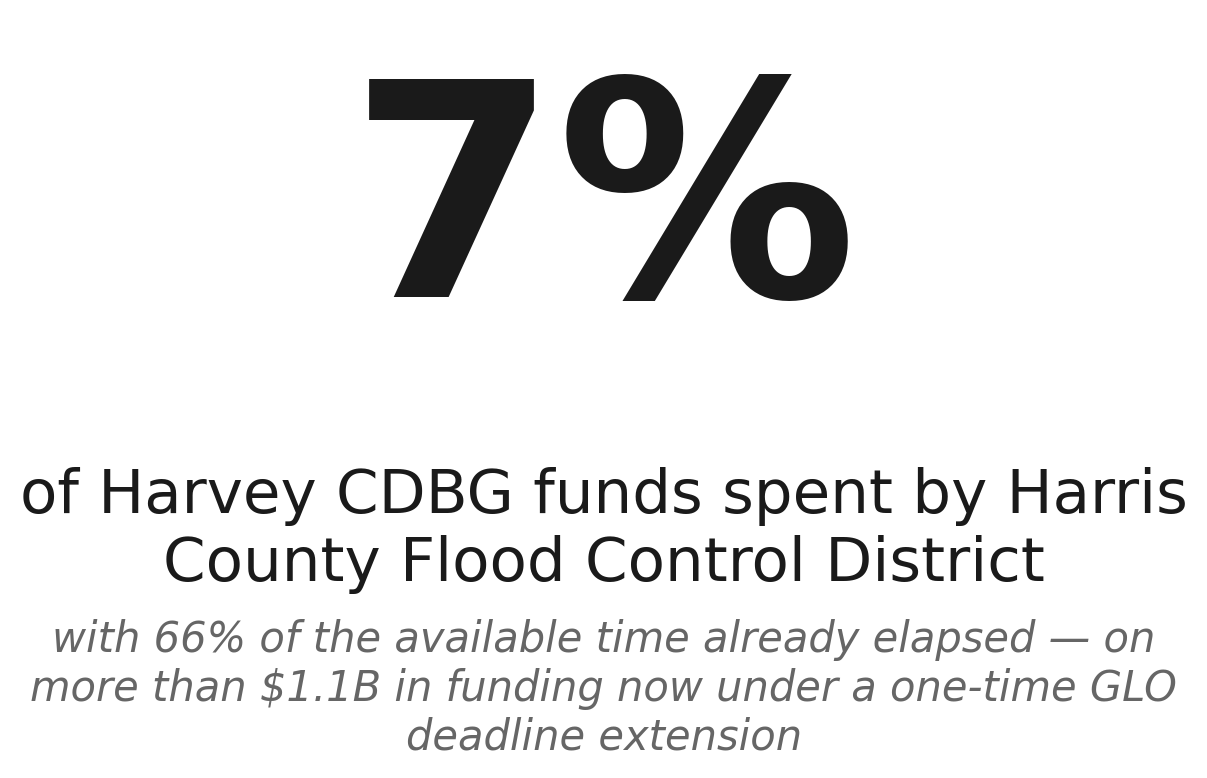
The scale of what's at stake is difficult to overstate. HUD allocated $5.67 billion in CDBG-DR and CDBG-MIT funds to Texas after Harvey, administered through the GLO. Harris County Flood Control District alone holds more than $1 billion in combined CDBG-DR and CDBG-MIT allocations. But according to HCFCD's own spending spreadsheet, the district has spent just 7% of its CDBG funds even though 66% of the available time has already elapsed. Buckingham's extension letter made clear that continued failure to hit benchmarks could result in remaining funding being withheld or expended money being recaptured, federal clawback language that landed hard on agencies watching their own timelines slip.
Source: NationGraph.
The two HUD programs in play here are related but distinct. CDBG-DR money is tied to specific Harvey-damaged communities and eligible for recovery infrastructure and housing rehabilitation; the extended deadline for Harris County's CDBG-DR contracts now runs to February 28, 2028. CDBG-MIT funds are for forward-looking flood-risk reduction, carry a slightly longer clock running to 2028 through 2032 depending on the contract, and come with their own HUD oversight rules. HCFCD is separately seeking an extension on its CDBG-MIT contracts, which expire in March 2028, and the district's own estimates suggest 11 of its 19 mitigation projects will miss even the extended schedule.
The October surge in RFP volume reflects both programs firing at once. The Galveston Housing Authority issued three solicitations under the GLO's CDBG-DRRP program for public housing rehabilitation. The City of Brazoria posted a CDBG-MIT procurement for drainage improvements. The City of Friendswood moved on disaster debris monitoring and logistics contracting. The Town of Refugio put out an equipment solicitation tied to Harvey FEMA funds. These are not large cities with deep procurement offices. The rush to issue compliant solicitations, qualify vendors, and award contracts before HUD deadlines is a real operational burden, which is part of why the money sat unspent for so long in the first place.
The GLO's history with these funds matters here. Texas has carried a slow-spending designation from HUD dating to 2020, and a 2022 HUD Office of Inspector General audit flagged significant oversight gaps in how the GLO administered CDBG-DR disbursements. The $4.3 billion in CDBG-MIT funds the GLO administers statewide has moved even more slowly than the recovery dollars, because mitigation projects, watershed studies, regional detention basins, drainage system overhauls, require longer planning horizons and more complex environmental review than repair work.
Layered on top of the Harvey deadline pressure is a separate, newer signal. FEMA's September 1, 2026, major disaster declaration (FEMA-4935-DR) covers 19 Texas counties hit by July 2026 storms, including Kerr, Uvalde, and Val Verde, and activates FEMA Public Assistance for emergency work and infrastructure repair. That program runs on a different clock, with different eligible uses and a different federal agency overseeing it. It is not driving the current RFP surge in any significant way, the October volume is a Harvey story, not a 2026 storm story, but it is seeding the early stages of a new, parallel procurement cycle that will build over the coming months.
For residents in the 49 Harvey-eligible counties, which account for roughly a third of Texas's population, the practical question is whether local agencies can actually execute what they're now committing to procure. Issuing an RFP is the easy part. Getting through bid evaluation, contract award, environmental clearance, and construction within the remaining window is where projects have historically stalled. The GLO's extension came with monitoring requirements and milestone benchmarks, not just a calendar adjustment.
The next pressure point arrives quickly. Harris County Flood Control District's CDBG-DR deadline, now extended to February 28, 2028, is the hardest constraint, and the district's own spending pace, 7% of funds drawn in 66% of elapsed time, suggests the math doesn't close without a dramatic acceleration. Commissioner Buckingham's office has said explicitly there will be no further extensions. That makes the next quarterly GLO spending reports, due in early 2027, the clearest signal of whether this procurement sprint is translating into actual construction, or whether hundreds of millions in Harvey money will ultimately flow back to Washington.