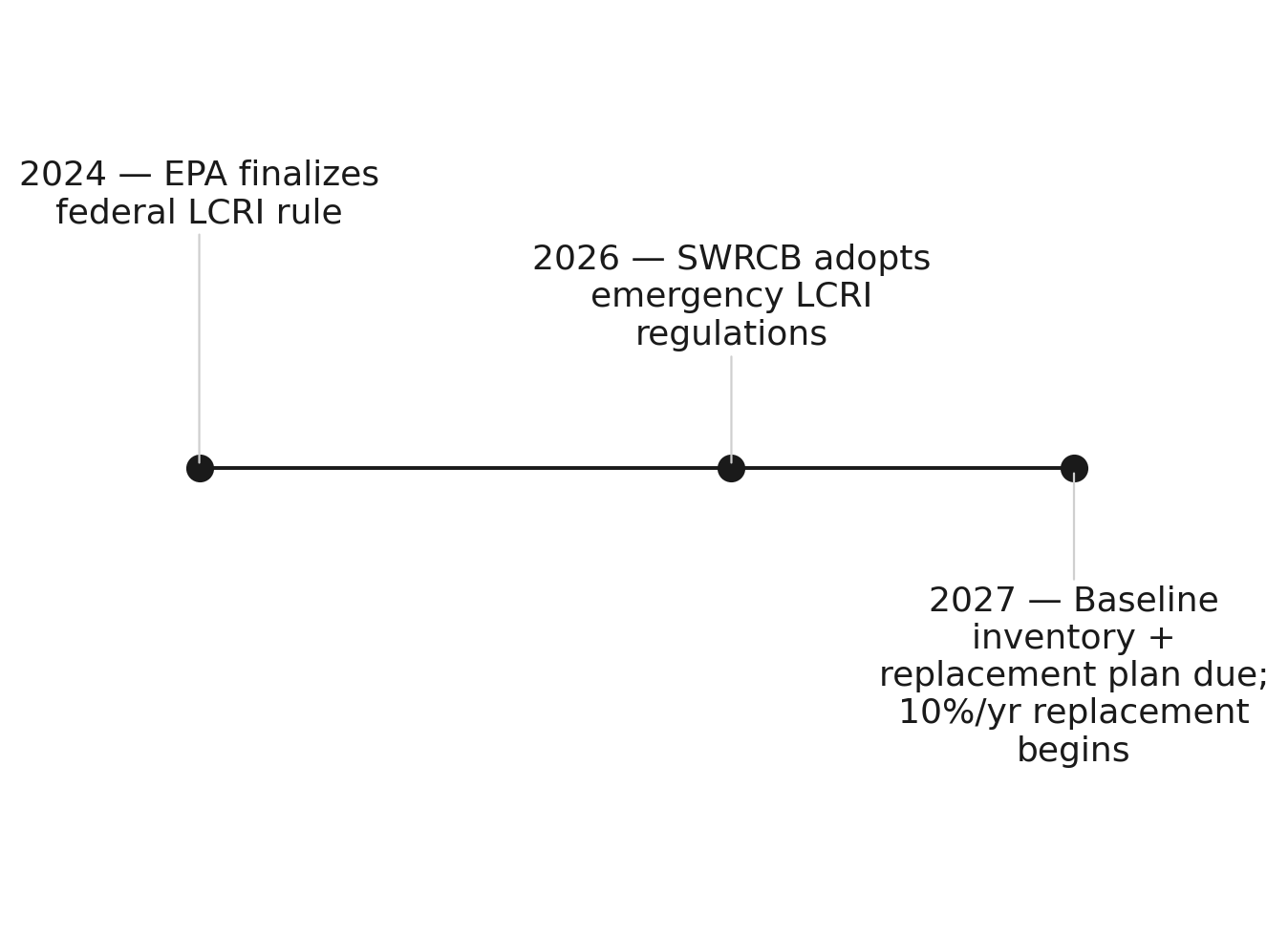
Lead service line replacement procurements in California have jumped to roughly four substantive contracts in October and November 2026 alone, against a monthly average closer to one or two over the prior year. The number matters less than the timing: every one of those procurements landed in the eight weeks after the State Water Resources Control Board adopted emergency regulations on August 19, 2026, converting the federal EPA's November 1, 2027 compliance deadline from a Washington obligation into an enforceable state mandate.
The regulation, designated SWRCB-DDW-26-001E, incorporates the EPA's Lead and Copper Rule Improvements (LCRI) into the California Code of Regulations. California pursued that emergency rulemaking pathway specifically to retain primacy, the legal authority to enforce the rule directly rather than cede that power to federal regulators. The SWRCB filed the regulation with the Office of Administrative Law on September 21, 2026, and the OAL review was still pending as of this writing. But water systems read the direction clearly: the state is in the enforcement seat now, and the clock runs to Sacramento.
The LCRI itself, finalized by EPA on October 8, 2024, set three hard deadlines for community water systems nationwide. By November 1, 2027, every system must submit a validated baseline service line inventory. By the same date, each must file a lead service line replacement plan. And beginning in 2027, systems must achieve a cumulative 10 percent annual replacement rate until every lead pipe is gone. A fourth deadline lands even sooner: by December 31, 2026, all customers served by lead, galvanized requiring replacement, or unknown-material service lines must receive annual notification.
Source: NationGraph.
That December notification requirement is what most immediately separates the prepared from the unprepared. Systems that never finished their initial inventories under the predecessor Lead and Copper Rule Revisions, which set an October 2024 inventory deadline, are now doubly exposed: they face Tier 2 and Tier 3 public notification requirements and must simultaneously accelerate inventory work to meet the 2027 plan submission. For those systems, the October–November procurement surge is not strategic planning. It is triage.
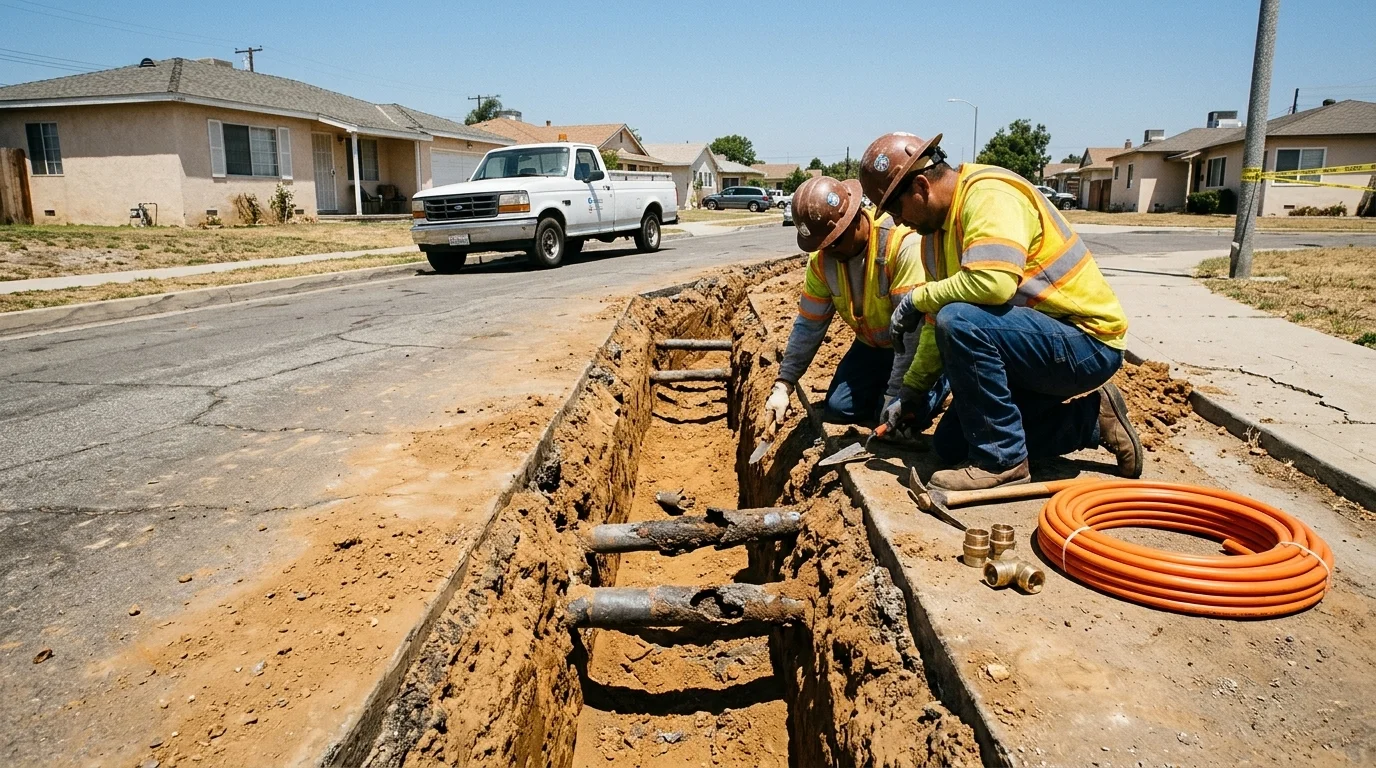
The agencies visible in recent procurements illustrate the range of that pressure. The City of Glendora issued an RFP for LSL inventory development, the foundational step every system must complete before it can file a compliant replacement plan. San Bernardino Municipal Water Department moved to procure service line replacement in the Muscoy service area, drawing on ARPA State and Local Fiscal Recovery Fund money that the department had already secured. The Santa Maria-Bonita School District put out a combined project covering both an 8,100-foot HDPE pipeline replacement and school-specific lead service line work. The City of Lodi, facing a different infrastructure profile, is pursuing granular activated carbon treatment for well water, an approach that addresses lead leaching through treatment rather than pipe removal.
The variation in those approaches reflects a real split across California's more than 400 large community water systems, plus hundreds of smaller ones. Older urban systems in Los Angeles, Oakland, Sacramento, and San Bernardino have aging infrastructure with confirmed or unknown lead service line populations and the organizational capacity to absorb a large procurement. Smaller systems in the Central Valley and rural areas often lack both the technical staff and the capital reserves to self-fund replacement.
The primary funding channel for those smaller systems is the EPA Drinking Water State Revolving Fund. California's SWRCB holds more than $600 million in active DWSRF federal grants from the FY2023 through FY2025 cohorts, administered as subsidized loans and principal forgiveness to individual water systems for lead replacement and other infrastructure work. Those sub-awards do not appear as direct grants to individual systems in federal spending databases, which means the financial footprint of California's lead pipe replacement effort is likely significantly undercounted in any grant-tracking analysis.
Layered on top of the federal mandate is California's AB 1096, a separate state law that requires community water systems to share lead sampling data collected under the LCRI, going beyond what EPA requires. AB 1096 does not add new replacement mandates, but it does add a transparency dimension: residents will be able to see which systems have lead lines and whether replacement is on schedule. That visibility adds political urgency to a regulatory one.
The next signal to watch is the OAL's approval of SWRCB-DDW-26-001E. Once that clears, the regulation takes immediate legal effect, and the SWRCB's Division of Drinking Water gains full enforcement authority. Systems that have not yet issued December 31 customer notifications or begun inventory validation will then be exposed to formal state enforcement action, not just a federal compliance gap. For water system managers across the state, the question is no longer whether to move. It is whether they started moving soon enough.