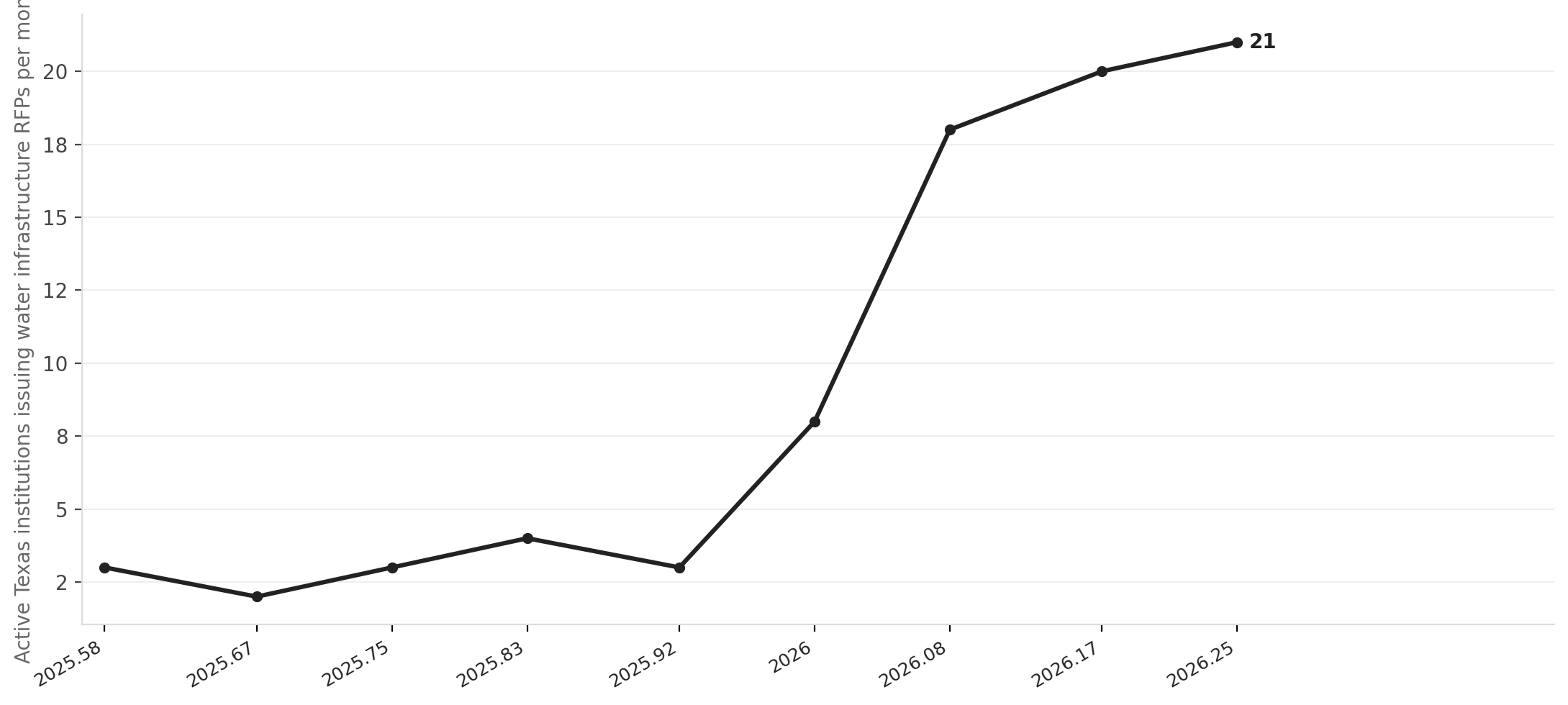
Sixteen Texas institutions issued a water infrastructure RFP for the first time in more than a year during the past 30 days, a burst of procurement activity that had no equivalent in any prior monthly window since last summer. The trigger is not a new pipe failure or a drought emergency. It is a calendar date: July 30, 2026, the hard application deadline for $1.038 billion in fully forgivable state grants administered by the Texas Water Development Board.
House Bill 500, passed during the 89th Texas Legislative Session and signed by Governor Greg Abbott, appropriated that amount to the TWDB Water Supply and Infrastructure Grant program with terms unlike anything the state has previously offered at this scale: 100 percent grant funding, no repayment required, and a use-it-or-lose-it commitment window that closes August 31, 2027. TWDB opened full applications in late March and early April 2026. On April 14, Governor Abbott publicly urged eligible entities to apply, and TWDB followed with implementation webinars on April 23 and May 13. The RFP data shows the response was almost immediate.
The shape of the activity is telling. From August through December 2025, only two to four Texas institutions per month were actively issuing water infrastructure procurement documents. That number climbed to 18 to 21 active institutions per month in February through April 2026, and 16 of those recent issuers had not touched a water infrastructure RFP in over a year. Texas now leads all large states in this category: 36 water infrastructure RFPs from 18 institutions in the trailing 30 days, compared to 23 RFPs from 13 institutions in California and 18 from 13 in Georgia.
Source: NationGraph.
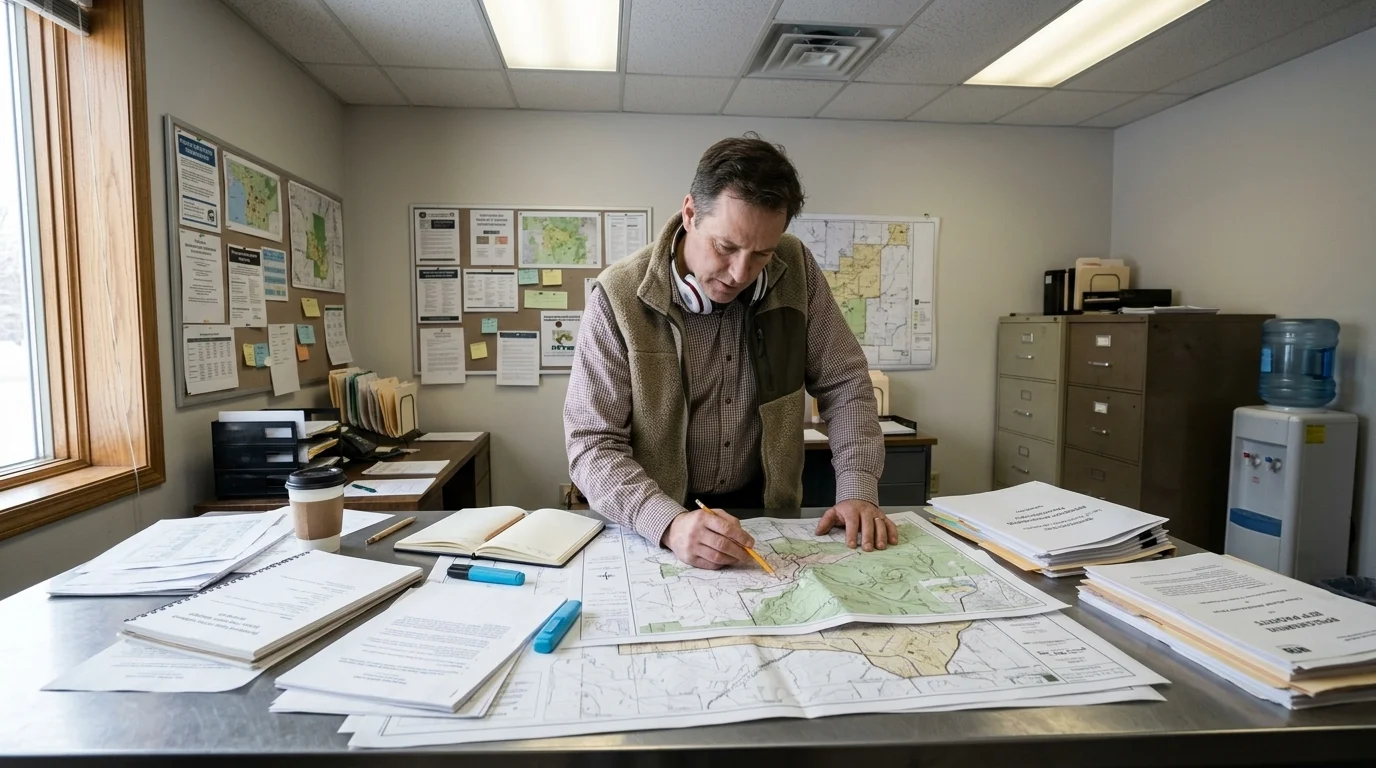
The reason small communities dominate this wave is structural. Towns like Nacogdoches (population 32,000), Mathis (population 4,300), and Troy (population 3,800) typically have no in-house engineering capacity. Before they can file a grant application with TWDB, they must first hire a consultant to prepare it, which means issuing a procurement document before they can do anything else. The City of Nacogdoches named this dynamic explicitly: its RFP is titled "Professional Services for TWDB Water Supply and Infrastructure Grants (WSIG)," the first water infrastructure solicitation the city has issued in more than 12 months. Mountain Peak Special Utility District in Midlothian, the City of Troy in Bell County, the City of Mathis in San Patricio County, and the Sabine River Authority of Texas are among the other identifiable first-time re-entrants from the same window.
The TWDB's WSIG program page describes the grant as available to political subdivisions for water supply projects, conservation measures, and infrastructure rehabilitation. Consulting firm ICF, which advises utilities on federal and state water programs, described the overall HB 500 rollout as "moving at breakneck speed." The East Texas Council of Governments circulated notices to member communities urging them to act before the deadline, a sign that regional intermediaries are helping smaller jurisdictions navigate the process.
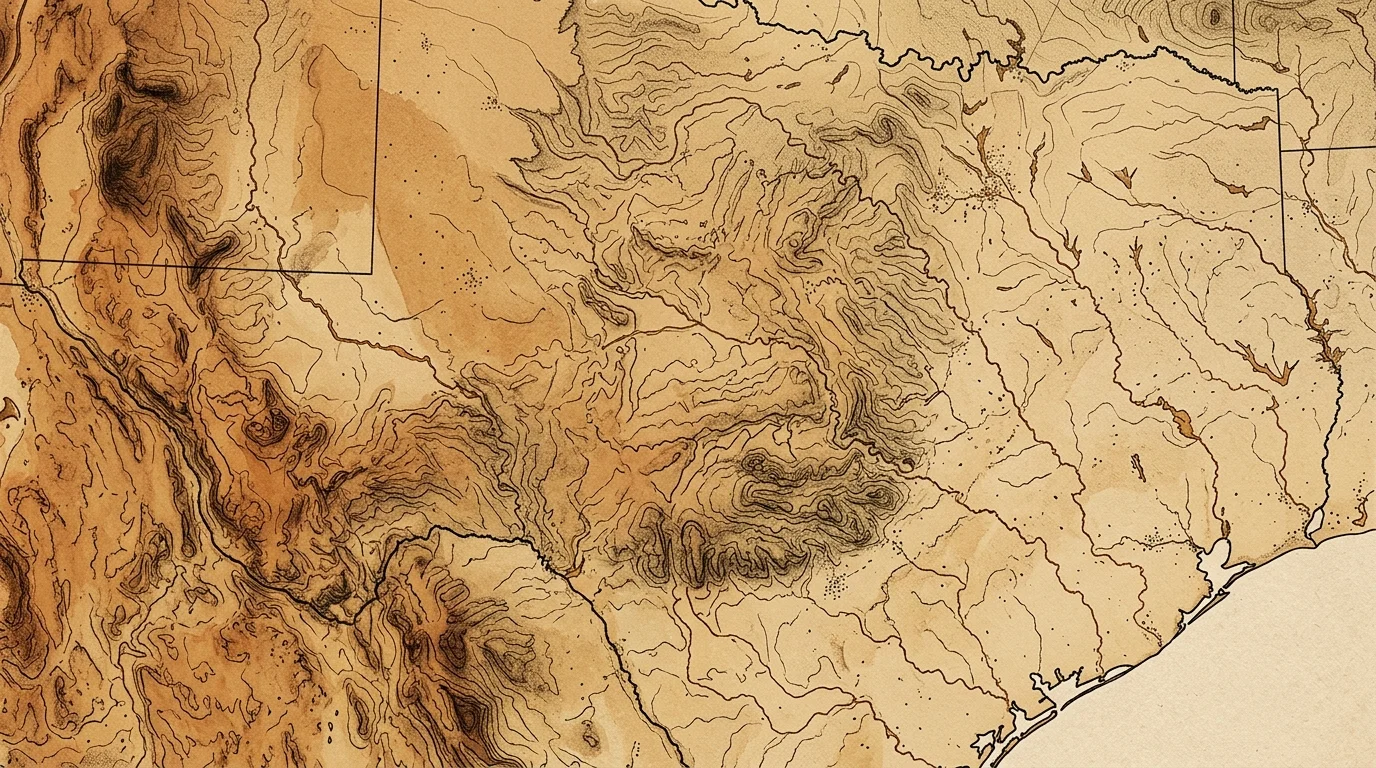
The federal backdrop adds further context. EPA currently holds $958 million in active drinking water and clean water revolving-fund grants obligated in Texas, with $144 million already outlaid. Abbott has framed HB 500 as part of a broader "$20 billion generational investment" in Texas water, alongside Senate Bill 7 (statewide water planning coordination) and Proposition 4, approved by Texas voters in November 2025, which dedicated a sales-tax revenue stream to the Texas Water Fund. The state's long-run pressure is real: the Texas State Water Plan projects a 3.4-million-acre-foot supply gap by 2070, a number that gives political durability to spending at this scale.
For residents of the communities now scrambling to file, the practical effect depends on whether their local government clears the procurement stage in time. A municipality that issues an RFP in late May, evaluates proposals through June, and executes a contract in early July still has a narrow path to a complete application by July 30. Communities that have not yet started that process are effectively out of this round. There is no signal from TWDB or the legislature that a second tranche at this funding level is coming.
The next signal to watch is how many of the 16 newly active institutions convert their RFPs into submitted applications before the deadline. TWDB is expected to announce awards later in 2026; the composition of that list will reveal whether the procurement scramble translated into delivered grants, or whether some communities moved too late to capture funds that will not come around again.