Minneapolis is moving to fund community doula services and birth justice programs, targeting one of Minnesota's most persistent racial inequities: the gap in who survives pregnancy and childbirth.
Black infants in Minnesota die at more than twice the rate of white infants, according to state Department of Health data. Black women nationally die from pregnancy-related causes at roughly 2.6 to 3 times the rate of white women, a gap that holds regardless of income or education. In Minneapolis, where roughly 19% of residents are Black and the city is also home to one of the largest Somali communities in the country and a significant urban Native American population, those numbers translate to real families.
The city's Health Department has posted a solicitation seeking organizations to deliver two related services: birth justice programming and community doula support. Community doulas are trained birth workers, typically from the same communities as their clients, who provide continuous support before, during and after labor. Research has linked doula-supported births to lower rates of cesarean sections, fewer preterm deliveries and higher rates of breastfeeding.
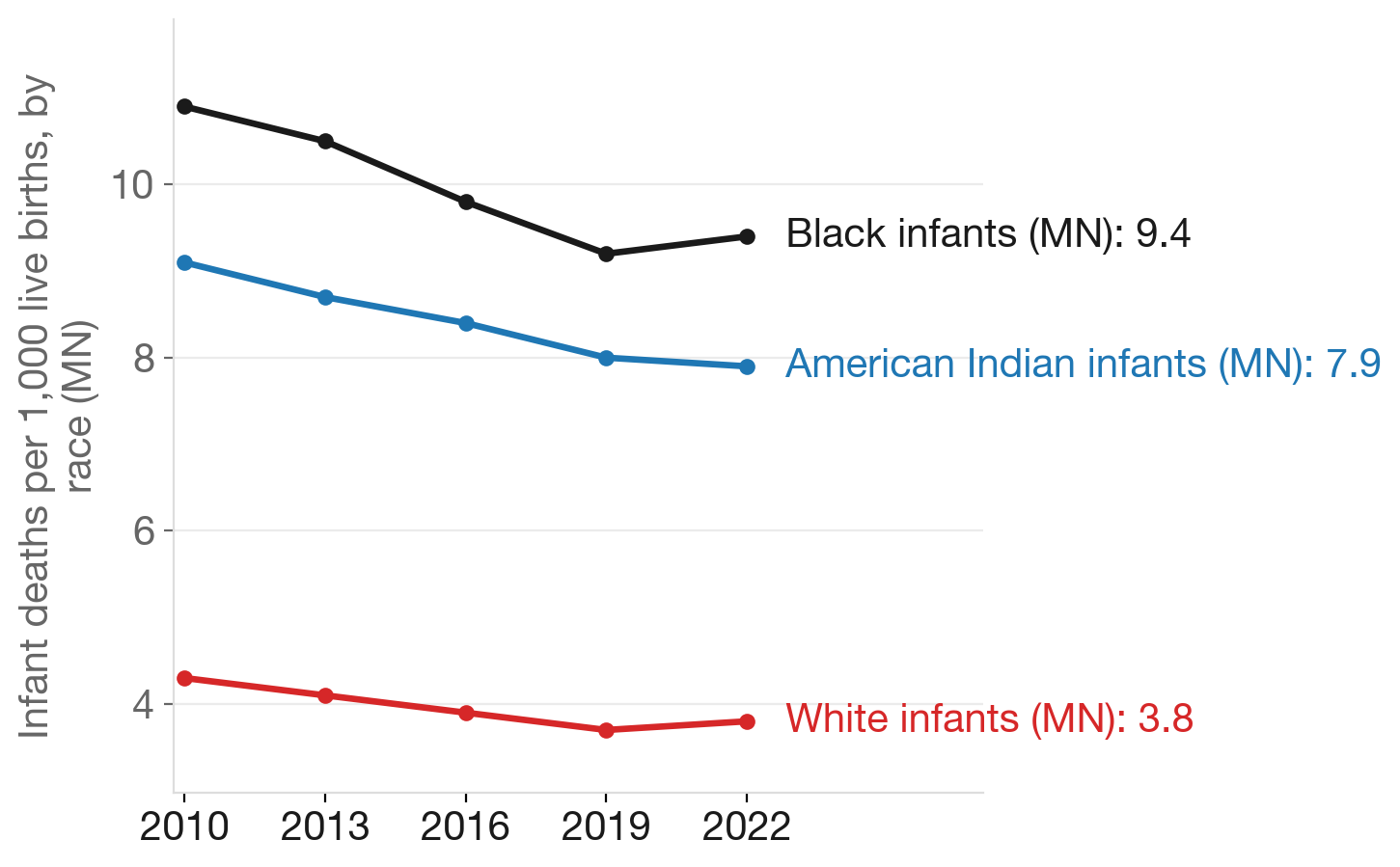
Source: NationGraph.
The initiative fits within the framework Minneapolis put in place after the July 2020 declaration that racism is a public health emergency, a policy shift that began routing health department dollars toward community-led, equity-focused work. Six years on, this is one of the more concrete tests of whether that commitment translates into sustained funding.
Minnesota has been ahead of most states on this issue. The legislature authorized Medicaid coverage for doula services back in 2013 and raised reimbursement rates as recently as 2023 after advocates argued the old rates were too low to keep community-based practices financially viable. Minneapolis's effort is designed to build a locally funded layer on top of that Medicaid infrastructure, reaching residents who fall through the gaps in state coverage.
Health Commissioner Damòn Chaplin, appointed in 2022, has emphasized contracting directly with community-based organizations. Groups like Everyday Miracles and Ancient Song have received prior city or state contracts for similar work, and Roots Community Birth Center, a Black-owned birth center in North Minneapolis, has become a hub for this kind of care in the city's most disinvested neighborhoods.
The contract value and duration were not specified in the solicitation. Organizations interested in providing services have until the deadline posted on the city's bid portal to respond.