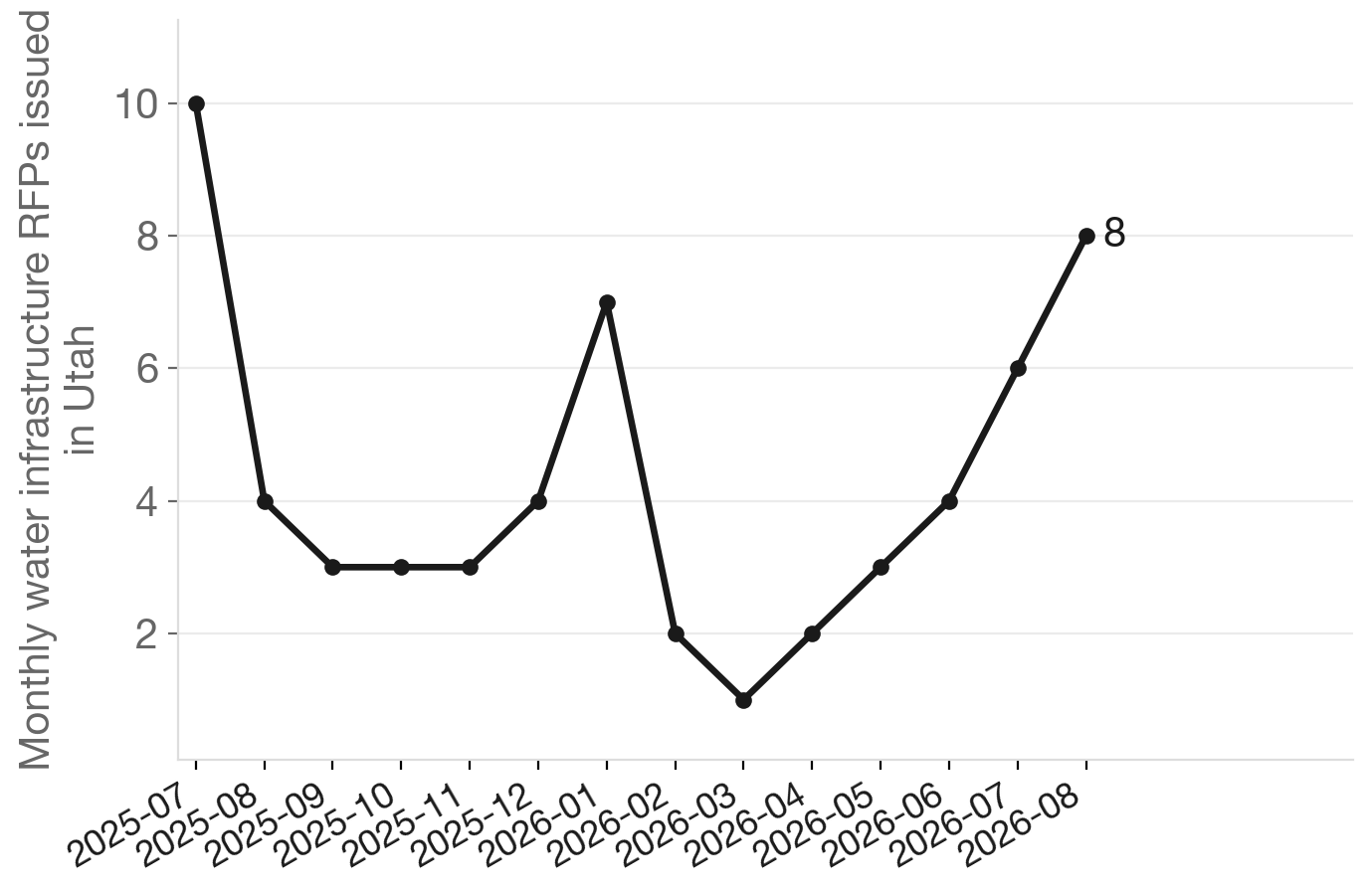
Eight water infrastructure RFPs have landed in Utah in the past 30 days, more than double the state's 12-month monthly average of roughly 3.4, and the largest of them tells you everything about how the state got here.
Weber Basin Water Conservancy District is seeking engineering firms to expand the Davis North Water Treatment Plant from 46 million gallons per day to 60 million gallons per day, with statements of qualifications due September 9. That is 14 million additional gallons of daily capacity for a system that serves Weber, Davis, Summit, Morgan, and Box Elder counties, five counties across northern Utah's Wasatch Front, home to hundreds of thousands of residents. The RFP is not a planning document. It is an admission that the infrastructure needed to serve the population that already lives here does not yet exist.
The immediate trigger is Gov. Spencer Cox's May 21, 2026 executive order declaring a statewide drought emergency. All 29 Utah counties entered severe or extreme drought after the state's snowpack peaked three weeks early at just 53 percent of normal, the lowest recorded level since 1930. That declaration activated the state's Emergency Operations Plan and opened federal funding pathways that have been sitting unused. It also gave water districts and municipalities the political cover to stop studying problems and start issuing contracts.
Source: NationGraph.
The federal money is substantial, though most of it has not yet moved. Utah currently holds 54 active EPA water grants totaling $225.6 million in commitments, with only $35.7 million disbursed so far. The Interior Department has 26 active water grants in the state totaling $101.2 million, including a $50 million Emergency Drought Relief grant to the Utah Department of Natural Resources running through 2031. On July 15, Senator John Curtis secured Senate Environment and Public Works Committee approval for an additional $40 million in federal water infrastructure funding for Utah, covering projects in Centerville and Ephraim, under the Water Resources Development Act. The money is there. The procurement volume suggests agencies are finally moving to spend it.
The current burst of RFPs is geographically broad, which matters. Summit County is replacing water lines in Park City. Sanpete County has issued an RFP for culinary water improvements in Holden. Iron County is moving on the Paragonah Water Improvement Project. Weber County, separately from the treatment plant expansion, is procuring secondary water metering in Marriott-Slaterville. These are not clustered in one crisis zone; they span the state's varied geography from the Wasatch Front to the rural south. That breadth is a signal that the drought declaration created system-wide urgency, not just localized panic.
The deeper story is structural. Utah depends on snowpack for roughly 95 percent of its water supply, making it more exposed than any other western state to warm winters. The 2026 drought arrives on top of a decade of Great Salt Lake decline, the 2026 legislature rushed through $30 million in emergency funding to acquire U.S. Magnesium's water rights on the lake, and sustained Wasatch Front population growth that has outpaced infrastructure investment. The state has committed more than $500 million in legislative water funding since 2021, but the draft 2026 State Water Plan released July 23 found that Utah's water providers still face a $1.2 billion annual infrastructure funding gap as the population grows. The emergency procurement happening right now is not supplementing a healthy system. It is catching up to one that was underbuilt before the drought began.
For residents across the Wasatch Front and rural Utah alike, the near-term consequence is construction: expanded treatment capacity, replaced distribution lines, new metering systems. Whether the projects deliver lasting resilience depends on whether this procurement cycle closes the gap or merely buys a few years of headroom before the next dry winter.
The signal to watch is the Weber Basin engineering award. If that contract moves to design and construction on schedule, it suggests the emergency framework is working, that unlocking federal dollars and political urgency actually accelerates large regional projects, not just small municipal fixes. Statements of qualifications are due September 9. What happens after that will say a great deal about whether Utah has found a mechanism for closing its infrastructure gap or simply found a faster way to queue up projects that will take years to complete.