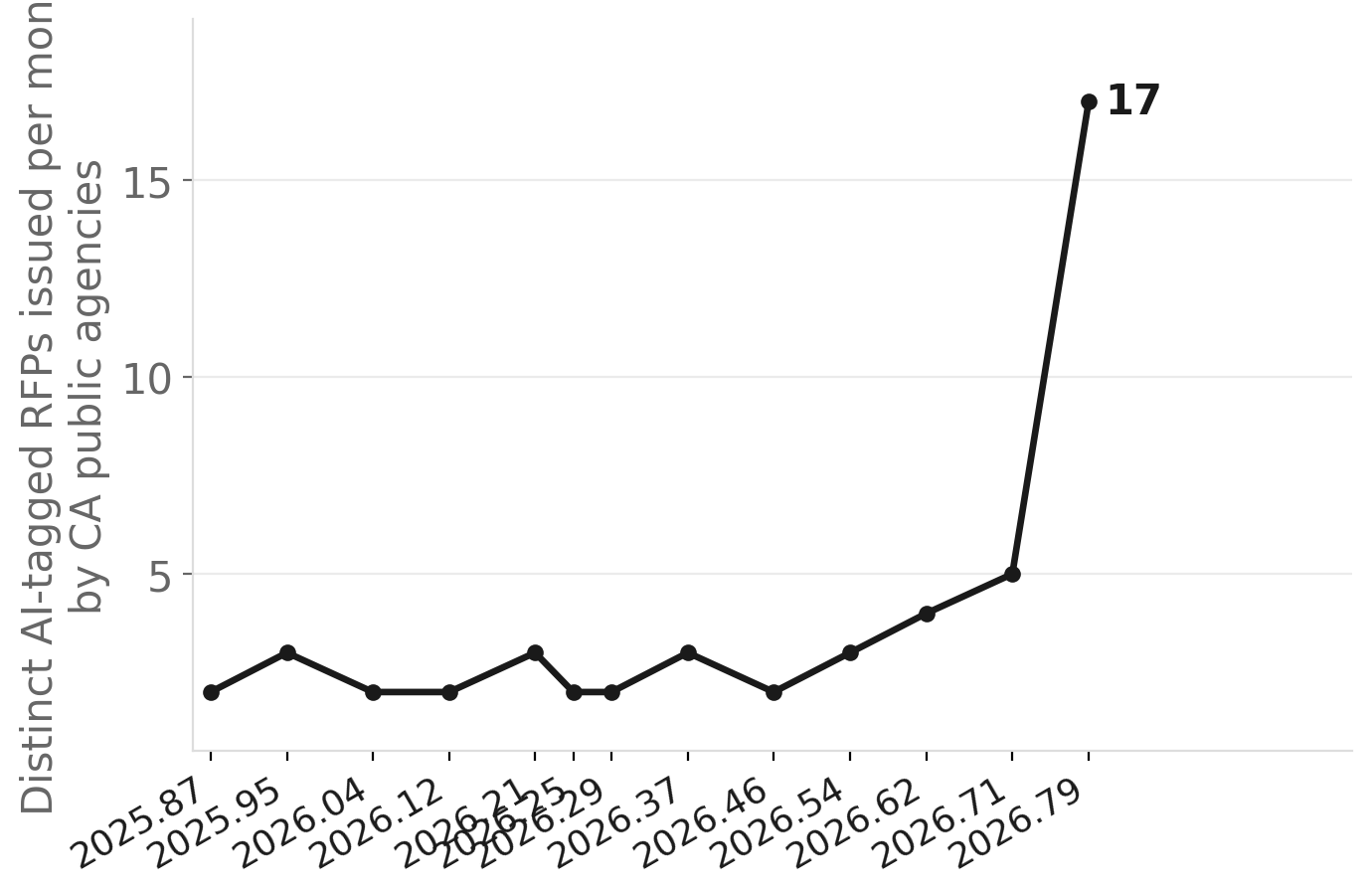
California public agencies issued 17 distinct AI-related solicitations in the past 30 days, 7.3 times the prior 12-month monthly average of about 2.3. The agencies span probation departments, public housing authorities, water utilities, retirement systems, wildfire detection programs, and smart city offices. That breadth is the signal: this is not one agency running an experiment. It is a sector-wide procurement scramble, and the deadline driving it is already in the rearview mirror.
The immediate cause is Executive Order N-5-26, signed by Governor Newsom on March 30, 2026, which directed every California state agency to develop AI vendor certification standards and begin integrating generative AI into operations. The order set a 120-day window for the Department of General Services and the California Department of Technology to submit certification recommendations, a deadline that matured in late July 2026. Agencies that want to sign contracts on their own terms have a narrowing window to issue RFPs before those certification standards harden into binding requirements.
But EO N-5-26 is only one layer of a regulatory stack that has been assembling for over a year. The Transparency in Frontier Artificial Intelligence Act (TFAIA, also known as SB 53), which took effect January 1, 2026 and was authored by Senator Scott Wiener, made California the first U.S. state to impose binding safety and transparency obligations on frontier AI developers, with penalties reaching $1 million per violation. The law does not govern agencies directly, it governs the vendors those agencies buy from. The practical effect is that any California agency procuring an AI tool must now independently verify that its vendor has met TFAIA's safety framework, transparency reporting, and incident-disclosure requirements before a contract can be signed. That vetting burden is new, and it has to be built into solicitation language from the start.
Source: NationGraph.
A third force is operating specifically within higher education. The California State University system's GenAI Advisory Committee issued a report in June 2026 recommending that AI disclosure requirements be embedded directly into RFP templates across all 23 campuses. The committee was co-chaired by CSU Long Beach's Director of Procurement Services, and its recommendations carry institutional weight: the CSU Chancellor's Office had already signed a $15 million OpenAI Enterprise Agreement for fiscal year 2025–26, signaling that the system is a large active buyer, not merely a policy actor. The CSU solicitations now appearing in the pipeline, including an AI platform for Clery Act compliance and an AI research evaluation RFP at Foothill College's Silicon Valley campus, reflect institutions moving from advisory framework to actual procurement.
These three policies are doing different things simultaneously. EO N-5-26 is a procurement directive aimed at agencies. TFAIA (SB 53) is a liability framework aimed at vendors. The CSU governance report is an institutional template recommendation aimed at a university system. None of them is the same program, and legal analysts tracking the order have noted that the certification regime they are collectively building will be more binding than anything currently operating at the federal level. EO N-5-26 explicitly authorizes California agencies to override federal supply chain restrictions on AI vendors, a provision that amounts to the state staking out independent procurement authority as Washington retreats from AI oversight.
The solicitations now in circulation reflect that layered pressure more than any unified enthusiasm for the technology. El Dorado County's probation department is seeking AI-enabled report generation. The Alameda City Housing Authority is procuring AI consulting. The Metropolitan Water District has issued an RFI on AI platforms. CalSTRS, the teacher retirement system, is soliciting generative business intelligence analytics. The City of Pasadena is evaluating early wildfire AI and thermal detection. San Jose has an open solicitation for AI and smart city systems. These agencies are not in the same industry, serve entirely different populations, and face different regulatory environments. What they share is the same compliance clock.
AB 2392, introduced in February 2026, would add a further layer of AI procurement standards specifically for postsecondary education. If it passes, CSU and UC system procurements will face additional disclosure requirements on top of those already embedded by the advisory committee's template recommendations, meaning the current wave of university RFPs may be the last issued under the lighter framework.
For vendors, the window to enter California's public-sector AI market without full TFAIA certification is effectively closed. For agencies still without an active solicitation, the practical question is whether waiting until DGS and CDT finalize certification standards later this year narrows their options or simply delays the same compliance work. The next indicator to watch is what the DGS and CDT certification recommendations actually require, and how many of the vendors named in current RFPs can clear them.