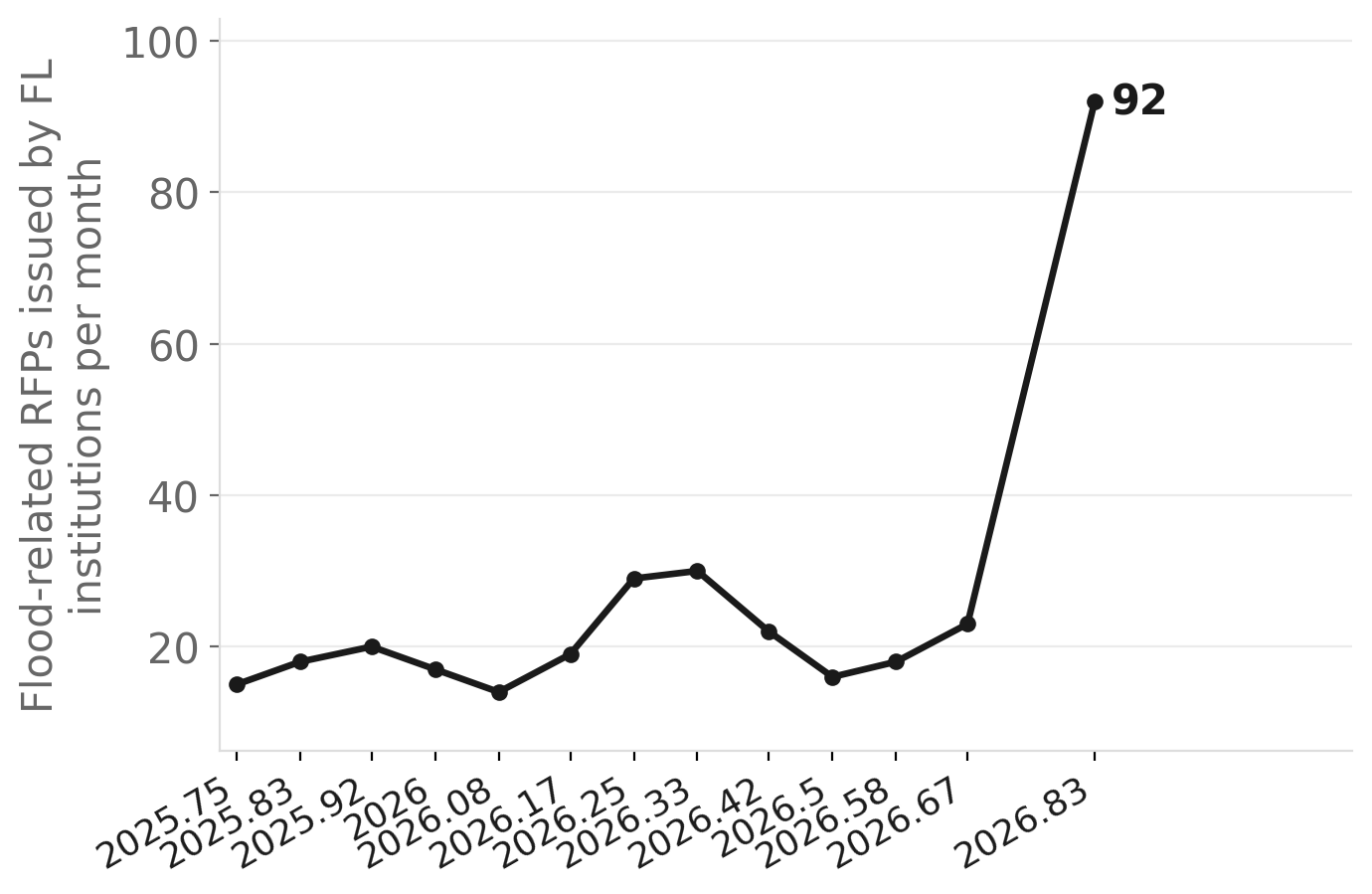
Florida flood-control procurement has surged to 92 requests for proposals in the last 30 days, nearly five times the 12-month monthly average of 18.7. The spike is not a policy shift or a new appropriation. It is the simultaneous release of roughly $4 billion in federal Community Development Block Grant Disaster Recovery funds that have been locked in administrative review since January 2025.
The money traces back to four federally declared disasters in 13 months: Hurricane Idalia in August 2023, Debby in August 2024, Helene in September 2024, and Milton in October 2024. Congress responded with the Disaster Relief Supplemental Appropriations Act, 2025 (Public Law 118-158, signed December 21, 2024), which appropriated more than $12 billion nationally for those disasters. HUD allocated more than $4 billion of that to Florida entities on January 7-16, 2025. As a HUD compliance summary noted at the time, Florida was the largest single-state recipient in the round.
But CDBG-DR funds do not flow on announcement day. Each grantee must develop a full action plan, publish it for a 30-day public comment period, submit it to HUD, and then wait up to 45 days for HUD to execute a grant agreement before a single dollar can be spent on contracts. For counties that had never previously managed a direct CDBG-DR allocation at this scale, the ramp-up required standing up entirely new program-management infrastructure first. Pinellas County, which received $813.8 million, contracted with program managers and received HUD action-plan approval in July 2025. Hillsborough County, with $709.3 million, received its approval in August 2025 and its executed grant agreement in January 2026, with the county commission approving seven infrastructure projects the following month. Lee County's most recent action-plan amendment cleared HUD in May 2026.
Source: NationGraph.
That sequencing, 12 to 18 months from announcement to contracts-ready status, explains precisely why the RFP surge lands in October 2026 and not in early 2025 when the headlines ran. The gates did not open gradually. They opened at roughly the same moment across most of Florida's largest grantees, because most of them spent the same calendar year navigating the same federal approval pipeline.
The geography of the spike matches the geography of the allocations almost exactly. Volusia County, which received $133.5 million, leads with 13 flood-related RFPs in the trailing 30 days. Lee County, at $100.7 million, has issued 12. Broward has issued 10. Pinellas, Pasco, Manatee, and Hillsborough round out the list. The RFPs themselves span the full recovery and resilience spectrum: watershed basin modeling, stormwater backflow preventors, home elevation, roadway elevation, drainwell replacement, pump station design, and CDBG-DR grant administration services. Hillsborough is channeling roughly half of its $709 million toward stormwater channels, culverts, pump stations, and wastewater lift stations, according to reporting on the county's grant program.
The procurement complexity is compounding the urgency. Federal procurement rules attach to every CDBG-DR contract: Davis-Bacon prevailing-wage requirements, Buy America/Build America material sourcing provisions, and a mandate that at least 70 percent of program benefits flow to low-to-moderate-income residents. Manatee County staff have explicitly warned that these requirements are slowing some procurements and concentrating contracts toward engineering firms with prior federal compliance experience. That is one reason the Florida Department of Commerce's Office of Long-Term Resiliency has emphasized technical assistance for smaller sub-grantees navigating the rules for the first time.
The use-it-or-lose-it pressure is real. Federal obligations recorded in grant databases show $2.81 billion in CDBG-DR funds tied to Florida entities with performance periods running through 2031. That sounds like a long runway, but CDBG-DR programs have historically faced clawback risk when grantees fail to maintain adequate procurement velocity. Counties that spent 2025 writing action plans spent none of that time building contractor pipelines, meaning the procurement surge and contractor competition are arriving together.
For residents of the counties involved, the practical signal is that flood infrastructure projects that were announced and then went quiet should begin entering active design and construction contracting phases through early 2027. Home-elevation programs, which require individual applicant intake in addition to contractor procurement, are likely to move more slowly than infrastructure RFPs.
The next observable signal is contract award velocity. Issuing 92 RFPs in a month is one thing; closing them on compliant federal timelines while managing Davis-Bacon audits and environmental reviews is another. How many of those RFPs produce executed contracts before the end of Q1 2027 will determine whether the procurement wave translates into construction activity or stalls again in a second administrative bottleneck.