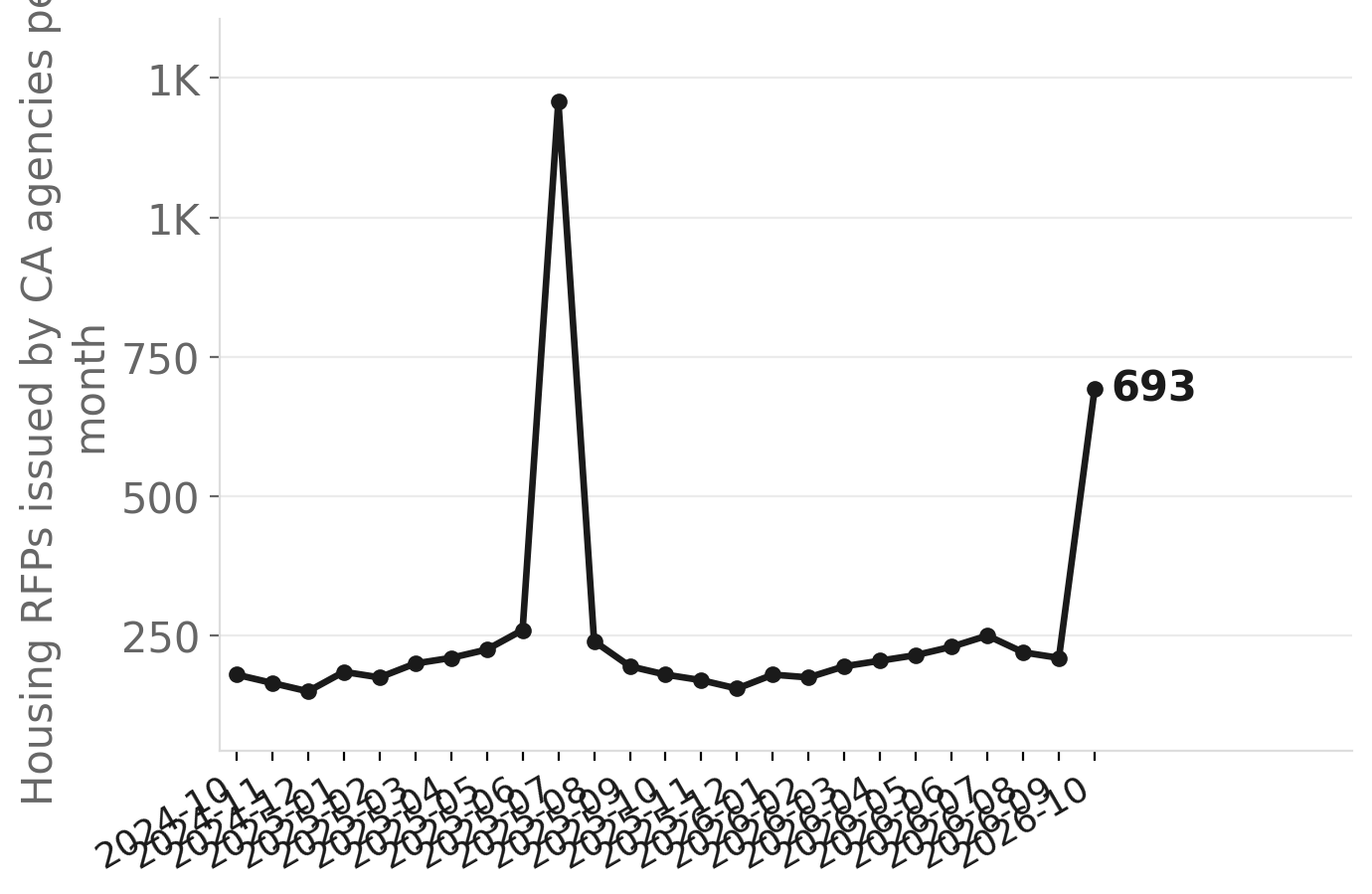
California local governments have issued 693 housing-related RFPs in October 2026 alone, a figure 3.7 times the trailing 12-month average of roughly 192 per month. That spike is not a sign of a new political appetite for housing. It is the procurement signature of governments that can no longer afford to wait.
Three distinct enforcement mechanisms converged this fall, each generating its own wave of contracting obligations. Individually, any one of them would have produced a busy quarter for housing consultants. Together, they have created the second-largest monthly RFP count in at least two years, trailing only July 2025 (1,208 RFPs), which also coincided with a state housing law implementation cycle.
The first pressure came from SB 79, the Abundant and Affordable Homes Near Transit Act, which took effect July 1, 2026. The law overrides local zoning to allow multifamily housing by right within a half-mile of qualifying transit stops across eight urban California counties, and requires cities to begin processing qualifying projects immediately. As Holland and Knight's summary of California's 2026 housing laws notes, SB 79 demands affirmative implementation steps from cities that lack the planning staff to execute them internally. Los Angeles, with a full legal department, has invoked every delay mechanism available, deferring full SB 79 compliance to roughly 2030. Most cities do not have that option. They are issuing RFPs for transit-oriented specific plan updates, zoning code rewrites, and implementation consulting.
Source: NationGraph.
The second pressure is litigation. Governor Newsom issued final warnings to 15 noncompliant Housing Element jurisdictions on March 25, 2026, and the Newsom administration filed suit against five cities on July 16, 2026, Calexico, Costa Mesa, Half Moon Bay, Ridgecrest, and Turlock, all prior recipients of those warnings. The financial cost of defiance is no longer theoretical: a Superior Court judge ordered Huntington Beach to pay $160,000 in penalties in May 2026, with fines continuing at $50,000 per month. HCD Director Gustavo Velasquez has been the named enforcement voice throughout, and his agency has made clear that noncompliant jurisdictions lose eligibility for state grant programs including the Permanent Local Housing Allocation and the Infill Infrastructure Grant. For most cities, those programs are not optional revenue. That combination of litigation risk and grant ineligibility has converted what was once a slow-moving political negotiation into a procurement emergency.
The third pressure is the calendar. CDBG and HOME Investment Partnerships Program funds are federal block grants that follow an annual program-year cycle, and Q4 is when procurement obligations regularly land. FY2026 CDBG funding stands at $3.1 to $3.3 billion nationally. Los Angeles receives $47 million directly, triggering its own action plan contracting cycle, while California's non-entitlement pool carries $29.4 million administered through HCD. HOME adds a separate stream. Neither program is driven by enforcement; both are driven by federal administrative calendars that require cities to demonstrate they have plans to spend what they've been allocated. The result is an annual RFP cluster in the fall that, in 2026, landed directly on top of the SB 79 and Housing Element surges.
The geographic spread of October's RFPs confirms this is a systemic activation rather than a single large agency running a procurement cycle. San Rafael issued 33 RFPs, Hemet 17, San Jose 12, CA HCD 12, and the Alameda Housing Authority 9. The San Gabriel Valley Council of Governments contributed 7. County-level agencies in Sacramento, Shasta, San Bernardino, and Merced are all active. The RFP types span CDBG and HOME program administration, affordable housing development, behavioral health bridge housing, voucher inspection services, and transit-oriented specific plan updates. That breadth of contract type, across that breadth of geography, is the signature of multiple policy mechanisms activating at once.
On the federal funding side, $237 million in new federal housing grant commitments to California started in the past 90 days across 484 grants, with HUD leading at $176 million. That sits on top of an active HUD housing grant portfolio of $4.0 billion obligated statewide, with $1.0 billion already outlayed. Those dollars require program administrators, inspectors, compliance officers, and in many cases, new software and reporting infrastructure. AB 1007, also effective in 2026, shortens permitting timelines from 90 to 45 days, adding another layer of administrative contracts cities need to execute before the shorter clock starts running against them.
What changes for someone living in a California city subject to these pressures is, for now, mostly administrative. The RFP surge is a leading indicator: consultants get hired before plans get updated, plans get certified before projects get approved, and projects get approved before units get built. The state's housing shortage is estimated at 2.5 million units, and no volume of procurement activity closes that gap in a single quarter. But the procurement surge does tell you something about where cities' political calculus has shifted. The cost of inaction has become legally and financially quantifiable in a way it was not two years ago.
The next signal to watch is how many of the five sued cities reach compliance agreements before their cases go to judgment, and whether a second round of AG lawsuits follows the next HCD compliance review cycle. If October's RFP count holds through November, it will mark the most sustained procurement surge California housing agencies have seen in the current RHNA cycle.