Public agencies issued 396 electric vehicle procurement solicitations in October 2026, roughly five times the trailing 12-month monthly average of 77, the highest single-month count on record in NationGraph's procurement database. The institutions behind those RFPs span 373 agencies across 35 states, more than three times the bimonthly average of 106, and the surge cuts across charging infrastructure, fleet replacement, and electric buses and trucks simultaneously.
The catalyst is not enthusiasm. It is fear.
In February 2026, Congress enacted the Consolidated Appropriations Act (P.L. 119-75), which clawed back approximately $879 million in unobligated NEVI formula and discretionary funds, distributing the cuts proportionally to states that had moved slowly. Nevada lost roughly $12.6 million, about a third of its original allocation, because it had not yet committed the money. Every procurement officer in the country received the same memo: unobligated dollars vanish. According to an Eno Transportation Foundation analysis of Washington v. U.S. DOT, the court ruling that preceded the clawback by ten days had permanently barred the Trump administration from withholding NEVI funds, restoring states' legal authority to spend, and then Congress immediately demonstrated the cost of not doing so.
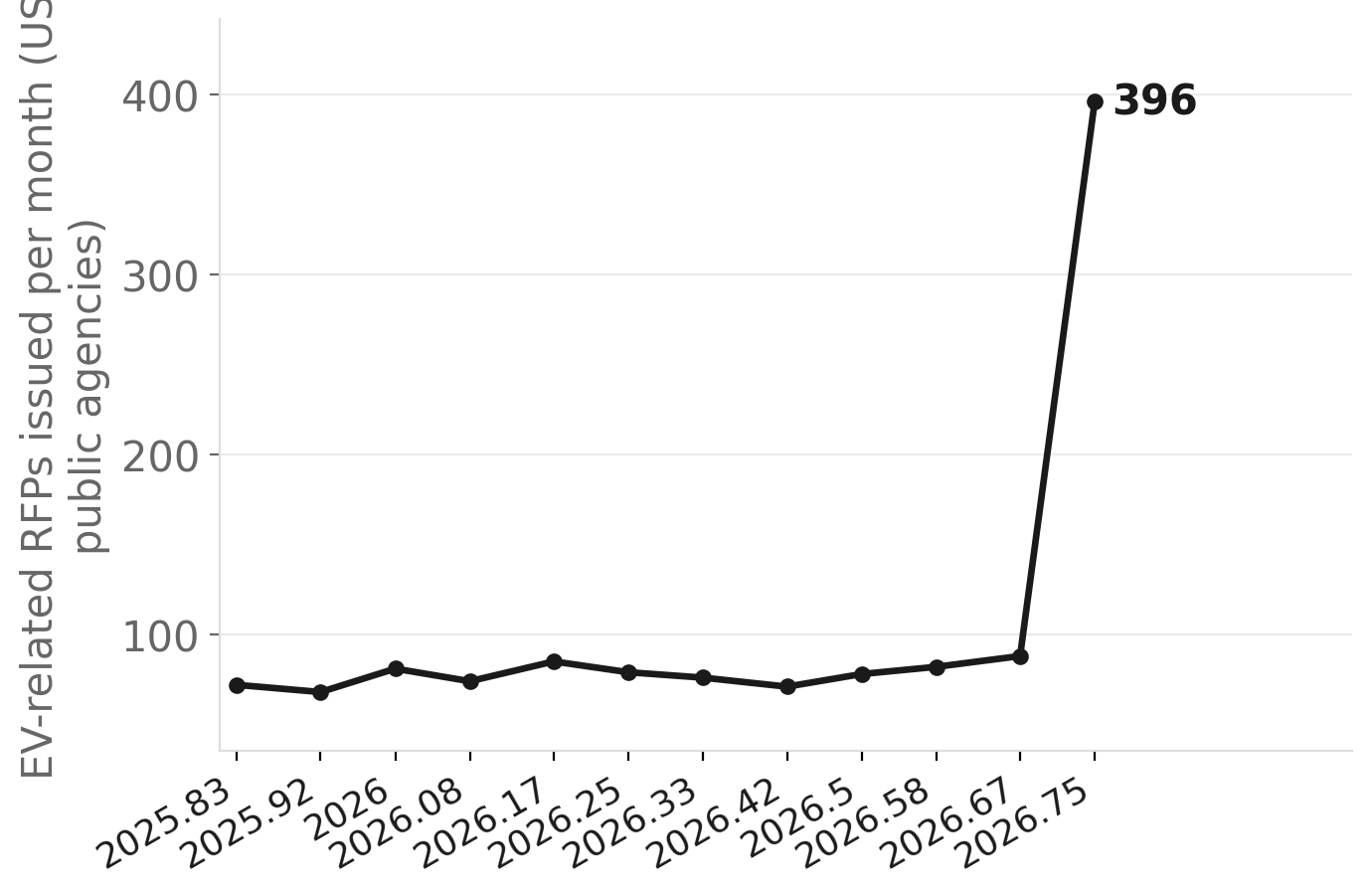
Source: NationGraph.
That sequence, a court order opening the spigot followed almost immediately by Congress draining part of the reservoir, created the sharpest procurement incentive the program has ever produced. States with approved FY2026 NEVI plans now face a further pressure: the House surface-transportation reauthorization bill, which advanced 62-2 in May 2026, would not renew NEVI as a standalone program after September 30, adding what amounts to a terminal deadline for the current funding structure.
The procurement surge is geographically diffuse but heavily concentrated in states that had the most to lose. California leads with 95 institutions active in the last 60 days, followed by Washington (28), New York (24), Illinois (22), and Florida and Massachusetts (16 each). These are precisely the states sitting on large unobligated NEVI balances, and, in several cases, the same states whose attorneys general joined the multistate lawsuit that restored frozen funds in January. Federal DOT EV grant obligations over the last 18 months total $3.29 billion, with California leading at $667 million, followed by Connecticut at $362 million, Florida at $276 million, Illinois at $182 million, and New York at $163 million.
California's October spike has a specific trigger beyond the NEVI panic: the state's NEVI Solicitation 6 (GFO-25-603), a $79 million federal grant opportunity for publicly accessible DC fast chargers along southern California highway corridors, carried a deadline extended to October 16, 2026. That single solicitation pulled scores of institutions into the procurement pipeline simultaneously. It is one of the clearest illustrations of how deadline architecture, not general EV sentiment, is producing the numbers.
The fleet electrification piece runs on a different legal track entirely. California's Advanced Clean Fleets regulation, maintained by CARB without requiring a federal waiver, mandates that state and local government fleets begin purchasing zero-emission vehicles on defined timelines. The 100 percent medium- and heavy-duty deadline arrives in December 2027. Washington State Executive Order 21-04 separately requires 40 percent of the state's light-duty fleet to be battery-electric by 2025 and 75 percent by 2030. These instruments share an outcome with NEVI, more EV procurement, but operate through entirely different legal authorities. The 42 fleet-electrification and electric-bus RFPs in October reflect compliance pressure from those mandates, not federal grant timing. The two forces are parallel accelerants, not the same program.
As NationGraph reported in May, Ohio cities were already feeling this pressure at the municipal level, trying to lock in charging funds before another federal freeze became possible. October's national numbers confirm that the dynamic Ohio illustrated is now operating at scale across the country.
For residents, the practical consequence is a substantial build-out of publicly accessible fast chargers along major corridors in the coming 18 to 24 months, particularly in states that are moving quickly. The 195 charging-infrastructure RFPs in October's count represent real construction contracts that will eventually become physical stations. States that obligated before the February clawback kept their full allocations; states that did not have less to spend and fewer sites to build.
The open question is what happens when the current NEVI authorization expires. If the House reauthorization bill clears the Senate without a renewed NEVI provision, the federal formula-grant framework that created this entire procurement cycle ends. What remains is a patchwork of state mandates, state-level grant programs, and whatever obligations agencies managed to lock in before the deadline. The October surge may be, in part, institutions betting that this window does not reopen.