New federal water infrastructure grants committed to Colorado over the past 90 days total $10.3 million, down 63% from $27.7 million in the same window a year ago. Strip out a $9.4 million airport grant that matched on keyword alone, and the genuine water commitment for the period falls below $1 million. For a state that sits at the headwaters of a river supplying 40 million people, the numbers describe something close to a funding standstill.
The collapse is not a signal that Colorado's water problems are solved. It is the product of two compounding forces arriving at the same moment.
The first is structural. The Infrastructure Investment and Jobs Act authorized $50 billion over five years for water infrastructure, channeled primarily through EPA's Drinking Water and Clean Water State Revolving Funds. FY2026 is the fifth and final year of that authorization, and it expires September 30, 2026. The large annual capitalization grants that drove last year's baseline, including a $43.6 million DWSRF commitment and a $19.7 million CWSRF commitment to the Colorado Water Resources and Power Development Authority in October 2024, were one-time annual tranches. They are not being replicated in the current window. As the IIJA authorization deadline approaches, no reauthorization legislation has been introduced in Congress, and the post-September landscape is structurally uncertain in a way it has not been since before the 2021 law passed.
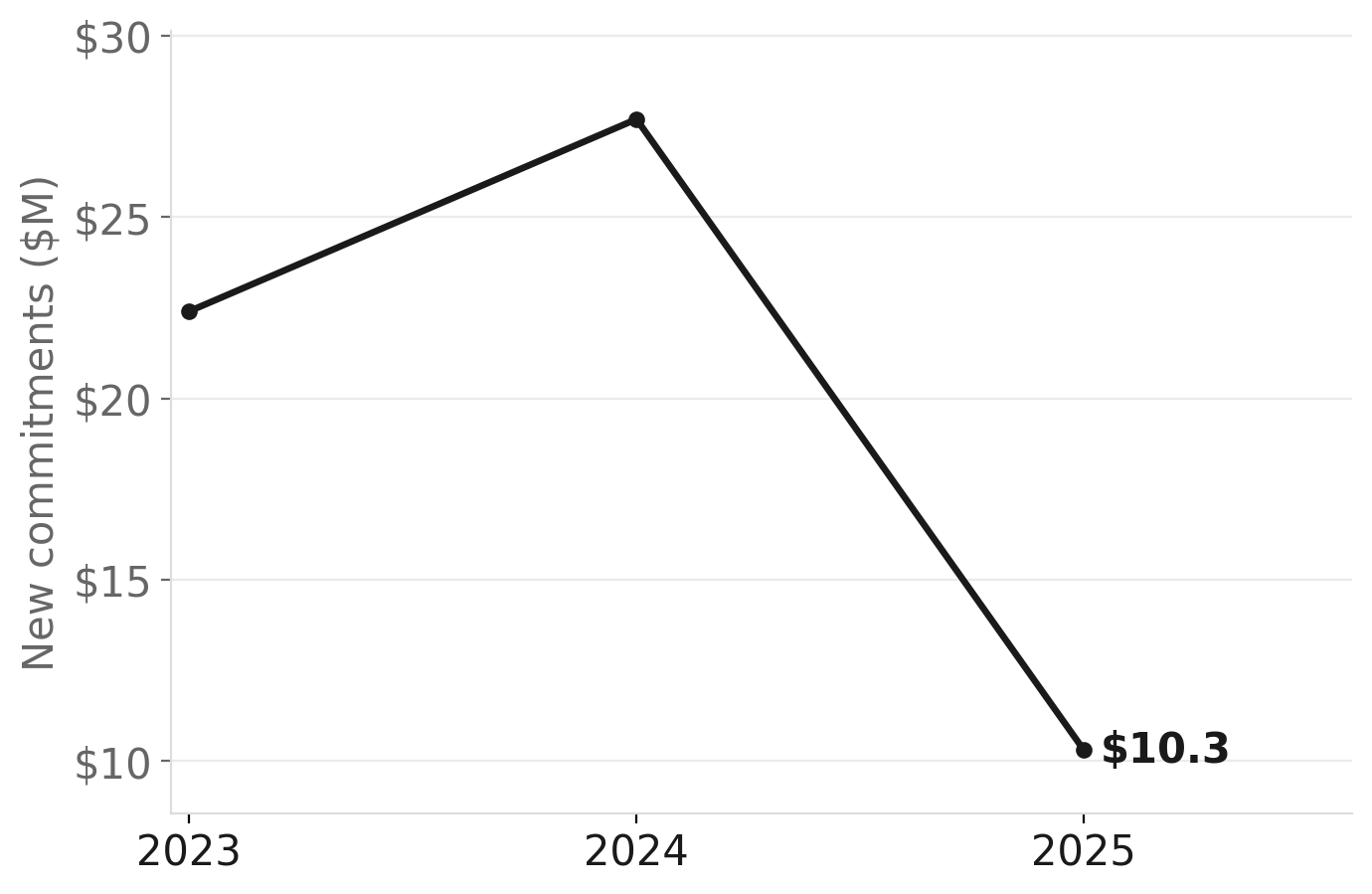
Source: NationGraph.
The second force is political. On January 17, 2025, the outgoing Biden administration awarded $152 million in Bureau of Reclamation IRA grants to 17 Colorado drought and water resilience projects across the Upper Colorado River Basin. Three days later, a Trump executive order froze them. Sixteen months of bipartisan pressure followed, including a letter from Colorado's entire congressional delegation demanding release of $140 million in frozen water funds. As of mid-May 2026, only about $47 million had been released. Roughly $92 million in Bureau of Reclamation IRA drought grants, awarded through a separate competitive program from the IIJA's SRF pipeline, remains frozen.
These are not the same pot of money, and the distinction matters. The IIJA SRF capitalization grants flow annually from EPA through the state revolving fund, which re-lends capital at low interest to municipalities for drinking water and wastewater projects. The IRA Bureau of Reclamation drought grants are direct, project-level competitive awards to water districts and tribes for specific conservation and efficiency work. WaterSMART, a third program proposed for elimination in the Trump administration's FY2027 budget, is a separate Bureau of Reclamation authority that has delivered $72 million to Colorado projects since 2010. All three are federal grants; all three are in trouble; and they are failing through different mechanisms for different reasons.
The paradox sitting underneath all of this is that Colorado actually holds one of the richest active federal water portfolios in the West. Ninety-four currently running federal water-related grants carry $683 million in committed funding. Only $154 million of that has been disbursed. Colorado's Department of Public Health and Environment reported in January 2026 that the state had already distributed more than $300 million to over 60 communities through the IIJA SRF cycle and expected a total of $560 million through 2026. The money is real and the projects are underway. What is closing is the intake valve: the pipeline of new commitments has effectively gone dry even as the existing portfolio continues to disburse.
Nationally, IIJA water project award volumes in the first half of 2025 ran 53% below the same period in 2024, driven by executive orders, EPA staffing reductions, and regulatory uncertainty. Colorado's drop is steeper, in part because its prior-year baseline was unusually high: the $43.6 million DWSRF tranche and a $129 million IRA Climate Pollution Reduction Grant to the Colorado Energy Office both landed in October 2024, inflating the comparison window.
The question for Western Slope communities in particular is what comes next. Those communities depend most heavily on the Bureau of Reclamation drought and conservation grants now frozen under the IRA order. The Trump FY2027 budget proposes cutting Clean and Drinking Water SRFs by roughly 79 to 90 percent against IIJA-elevated levels and eliminating WaterSMART entirely. Congress rejected the deepest FY2026 proposed cuts, funding the CWSRF at $746 million, but the post-IIJA baseline will be structurally lower even in a favorable congressional outcome. Colorado has no large-scale state bond program positioned to absorb the gap.
The clearest near-term signal will come from two directions: whether Congress introduces any IIJA reauthorization language before the September 30 deadline, and whether the remaining $92 million in frozen Bureau of Reclamation IRA grants moves before the administration's posture on IRA-funded programs hardens further into the FY2027 budget cycle. For the 60-plus Colorado communities mid-project on IIJA SRF work, the existing commitments will carry them through. For the next round of projects, the funding source does not yet exist.