Federal water infrastructure grants flowing to Washington state have collapsed to $10.2 million in the last 90 days, down 73 percent from $37.7 million in the same window a year ago. The state received just four awards in that period, none of them from the EPA, the agency that historically anchors Washington's water funding.
The drop is starker when viewed against the peaks that preceded it. In the second quarter of 2024, Washington pulled in roughly $160 million in federal water infrastructure commitments, driven by front-loaded IIJA capitalization grants. A third-quarter 2025 spike reached $144 million, anchored by a single $22 million NOAA Pacific Coastal Salmon Recovery grant to the state's Recreation and Conservation Office. In the current 90-day window, that number has fallen to $2.4 million in new Q3 2026 awards.
Two distinct forces are converging to produce this trough, and they should not be confused with each other.
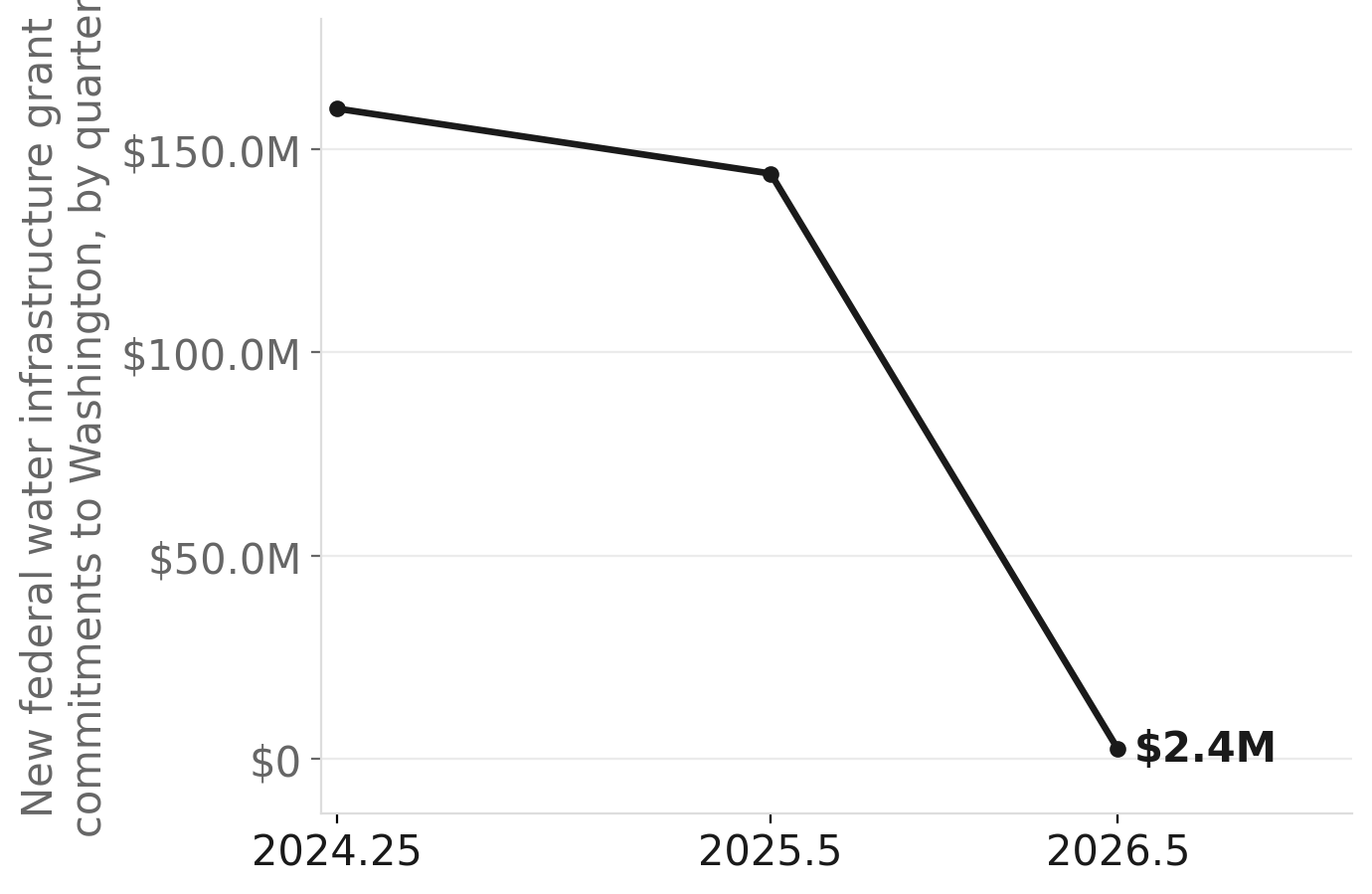
Source: NationGraph.
The first is statutory. The Infrastructure Investment and Jobs Act (P.L. 117-58), which directed $50 billion to water infrastructure over five years nationally, expires on September 30, 2026. Washington's EPA Drinking Water State Revolving Fund received three IIJA-backed capitalization grants totaling $118.8 million, currently running through 2029 and 2030. The Clean Water SRF carries another $42.8 million active through 2030. Those dollars are real and are being spent. But the IIJA's supplemental layer was front-loaded by design, and cities and water stakeholders are now urging Congress to reauthorize the core water programs before the authorization cliff arrives. No reauthorization legislation has been introduced.
The second force is administrative. In January 2025, the Trump administration's OMB issued memo M-25-13, pausing federal grant obligations across multiple programs. In March 2025, EPA Administrator Zeldin terminated more than 400 previously awarded grants worth $1.7 billion. Washington's Department of Ecology did not need to consult grant databases to feel the effect: the agency directly warned that the proposed EPA budget for FY2026 would cut water program funding by more than 90 percent nationally, greatly reducing the projects in Washington that could be funded in the future.
Congress partially checked that proposal. P.L. 119-74 held EPA's water infrastructure programs at FY2025 enacted levels, providing roughly $3.04 billion. But that legislation does not restore the IIJA's supplemental capitalization layer, and it does not reverse the administrative freeze on competitive and categorical grants. The two mechanisms that suppressed new-commitment volume are still operating.
The composition of the current 90-day awards illustrates the gap. Of the $10.2 million Washington received, $7.6 million came from the National Science Foundation, largely through a Whatcom Community College STEM infrastructure grant. The Department of Commerce contributed $2.6 million to the University of Washington. EPA, which issued $5.4 million in new Washington water grants in the same window last year, contributed zero. Interior, which added $4.8 million last year, contributed zero. The channel that made 2024 and 2025 extraordinary has gone quiet.
Nationally, award volumes declined roughly 53 percent in the first half of 2025 compared to the prior year. Washington's 73 percent year-over-year drop is steeper, partly because the state's prior-year window included the $22 million Pacific Coastal Salmon Recovery grant, a large cyclical award that does not recur on an annual basis and has no comparable replacement in the current cycle. Washington's deep integration with federal-tribal-state water nexus programs, including the Puget Sound restoration ecosystem and the Pacific Salmon Treaty framework, makes it more exposed to cyclical variability than states with simpler grant portfolios.
The practical situation is paradoxical. Washington is actively executing on more than $160 million in federally funded water infrastructure, with EPA SRF grants running through the end of the decade. Utilities and state agencies drawing on that existing portfolio are not seeing their work stop. What has stopped is the initiation of new commitments, the awards that would define Washington's water infrastructure pipeline in 2027 and beyond.
The question now is whether Congress acts before September 30. According to a federal infrastructure funding analysis, no reauthorization vehicle has advanced through committee, and the remaining IIJA competitive program rounds are in their final cycles. If the authorization expires without a successor bill, the formula SRF capitalization grants that have anchored Washington's water system modernization will lose their statutory basis. The White House's FY2026 EPA budget request proposed cutting the Clean Water SRF by 90.5 percent and the Drinking Water SRF by 87 percent; Congress held the line this year, but that position is not guaranteed in FY2027.
The next signal to watch is whether a water infrastructure reauthorization bill clears the Senate Environment and Public Works Committee before the congressional August recess. If it does not, Washington's $160 million in active grants will keep running, but the pipeline that would follow them will be empty.