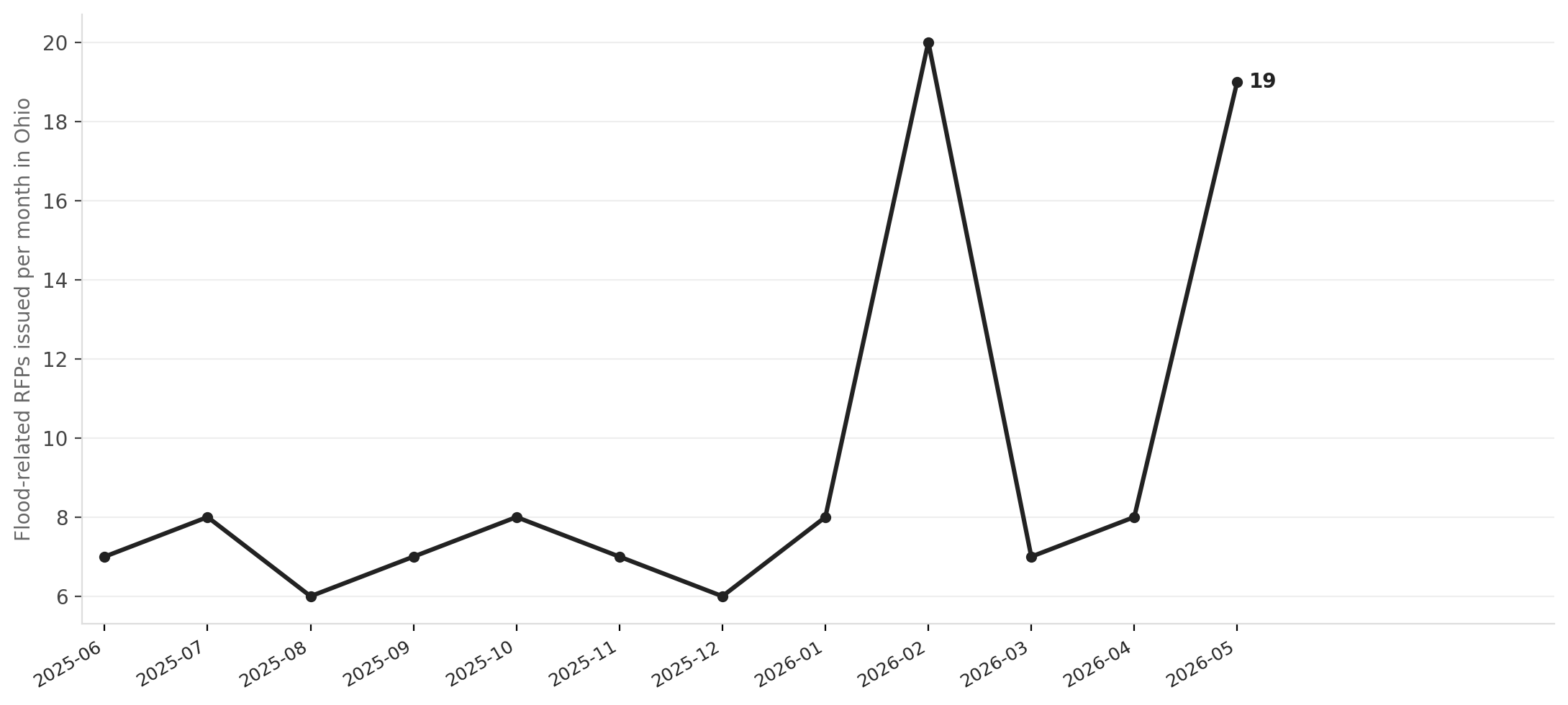
Ohio issued 19 flood-related RFPs in the 30 days ending early June 2026, against a 12-month monthly average of roughly 7.8, a 2.4x surge that is not the product of a single big project, but of three separate funding streams maturing simultaneously and forcing procurement offices across the state to move at once.
The trigger was FEMA's April 22 announcement of a $24 million Flood Mitigation Assistance grant to Findlay, the largest single-state award in a $250 million national FMA package that FEMA described as clearing a grant backlog "even 67 days into the current lapse in appropriations." The Blanchard River had crested above 11 feet just weeks earlier. Findlay Mayor Christina Muryn said the award finally allowed the city to complete flood mitigation plans delayed by COVID and staffing changes. The full project runs $46.8 million: FEMA covers 51 percent, Ohio DNR covers the remaining $22.8 million. When complete, it will restore 935 acres of Blanchard River shoreline to native wetland and remove roughly 1,290 parcels from the regulatory floodway.
That announcement did not just unblock Findlay. It signaled to other Ohio communities that the FMA pipeline was open, and it collided with two other forces already in motion. Ohio voters approved Issue 2 in May 2025, authorizing $2.5 billion in State Capital Improvements Program bonds over 10 years, explicitly including flood control systems. Those bonds provide the local match that makes federal FMA dollars spendable, without them, many communities could not meet the cost-share threshold to accept federal grants. And the FMA application deadline of August 6, 2026 creates a hard forcing function: communities that want to be in the next award cycle have to have their engineering studies and procurement documents in order now.
Source: NationGraph.
The result is visible in two distinct flood geographies running their own parallel procurement bursts. Port Clinton, on the Lake Erie shoreline in Ottawa County, accounts for roughly 11 of the 19 RFPs: a mix of sealed-bid home-elevation solicitations tied to individual addresses on Shore Drive, Miami Beach Road, Ewersen Road, and Shawnee Drive, plus a public hearing on proposed amendments to the Ottawa County Flood Damage Resolution. These are not large infrastructure contracts; they are address-by-address elevation projects, the granular end of a federal mitigation program that pays to lift houses above base flood elevation rather than wait for them to flood and file insurance claims. Ottawa County had staged this pipeline under earlier FMA grants; the April federal release appears to have pushed the whole queue to active bid in a single month.
In the inland river corridor, Reynoldsburg posted an Upper Blacklick Creek Watershed Study and Flood Mitigation Analysis RFP in Franklin County, and a FEMA-tagged mitigation project surfaced in Sharonville in Hamilton County. The monthly time series shows this is actually the second wave: Ohio hit 20 flood RFPs in February 2026, suggesting award signals reached local governments months before the formal April announcement, and procurement offices began preparing then. Active federal FMA grants to Ohio's Emergency Management Agency total roughly $5 million obligated, with outlays still early, the construction phases these RFPs are feeding have not yet begun to draw down.
The legislative backdrop extends the timeline beyond this fiscal year. The Ohio River Restoration Program Act, introduced in the 119th Congress as S.3796 in February 2026, authorizes $350 million per year from FY2026 through FY2030 for basin-wide flood resilience. If it clears Congress, it would layer a third federal stream onto the FMA and SCIP funding already in motion, and it would extend the procurement pressure well past the current surge window.
For Ohioans living in floodplains, the immediate consequence is practical: home-elevation solicitations are now active in Ottawa County, engineering studies are being scoped in Franklin and Hamilton counties, and the Blanchard River project in Findlay will begin moving from design to ground disturbance. Removal from the regulatory floodway carries a direct financial benefit, homeowners no longer required to carry federal flood insurance can save hundreds to thousands of dollars annually, and the 1,290 parcels in the Findlay project represent a meaningful share of Hancock County's housing stock.
The next signal to watch is the August 6 FMA application deadline. Communities that have RFPs outstanding now are positioning themselves for the following award cycle. If FEMA continues clearing its backlog at the pace suggested by the April package, another Ohio procurement wave in late 2026 or early 2027 is a reasonable expectation, particularly if the Blanchard River crests again before construction on the current project is complete.