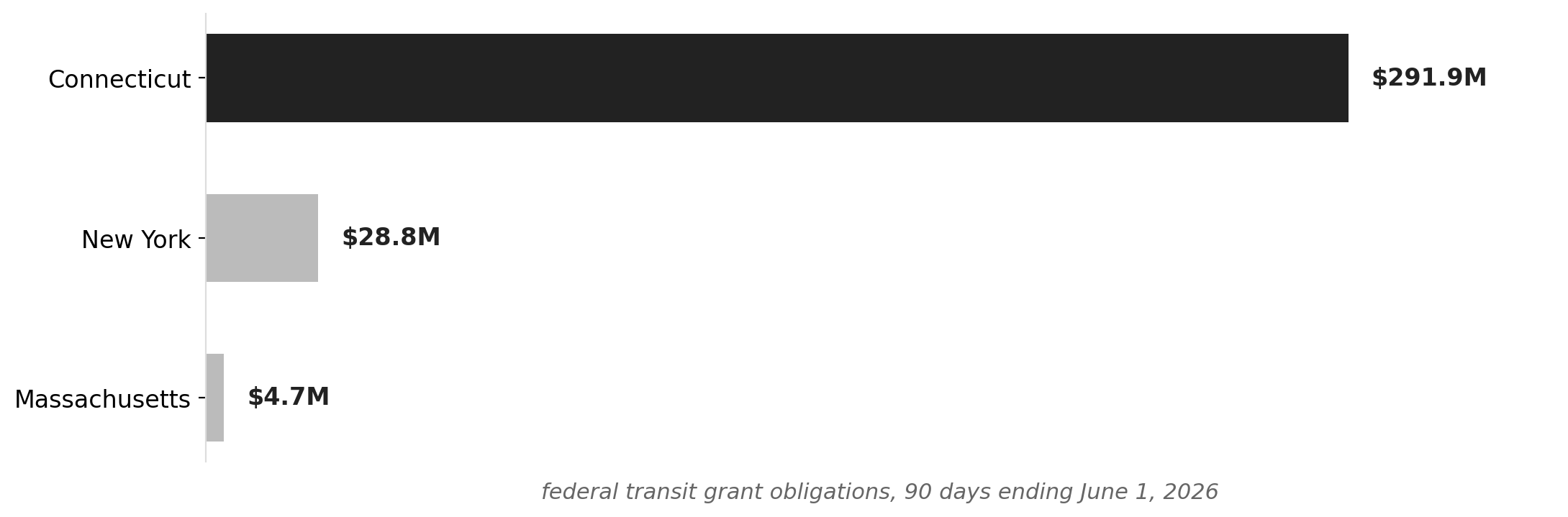
Connecticut received $291.9 million in federal transit grants in the 90 days ending June 1, 2026, a 202% increase over the $96.6 million recorded in the same window a year earlier. There was no ribbon-cutting. No senator issued a press release claiming credit. The money arrived because Congress passed a budget.
The mechanism matters. When President Biden signed the Full-Year Consolidated Appropriations Act, 2026 (Public Law 119-75) on February 3, 2026, he ended months of continuing-resolution uncertainty that had frozen the Federal Transit Administration's ability to post its annual formula apportionment tables. The FTA published those tables on March 31, 2026, releasing $20.6 billion in FY2026 apportionments nationwide, with nearly $14.6 billion sourced from the Infrastructure Investment and Jobs Act. One day before that national announcement, on March 30, the FTA obligated a $283.4 million Federal Transit Formula Grant directly to Connecticut DOT. That single transaction accounts for 97% of the state's 90-day surge.
The comparison to neighboring states is striking but not what it appears. Connecticut's $292 million dwarfs New York's $28.8 million and Massachusetts's $4.7 million in the same window. That gap reflects the lump-sum, calendar-driven nature of formula obligations, not a policy preference for Connecticut. Formula grants flow according to statutory apportionment tables, and the timing of when any given state's obligation gets posted can compress or spread across quarters. Connecticut's number happened to land in a single accounting period.
Source: NationGraph.
What makes this genuinely significant is where that money is going. Connecticut enters 2026 with an active transit portfolio exceeding $860 million, spanning formula grants and State of Good Repair programs running through at least 2030. The state's transit RFP volume has climbed to 11.3 per month, up from a 6.8 monthly average in the prior period, a signal that procurement is already accelerating to absorb the new capital. Connecticut is not a state that will spend the next two years figuring out what to do with $292 million.
The project pipeline is dense by any measure. The New Haven Bus Rapid Transit project, which serves a bus network handling roughly 8 million annual trips and nearly a quarter of all Connecticut bus ridership, is targeting a 2026 construction start. It already has a $25 million RAISE grant in hand and needs approximately $275 million more in federal and state dollars to complete. The Hartford Line, which functions as the physical link between Metro-North's New York service and the Amtrak corridor running toward Springfield and Boston, is carrying active improvement work. And a $29.6 million All Stations Accessibility Program award is moving three Metro-North Waterbury Branch stations toward ADA compliance.
A separate federal-state agreement adds further urgency. USDOT has partnered with Connecticut on a streamlined historic-review process that can cut six or more weeks off the approval schedules of at least 90 state transportation projects per year. CTDOT Commissioner Garrett Eucalitto specifically cited the agreement as a tool to reduce costs and advance projects more efficiently. That kind of procedural acceleration matters most precisely when a large capital infusion arrives on a compressed timeline, which is the situation Connecticut now faces.
The IIJA context sets a harder deadline. The $283.4 million formula grant represents part of the final year of the IIJA's five-year, $91 billion transit commitment. Congress has not yet authorized a successor infrastructure package, which means FY2026 formula apportionments could be among the last large, predictable transit disbursements states receive for some time. Connecticut's $577 million in active formula grants and $285.6 million in State of Good Repair grants provide a buffer, but the pipeline these funds are meant to fill, including the remaining $275 million gap in New Haven BRT financing, depends on continued federal commitment that is not yet legislated.
For Connecticut commuters and the broader Northeast corridor, the practical question is whether the state can convert this capital into steel, concrete, and accessible platforms before the next funding cycle arrives with different rules or a smaller number. The procurement acceleration already visible in the RFP data suggests the answer is yes, provided the streamlined review agreement holds and project-level financing for the BRT gap closes on schedule. The next signal to watch is whether New Haven BRT secures its remaining federal funding commitment before the end of calendar 2026, when IIJA successor negotiations are likely to dominate the congressional transportation agenda.