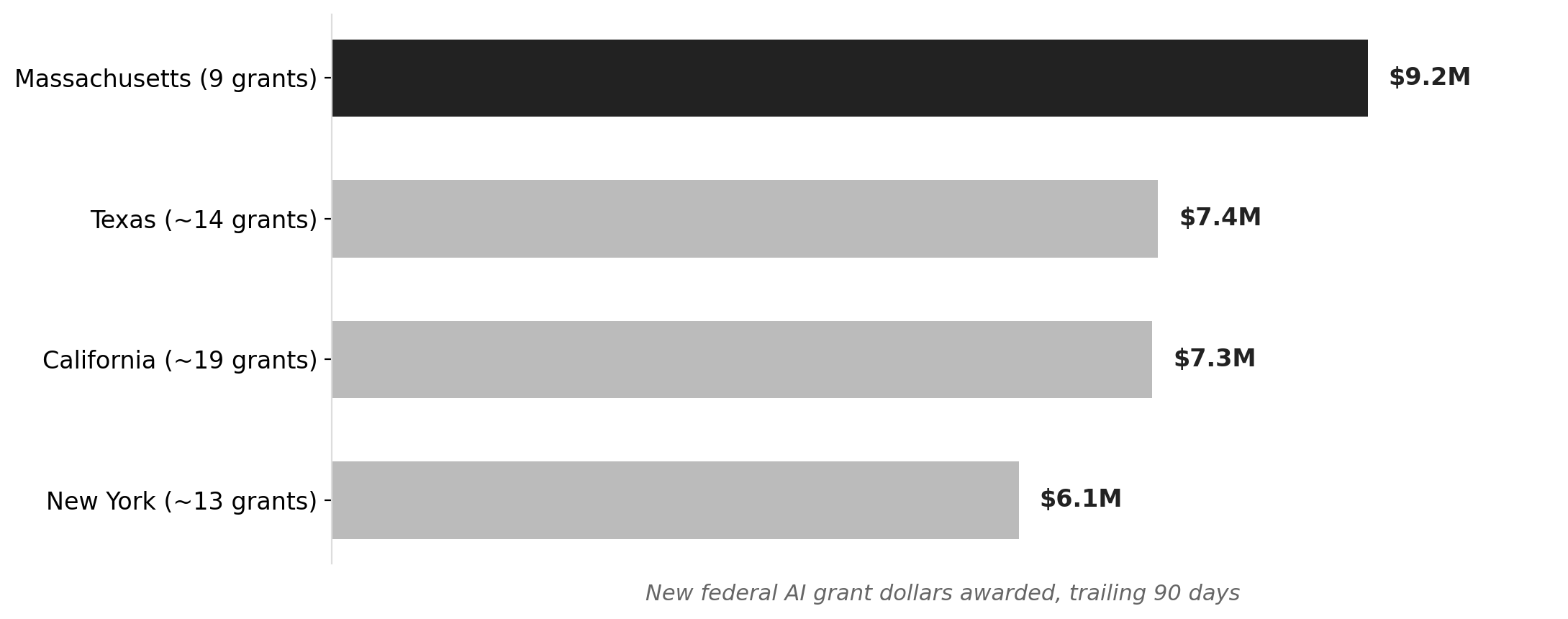
Massachusetts pulled in $9.23 million in new federal artificial intelligence grants over the last 90 days, a 217% jump from the $2.91 million the state received in the same window a year ago. That figure puts Massachusetts ahead of California ($7.31M), Texas ($7.36M), and New York ($6.12M) in the same period, and the state did it with nine grants, while its peer states received between thirteen and nineteen.
The arithmetic tells the story: fewer awards, larger checks, and institutions that have been inside the federal AI funding system long enough to renew at higher levels.
The single largest award anchoring the current window is a $4.98 million Mathematical and Physical Sciences grant to MIT, representing the NSF's renewal of the Institute for Artificial Intelligence and Fundamental Interactions (IAIFI). NSF announced the renewal in early June 2026, raising the annual award from $4 million to $4.98 million and extending the institute for five more years. The renewal also added Boston University as a core consortium member, giving the IAIFI a roster that now spans MIT, Harvard, Northeastern, Tufts, and BU, effectively the entire research spine of the Boston-Cambridge corridor operating under a single federal institute umbrella.
Source: NationGraph.
The force behind the current surge is traceable to two converging federal actions. The first was NSF's July 2025 announcement of a $100 million AI Research Institutes investment, made in partnership with Capital One and Intel and aligned explicitly with Executive Order 14277 and the White House AI Action Plan. That announcement triggered a cascade of renewed and new multi-year awards; Massachusetts alone saw $20.2 million in new AI grant activity in September 2025, against monthly averages closer to $1-2 million earlier in the year. The second action was the IAIFI renewal itself, which injected a fresh five-year commitment into a 90-day window that was already elevated.
Harvard rounds out the university-level concentration. The current cohort includes a $1.14 million Biological Sciences award, a $749,000 Geosciences award, and a $400,000 Mathematical and Physical Sciences award, all to Harvard. Northeastern holds two Engineering grants totaling just over $1 million. The Department of Defense contributes a modest $58,000 to UMass Lowell, but the overwhelming funding source is NSF, which accounts for $9.17 million of the $9.23 million total.
The concentration gets deeper when you look beyond the 90-day window. General Hospital Corporation (Massachusetts General Hospital) holds $86.5 million in currently active AI-tagged HHS grants across twenty awards. Harvard's active HHS AI portfolio adds another $76.3 million. MIT and Northeastern together hold more than $39 million in active NSF AI grants. The state's research hospitals, MGH, Brigham and Women's, Beth Israel Deaconess, have separately accumulated more than $115 million in active HHS AI grants, a clinical AI funding layer that sits entirely apart from the university research stack.
No other state replicates that combination at equivalent density: basic physics and machine learning research at universities, and clinical AI deployment at major medical centers, all in the same metropolitan area.
The structural reason Massachusetts keeps winning these renewals is that the NSF AI Research Institutes program was built, in part, around the Boston-Cambridge cluster from the beginning. The IAIFI launched in 2020 as one of the program's original seven institutes, meaning MIT and its consortium partners have five years of institutional knowledge about how to write, manage, and expand these grants. The BU announcement of its addition to the IAIFI noted that the institute now spans fields from particle physics to cosmology to quantum information, a breadth that makes it easier to attract matching interdisciplinary proposals that feed the next grant cycle.
NSF spends more than $700 million annually on AI research nationally and is currently transitioning the National AI Research Resource from a pilot program, which has already supported more than 600 research teams, to a permanent operations center. Massachusetts institutions are embedded in that infrastructure at multiple levels, as both grant recipients and as institutions whose faculty sit on advisory bodies that shape future solicitations.
For residents and policymakers in Massachusetts, the practical implication is that the state's universities and hospitals are accruing federal AI research infrastructure at a pace that compounds over multi-year award cycles rather than arriving in single large events. The next signal to watch is whether any of the remaining NSF AI Research Institutes cohort announcements, expected through late 2026 under the July 2025 $100 million commitment, add further Massachusetts-led or Massachusetts-anchored awards. A second major institute win would extend the lead; a dry spell would test whether the current surge is a renewal spike or a sustained shift in where federal AI dollars land.