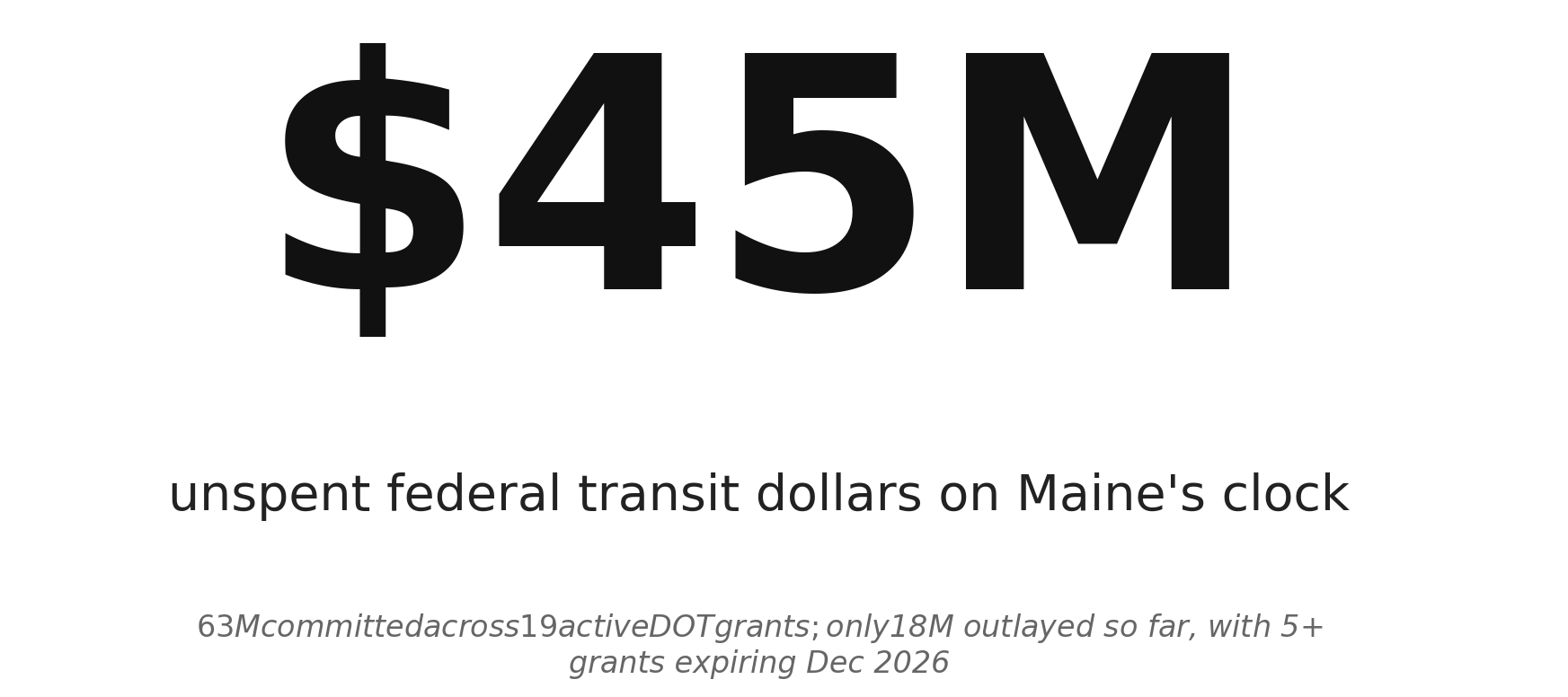
Maine's transit agencies have flooded procurement systems with 35 RFPs in the last 30 days, roughly double the monthly average of 17, and the urgency behind that number is straightforward: at least five of the state's 19 active federal transit grants expire by December 2026, covering a portfolio worth $63 million, of which only $18 million has been outlayed so far.
This is a spend-or-lose moment, and Maine's operators know it.
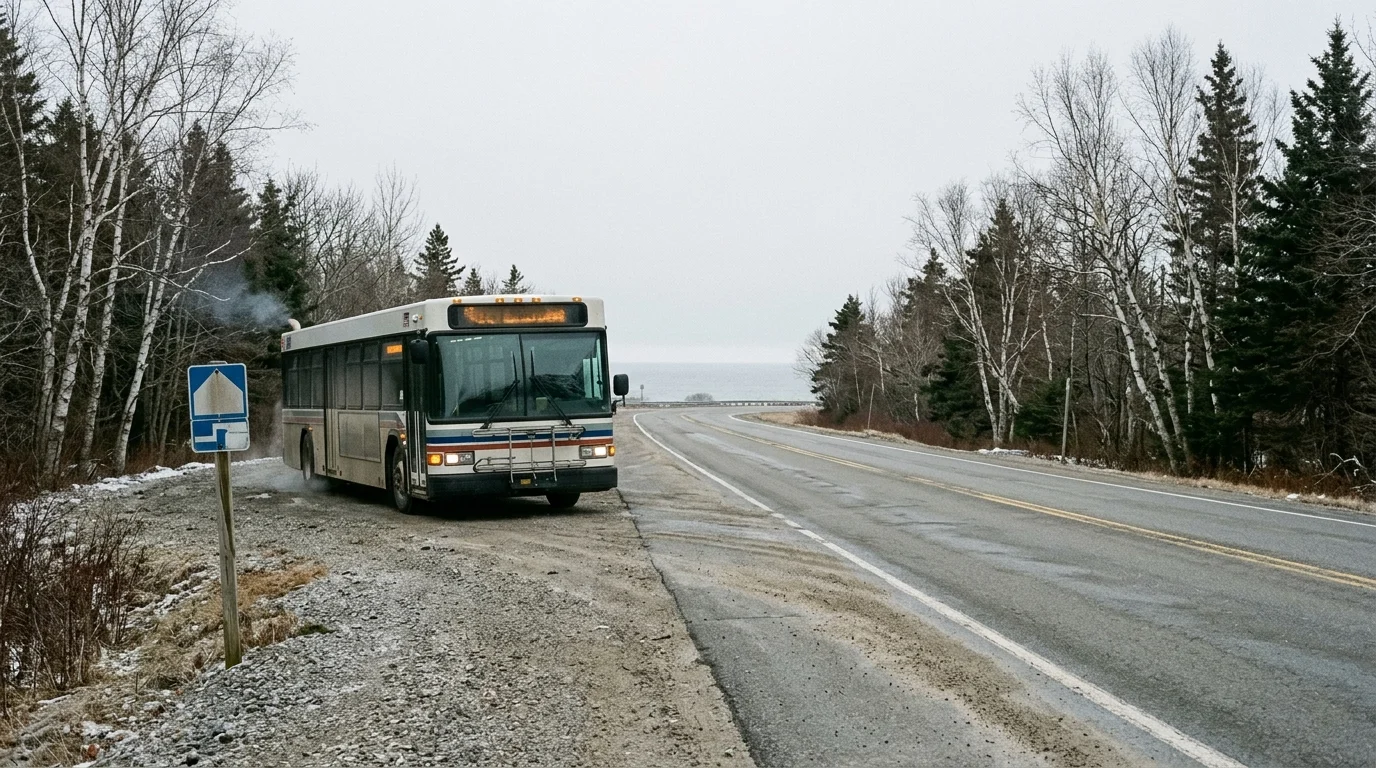
The single largest commitment arrived May 18, 2026, when the U.S. Department of Transportation awarded a $23.5 million National Infrastructure Investments grant to MaineDOT for 40 low-emission buses at Downeast Transportation Inc. That grant runs through April 2031, but the procurement clock started immediately. Downeast serves Washington and Hancock counties, the most rural stretch of coastal Maine, where a bus is often the only connection between a disabled resident and a dialysis appointment. The agency's fragility is not hypothetical: a predecessor provider, Downeast Community Partners, collapsed entirely in recent years and had to be replaced by Waldo Community Action Partners. The new federal money lands in a system with almost no margin for delay.
Source: NationGraph.
Greater Portland Metro, the state's largest transit provider, is the other axis of this push. Since February 2026, GPM has issued RFPs for microtransit software, CNG infrastructure maintenance, fare analysis, facility alternatives, and transit advertising, a procurement pace that reflects a $4.25 million federal Buses and Bus Facilities grant awarded in November 2025 for six buses, three of them dedicated to a new Scarborough route slated to launch this year. Scarborough voted to fund its share of service costs, which unlocked matching money from FTA, MaineDOT, and the Maine Turnpike Authority. The software, the fare systems, and the facility work all have to be in place before the route opens.
GPM also operates Maine's only CNG fueling station for transit vehicles, which makes its infrastructure procurements consequential beyond Portland. Other providers across the state depend on that single fueling point, so GPM's maintenance contracts are effectively regional infrastructure.
The institutional scaffolding behind this wave was built deliberately. MaineDOT's 2026-2028 Work Plan, released February 12, 2026, commits $4.5 billion across 2,798 projects and includes $90 million for the Amtrak Downeaster. Commissioner Dale Doughty used the Work Plan to operationalize Maine's 2023 State Transit Plan, releasing $2 million in new state discretionary funds to 10 agencies for 17 projects, including microtransit pilots in Harrison, Gorham, Standish, and southern Maine through BSOOB Transit. A Transit-Oriented Development Planning Partnership Initiative covering Freeport and Cumberland County posted in June 2026, adding a land-use layer to what had been a purely operational conversation.
The 132nd Maine Legislature added institutional momentum with LD 1451, directing MaineDOT to establish a statewide Mobility Management Working Group with a formal implementation plan, timeline, and budget. The legislation acknowledges something that transit planners in Augusta have said privately for years: Maine's 20 bus-service providers operate in silos, and no single entity coordinates them.
Doughty was direct about the political backdrop when he released the Work Plan, acknowledging that "federal uncertainty and changing priorities are certainly heightened at this moment." That framing explains the procurement surge as well as anything. Agencies that spent years waiting for IIJA money to reach them are now sprinting to obligate it before any federal policy shift can claw it back. The grants are awarded; the question is whether contracts can be executed in time.
For residents across rural Maine, the stakes are concrete. Maine is the most rural state east of the Mississippi, and its transit network connects elderly, disabled, and low-income households to jobs, medical care, and groceries across distances that make car ownership nearly mandatory. GPM Executive Director Glenn Fenton framed the growth-side argument for the Portland metro area: "Reliable transit is essential to making this growth sustainable." Both ends of the state, the rural corridors served by Downeast and the suburban ring being built out around Portland, are pressing against the same deadline from different directions.
The next signal to watch is whether MaineDOT's newly formed Mobility Management Working Group produces a coordination framework before the December 2026 grant expiration window closes. If it does, Maine will have used a one-time federal funding surge to build something more durable than a fleet of new buses. If the procurement wave outpaces the institutional work, the state will have newer vehicles and the same fragmented system running them.