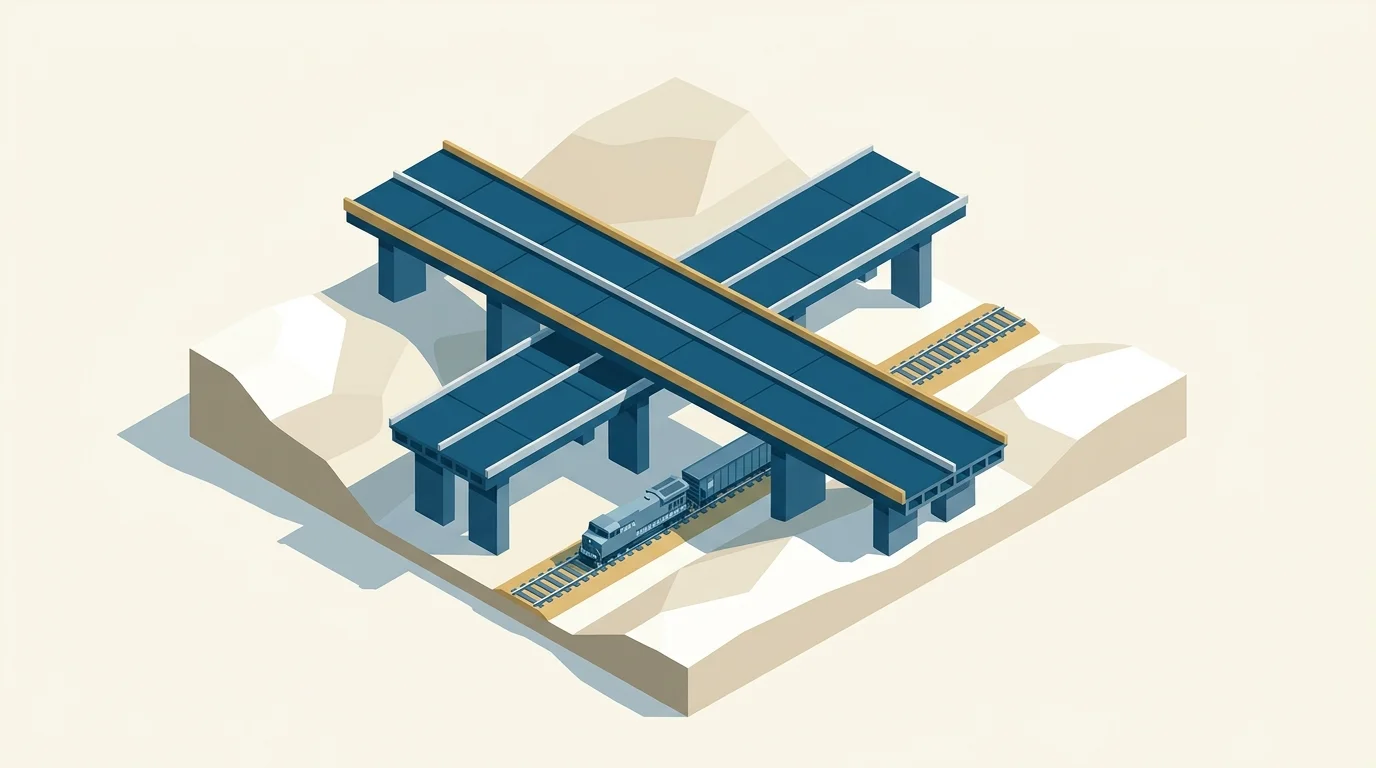
A crumbling bridge over active railroad tracks on Route 11 in Jefferson County, New York is getting replaced, with the federal government picking up the entire $3 million construction tab.
The bridge in the Town of Ellisburg, a rural stretch between Watertown and the Tug Hill Plateau, carries highway traffic over CSX Transportation's freight rail line. Replacing a structure like this, which must meet both highway and railroad safety standards, is among the more complex and expensive bridge jobs a small rural county can face. Jefferson County, home to about 116,000 residents and anchored economically by Fort Drum, dairy farming, and forestry, has limited capacity to fund major infrastructure on its own.
The National Highway Freight Program grant, posted April 15, funds replacement of the bridge's superstructure, the deck, beams, and structural elements above the support piers, which have deteriorated to the point of requiring full replacement rather than repair.
New York is covering its usual 20% cost share through toll credits, a mechanism that lets the state count toll revenues collected elsewhere on its highway system as a paper match rather than contributing actual dollars. The state has accumulated substantial credits through the Thruway and other tolled facilities, a financial tool that fiscal watchdogs have periodically criticized for allowing states to sidestep real spending commitments, but one that has become essential for programming projects in cash-strapped regions.
The broader context is significant. The American Society of Civil Engineers has flagged more than 46,000 U.S. bridges as structurally deficient, and New York, with more than 17,400 highway bridges, carries one of the country's heaviest loads of aging infrastructure. Many of those structures were built in the mid-20th century and are now reaching or exceeding their design lives.
Route 11 is a north-south corridor that predates the interstate system and still handles freight and local movement that I-81, running roughly parallel, doesn't fully serve. For Fort Drum, one of the Army's most active installations, regional roads like Route 11 are part of the logistics network that keeps the post functioning. Disruptions to the corridor force detours through rural areas with few alternatives.
New York State DOT is managing the project. A construction timeline has not been publicly announced.