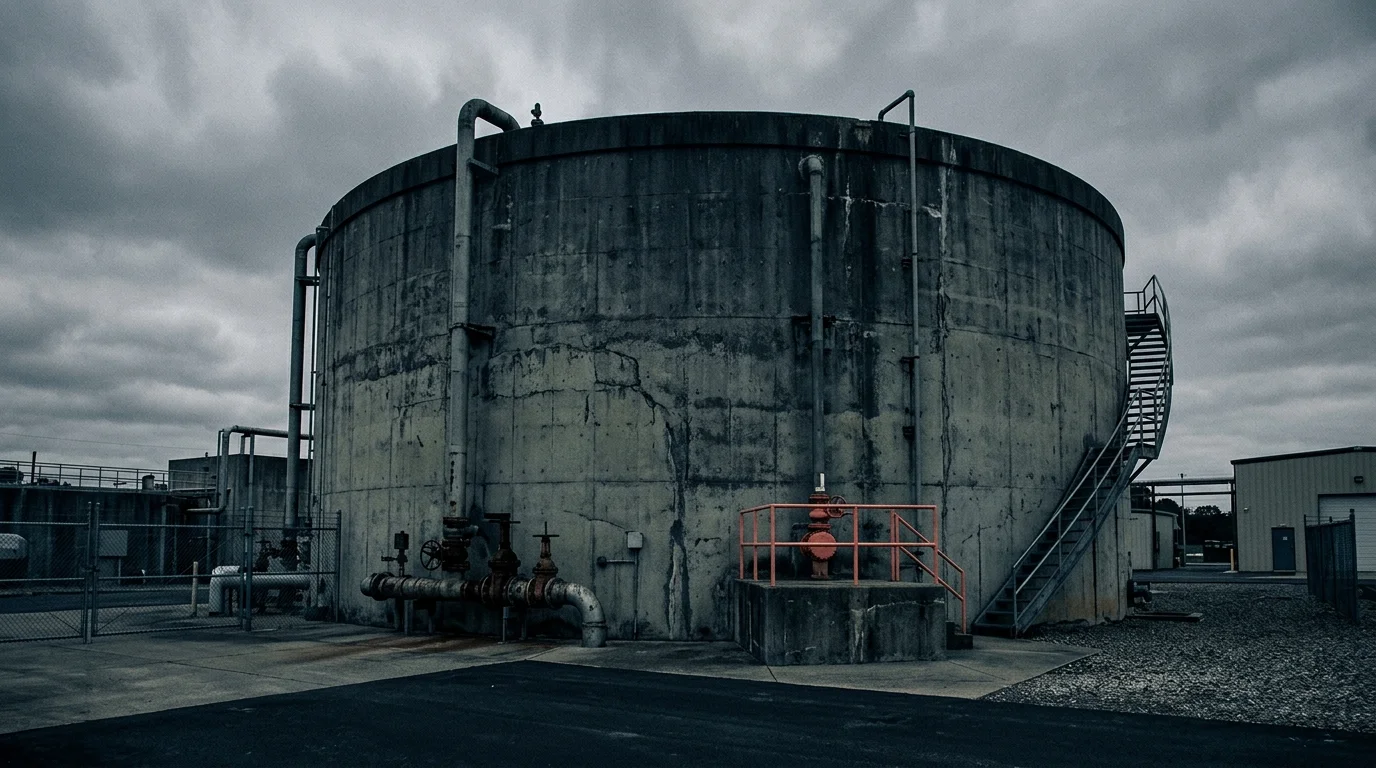
The agency that supplies drinking water to roughly 200,000 people in the Wilmington, North Carolina area is moving to repair a critical 4-million-gallon storage tank at one of its main treatment facilities before it fails.
Cape Fear Public Utility Authority (CFPUA) is seeking contractors to rehabilitate a clearwell at the Sweeney Water Treatment Plant, which draws raw water from the Cape Fear River and serves much of New Hanover County. A clearwell is a large holding tank where treated water sits before entering the distribution system, giving chlorine enough contact time to kill pathogens. When one goes offline, a utility's ability to maintain water pressure and meet federal disinfection standards is directly at risk.
The work includes replacing the tank's expansion joint, a component that absorbs structural movement and prevents cracking. Projects of this type for tanks of this age typically also involve recoating interior surfaces and addressing other deterioration, though the full scope is detailed in the bid documents. The tank is the kind of infrastructure that rarely makes headlines until it doesn't work.
The timing carries particular weight in Wilmington. Since 2017, when the chemical compound GenX, a member of the PFAS family of synthetic chemicals, was discovered in the Cape Fear River at alarming levels traced to the Chemours plant upstream in Fayetteville, public anxiety about the region's drinking water has run high. CFPUA has spent heavily on granular activated carbon filtration systems to address PFAS contamination, adding financial pressure on top of routine infrastructure needs. The authority has raised rates multiple times in recent years to cover those costs, making every capital expenditure a politically sensitive decision.
Hurricane Florence compounded the picture in 2018, flooding much of the Cape Fear watershed and stressing water and wastewater systems across the region.
The pressure CFPUA faces is not unique. The American Society of Civil Engineers has repeatedly graded U.S. drinking water infrastructure a C- or D, with a national investment shortfall running into tens of billions of dollars annually. Most of the country's water systems, including the Sweeney plant, were built during the post-World War II building boom of the 1950s through 1970s, meaning key components are now pushing 50 to 70 years old. The 2021 Bipartisan Infrastructure Law directed $55 billion toward water infrastructure nationally, giving utilities like CFPUA new funding pathways, but the backlog of deferred maintenance remains enormous.
Contractor bids are now being accepted. Once a contractor is selected and work is complete, the rehabilitated clearwell will need to return to service without disrupting water supply to the county.