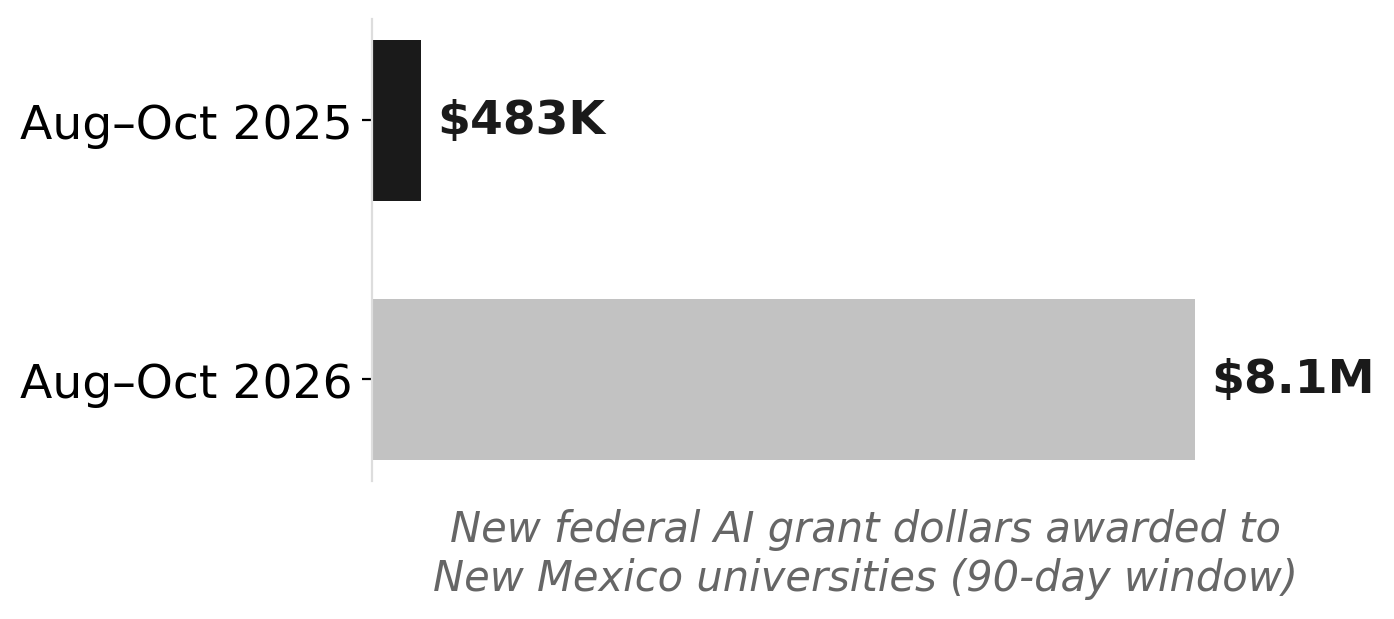
Federal AI grants flowing to New Mexico universities hit $8.14 million in the 90 days from August through mid-October 2026, a 1,585% increase over the $483,000 the state captured in the same window last year. The money is concentrated at two institutions: the University of New Mexico took in $5.74 million across seven awards, and New Mexico State University added $2.07 million across four more. For a state that has hosted Los Alamos and Sandia National Laboratories for eight decades, the numbers mark something of a long-overdue arrival.
The proximate driver is NSF. Eleven of the 13 new awards came from the National Science Foundation, which has been executing a White-House-aligned expansion of its AI research portfolio that now exceeds $700 million per year nationally. That expanded pool created an opening. What's new in New Mexico is an institutional mechanism capable of walking through it.
Los Alamos National Laboratory convened a formal consortium that now links LANL, Sandia, UNM, NMSU, NM Tech, Central New Mexico Community College, and the New Mexico Consortium. The explicit purpose, as reported by the Santa Fe New Mexican, is to pool institutional resources to compete for large federal AI grants, the kind of coordinated posture that smaller state university systems rarely manage on their own. The grant surge of the past 90 days is the first measurable result.
Source: NationGraph.
The awards themselves span a notable range of application domains. The single largest, a $1.54 million HHS Congressional Directive to UNM, funds work on incorporating AI into rural healthcare training and practice, a natural fit for a state where provider shortages are severe and geography is unforgiving. A second HHS award adds to UNM's biomedical AI portfolio. On the NSF side, a $1.01 million award supports environmental data cyberinfrastructure using AI and machine learning, running through July 2028. NMSU's new grants include work in agriculture and climate-resilient energy infrastructure, drawing on the university's long land-grant research profile. In aggregate, the active AI grant portfolios at the two institutions, counting awards from prior cycles still in progress, now total $15.88 million: $10.27 million at UNM and $4.97 million at NMSU.
State policy has built scaffolding around this federal push without causing it. Governor Michelle Lujan Grisham's administration released a Science and Technology Roadmap in July 2025 that explicitly names AI, high-performance computing, and complex modeling and simulation as priority growth clusters. House Bill 20 (2025) created the Technology and Innovation Office and a $90 million Research, Development and Deployment Fund. The RD&D Fund launched its first Targeted Federal Match grant in July 2026, specifically designed to strengthen New Mexico applications for programs including NSF's X-Labs initiative and NSF SBIR/STTR. The state money is a complement, not a cause: NSF awards on standard merit review, and state officials play no role in those decisions. But the match-grant structure signals to federal reviewers that the state is a willing institutional partner, which matters in competitive solicitations.
The governor's 2026 State of the State address also called for $150 million in tax credits for quantum and fusion technologies. Those credits, if enacted, would target adjacent sectors rather than the university AI research grants captured here, a distinction worth keeping clear as the state's tech investment story grows more complex.
The bracket comparison underscores how much ground New Mexico has compressed in a short window. In the same 90-day period, Utah received 19 grants totaling $8.8 million and Colorado received 20 grants totaling $8.7 million. Both states have mature research university systems and well-established federal grant pipelines. New Mexico, at 2.1 million people and with almost no prior AI grant footprint in comparable windows, is now within rounding distance of both.
The next stress test is already dated. NSF's State and Regional AI Infrastructure Hubs program (NSF 26-513) has up to $100 million available and awards only one grant per state or region, in the $40 million to $100 million range. The application deadline is November 4, 2026. New Mexico's consortium, assembled precisely to compete for solicitations at this scale, is structurally positioned to submit. Whether the 90-day surge in smaller awards translates into a winning bid for the largest single AI infrastructure grant NSF has ever offered will be the clearest test yet of whether the state's new posture is durable or an artifact of a favorable funding moment.