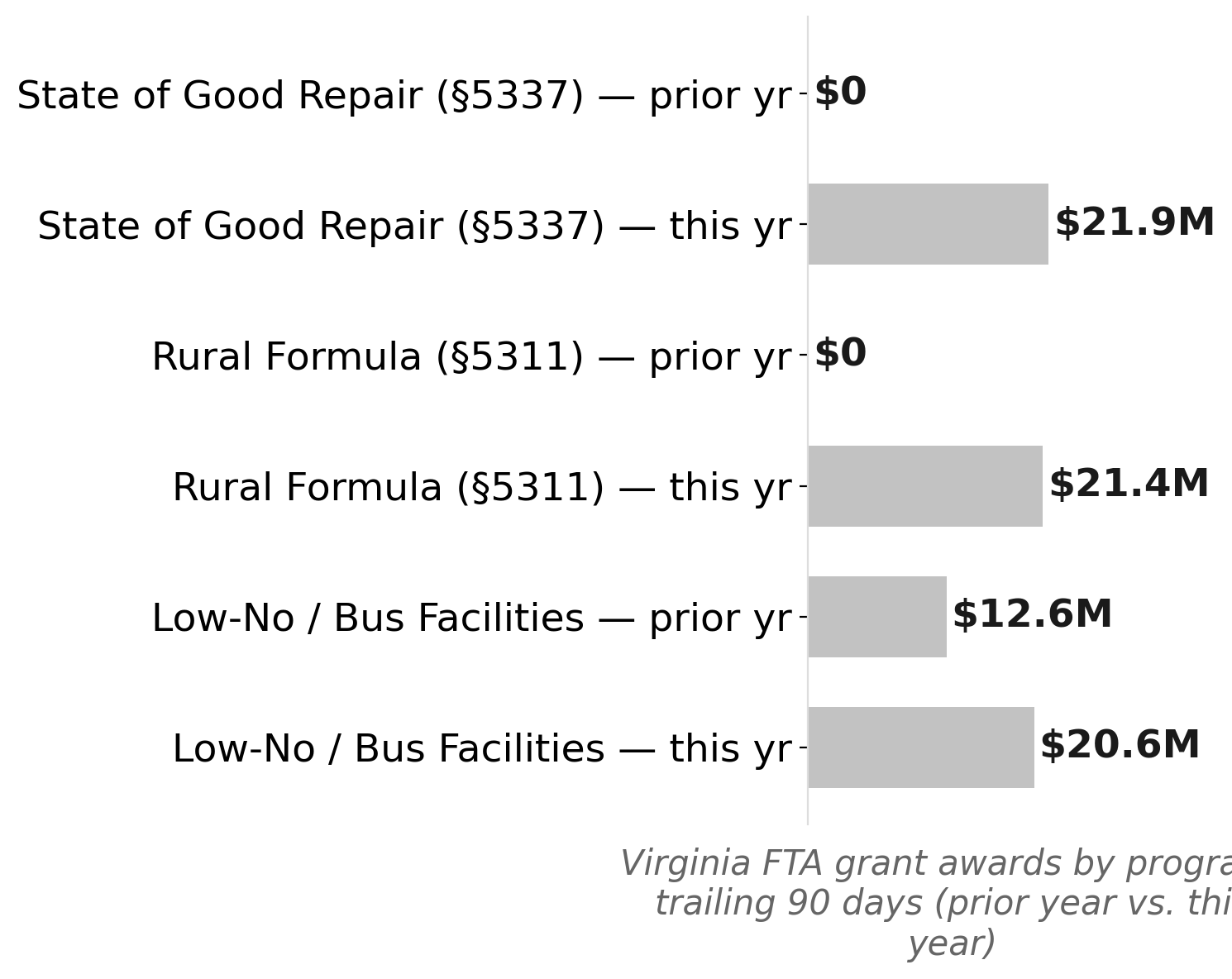
Virginia has collected $137.8 million in federal transit grants over the past 90 days, a 56% jump from the $88.4 million it received in the same window last year. The number looks like a policy win, but the mechanics behind it are more specific than that: two federal grant programs that awarded Virginia nothing in the prior comparable period, FTA's State of Good Repair grants and its Rural Area Formula program, delivered a combined $43 million this fiscal year, almost entirely accounting for the gap.
The timing is not accidental. FY2026 is the peak authorized funding year under the Bipartisan Infrastructure Law, which stepped up the Federal Transit Administration's annual authorization from roughly $13 billion under its predecessor statute to $21 billion at the ceiling. Virginia's Department of Rail and Public Transportation had a plan ready to receive it: the FY2026 Six-Year Improvement Program allocates approximately $860 million for public transit statewide, structured to absorb exactly these federal formula releases as they arrive. The federal surge and the state absorption plan hit simultaneously.
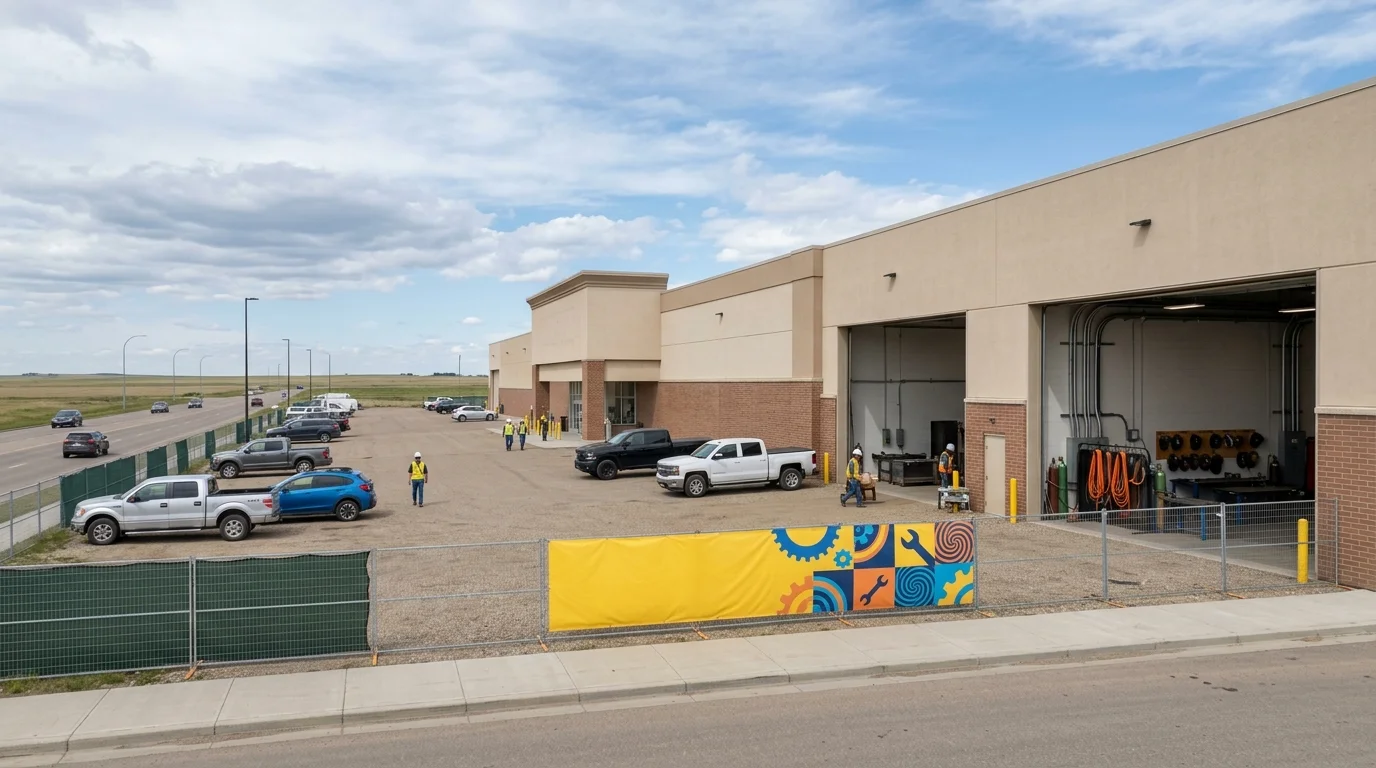
The two programs driving the year-over-year difference are distinct in how they work and where the money goes. The State of Good Repair program (FTA §5337) is a formula grant that flows directly to large urbanized transit agencies for capital rehabilitation of aging assets. In the current window, $21.9 million landed at the Transportation District Commission of Hampton Roads, where it will fund fleet and facility modernization through 2033. Hampton Roads Transit is the top recipient overall in this period at $45.2 million across five grants; according to HRT's own budget documents, roughly 47% of its revenue comes from federal and state sources, and its capital improvement plan identifies state-of-good-repair investments, including transfer centers in Chesapeake, Newport News, and Hampton, as its primary capital priority. A year ago, the §5337 program contributed zero dollars to Virginia's trailing 90-day total.
Source: NationGraph.
The Rural Area Formula program (FTA §5311) operates differently. It flows through Virginia DRPT as state intermediary, which then distributes dollars to rural and smaller operators statewide. The Commonwealth Transportation Board confirmed a $23.1 million FY2026 allocation under this program at its July 2026 workshop; $21.4 million of that arrived in the current measurement window. As with the State of Good Repair program, this program contributed zero to the prior-year comparable window in Virginia. The two together represent a structural shift in which programs are releasing money in which fiscal quarters, not a broad lift across all FTA channels. Standard urbanized formula grants (§5307) actually declined slightly, from $41.7 million to $33.5 million year over year, confirming that the baseline has not simply risen across the board.
A third program contributed to the increase, though it was already active in the prior year. FTA's competitive Low or No Emission and Bus Facilities program (§5339) grew from $12.6 million to $20.6 million in Virginia's window. The FTA published a $610 million national funding opportunity for FY2026 Bus and Bus Facilities grants on July 27, 2026. The City of Alexandria received $10.9 million from that pool for electric bus fleet and facilities, running through 2030. Blacksburg received $5.9 million, Petersburg $2.5 million, and Charlottesville $621,000. These are competitive awards, won agency by agency on individual proposals, they reflect preparation by the individual grantees, not an automatic formula entitlement.
The combined effect places Virginia third among comparable states in trailing 90-day transit grant intake, behind Pennsylvania at $214.7 million and Maryland at $159.2 million. Both of those states have larger legacy transit systems, but Virginia's position is notable given that its two dominant urban systems, WMATA and the Virginia Railway Express in Northern Virginia, operate under funding structures that don't fully appear in DRPT's books.
For riders and local governments, the practical consequence is that capital projects in the pipeline, HRT's transfer center network, rural van and bus operations across the state's non-urbanized corridors, electric bus fleets in Alexandria and Blacksburg, are now funded for several years out. The question is what comes after FY2026. The Bipartisan Infrastructure Law's authorization ramp peaks this year; absent new federal surface transportation legislation, FTA program levels are likely to plateau or fall back toward pre-IIJA baselines in subsequent years. Virginia's SYIP and the Commonwealth Mass Transit Fund were designed to coordinate with the federal ramp, but the state match structure will face a different set of numbers if the federal authorization does not continue climbing. The next federal surface transportation reauthorization, expected before the current law's expiration, will set those ceilings. What Virginia's transit agencies have built in the current window, and whether the infrastructure capacity created now can be maintained without the same funding levels, will be the more durable story.