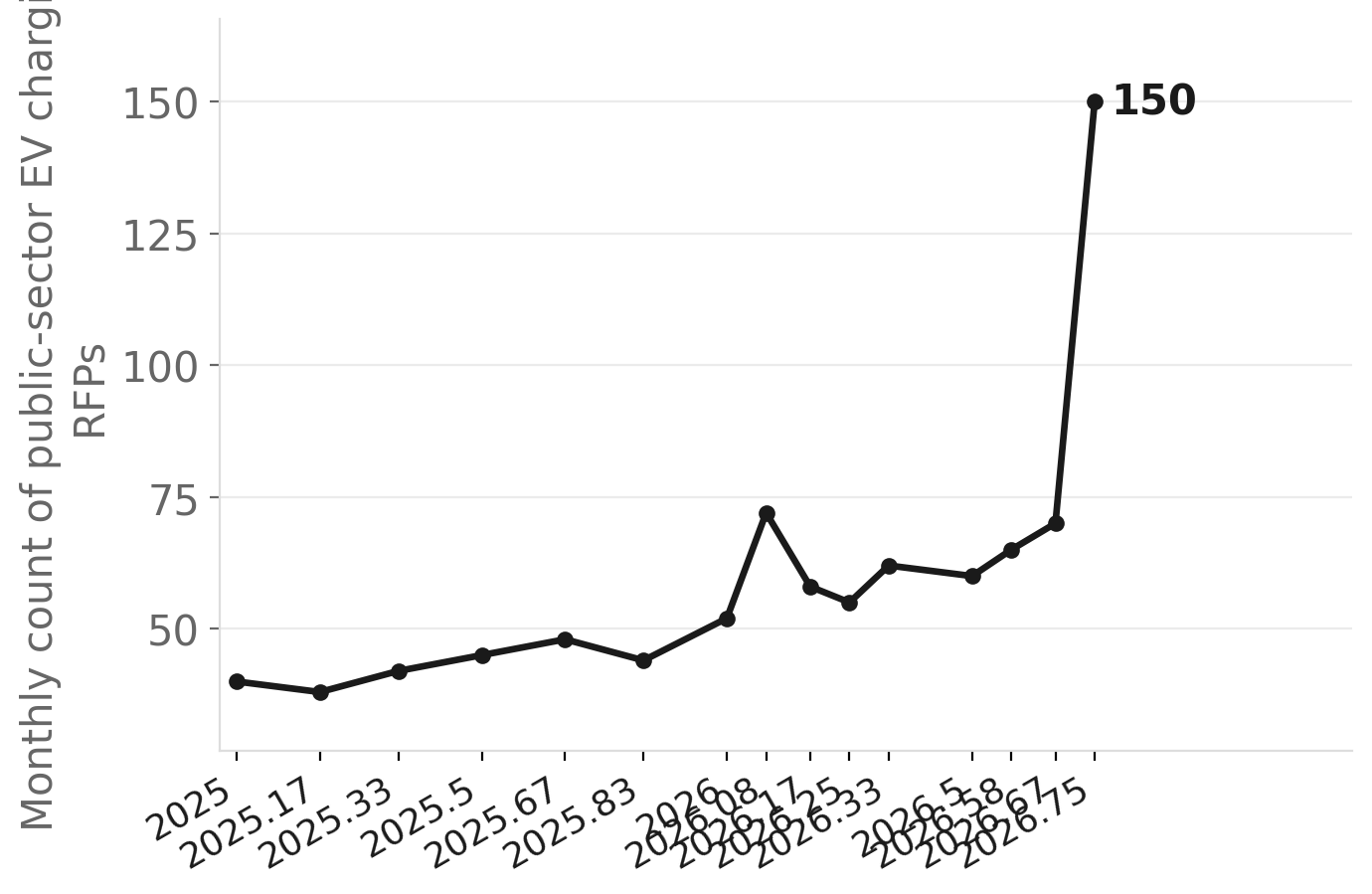
Public agencies across 18 states issued EV charging RFPs or procurement solicitations in the last 60 days at roughly three times their historical rate, with 134 institutions posting bids against a pace that averaged 44 per two-month window over the prior year. October 2026 alone produced 150 distinct RFPs spanning 39 states, a single-month record by a wide margin and more than double the previous peak of 72 in February 2026. The number tells a specific story: a court victory unlocked the money, and a congressional threat may take it back, so localities are moving as fast as bureaucracies can move.
The legal event that set all of this in motion was a final judgment entered January 23-24, 2026 by Judge Tana Lin of the Western District of Washington in *State of Washington v. U.S. Department of Transportation*. The ruling permanently barred DOT from withholding NEVI formula funds, declaring the Trump administration's February 2025 freeze of the program "arbitrary and capricious" under the Administrative Procedure Act. DOT did not appeal. That judgment restored approved state deployment plans for all 50 states and restarted solicitation rounds that had been frozen for nearly a year.
NEVI, authorized under the 2021 Infrastructure Investment and Jobs Act, distributes $5 billion in federal formula grants to state DOTs over five years, which then run competitive solicitations to deploy DC fast-charging stations along Alternative Fuel Corridors and, once corridors are certified, community charging sites. FY2026 is the final year of that five-year window, with $885 million allocated. The active federal grant portfolio currently shows roughly $486 million obligated through DOT, with top recipients including North Carolina ($120 million), California ($120 million), Arkansas ($101 million), New York ($90 million), and Connecticut ($50 million). Most of those grants have disbursed nearly nothing, reflecting an execution backlog that accumulated during the freeze and that states are now scrambling to procure against.
Source: NationGraph.
California leads the current burst with 45 institutions issuing RFPs, followed by Ohio (11), Washington (10), New York (9), and Illinois (8). What's striking about California's number is its distribution: the 45 solicitations come from cities like Oceanside, San Jose, and East Palo Alto; school districts including Sequoia Union and San Diego Unified; community colleges; park districts; and UC campuses. That breadth suggests the procurement wave has moved well past state highway agencies and into every tier of local government that can qualify for community charging funds. Washington state's arc from lead plaintiff to active spender is one NationGraph has tracked closely, from the lawsuit itself to the renewed federal pressure that followed the ruling.
The February 2026 surge, the prior record at 72 RFPs, was itself a post-ruling effect: states that had rebuilt compliant procurement templates against the FHWA's revised interim guidance, issued August 11, 2025, began moving the moment the final judgment cleared the legal risk. October's 150-RFP record reflects the next wave, states that needed the February filings to complete, be awarded, and then trigger downstream local solicitations. Minnesota's NEVI Round 3a, which opened August 26 with up to 40 awards and a November 2 deadline, and Oregon's third grant round, which opened October 21, are representative of that sequencing.
The urgency is not just about the five-year clock. A pending FY2026 appropriations measure in Congress would transfer $879 million in remaining NEVI funds into general Federal Highway Administration highway programs, effectively dissolving the dedicated EV charging pipeline in its final year. That threat hasn't passed, but its existence has concentrated minds: states and localities that don't obligate funds before the appropriations window closes may lose access to the program's last tranche entirely. Eighteen months of frozen procurement compressed into two post-ruling surges, and the October spike suggests the compression is still building.
For residents in states with active NEVI portfolios, the practical consequence is a wave of charger construction announcements over the next 12 to 18 months, assuming awarded projects execute on their timelines. The gap between obligated and disbursed dollars is large enough that most of the physical infrastructure hasn't been built yet. The next signal to watch is whether Congress finalizes the FY2026 appropriations transfer. If it does, October 2026 will likely stand as the high-water mark of public EV charging procurement in the NEVI era. If it doesn't, the program's final allocation stays intact, and the procurement pace may hold through a spring 2027 closeout round.