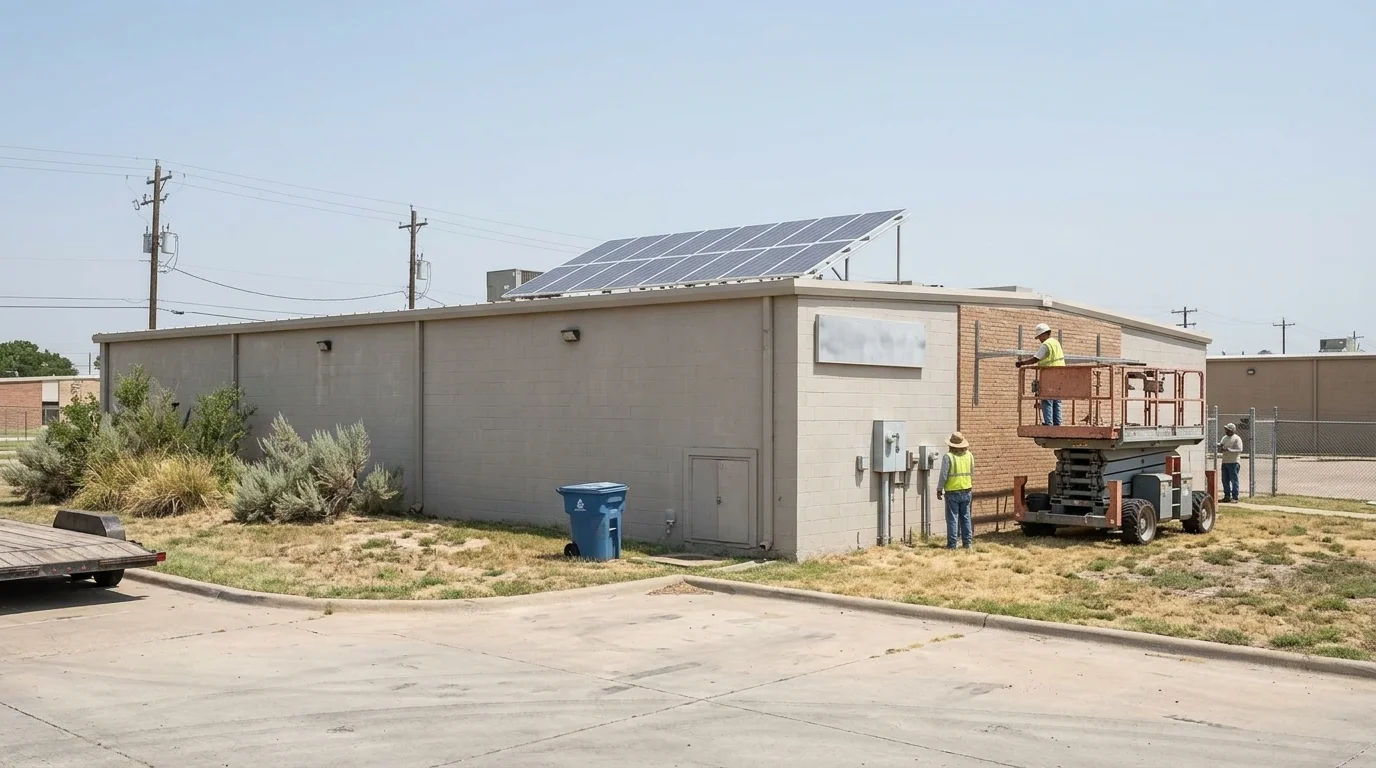
Six Pennsylvania public institutions issued solar procurement requests in the last 30 days after going more than a year without one, a burst of activity that reflects less a growing appetite for solar and more a shrinking window to act before three simultaneous deadlines rewrite the terms.
The institutions include Delaware County, which is soliciting design and installation services for solar arrays at three county government sites with an August 31 deadline; the Susquehanna River Basin Commission in Harrisburg; the Erie Western Pennsylvania Port Authority; and Cumru Township's police department in Berks County, which is explicitly seeking tax-exempt financing for a municipal solar system. Monthly RFP volume across the state has been elevated since late 2025, with 15 to 16 institutions issuing solicitations in both December and March, so this is a sustained wave. But the pressure driving that wave is getting sharper, not softer.
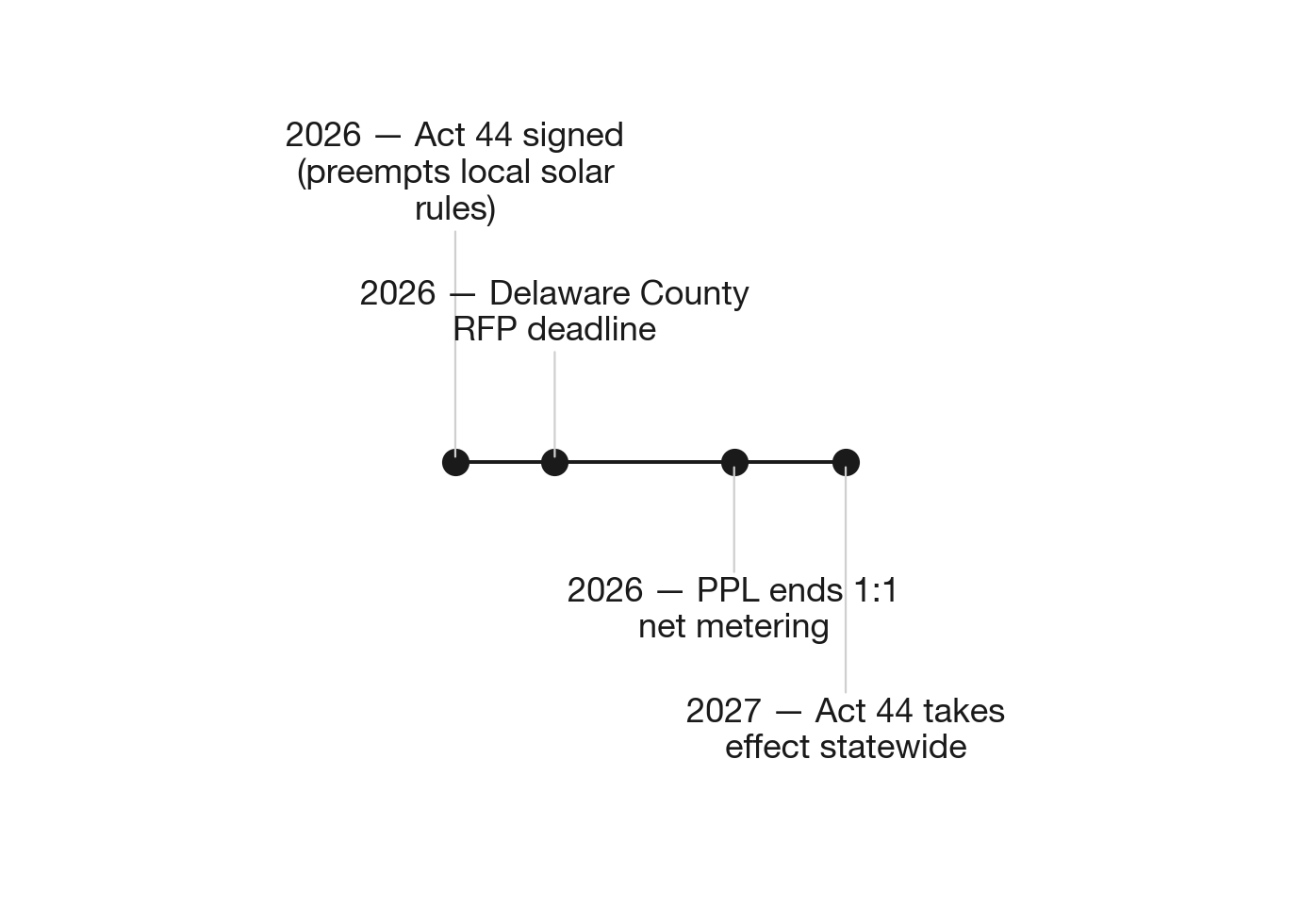
The most direct trigger is Act 44 of 2026, which Governor Josh Shapiro signed on July 20. The law establishes Pennsylvania's first statewide solar decommissioning and bonding framework for facilities over 2 megawatts built on leased land, and critically, it preempts existing municipal solar ordinances starting in January 2027. Pennsylvania has more than 2,500 municipalities, most of them operating under locally written solar rules that vary township by township. Once Act 44 takes effect, that patchwork disappears and a single state framework replaces it. The Pennsylvania State Association of Township Supervisors opposed the law, warning that locally crafted ordinances would simply be invalidated. The bill still passed the House 196 to 6 and the Senate 49 to 1.
Source: NationGraph.
For municipal governments already in the middle of planning solar projects, the message is clear: finish the work under rules you know, or start fresh under rules you don't. That explains why solicitations are landing now rather than waiting for fall budget cycles.
The second pressure is economic. PPL customers, covering a large swath of eastern Pennsylvania, face a proposed shift from one-to-one net metering to hourly locational marginal price credits sometime in mid-to-late 2026. Systems installed and interconnected before the new tariff structure takes effect may be grandfathered at the more favorable rate. Leo Kowalski of the Pennsylvania Solar Center has warned publicly that rising electricity prices make the timing especially consequential for local governments evaluating long-term energy contracts. A system that pencils out at today's net-metering rate may look different under hourly LMP pricing, which fluctuates with grid conditions rather than offsetting consumption dollar for dollar.
Federal money adds a third complication, though in the opposite direction: it creates urgency through scarcity rather than through deadline. Pennsylvania holds a $396 million EPA Climate Pollution Reduction Grant active through 2029, but only about $5.4 million of it has been outlayed so far. A separate $156 million EPA Solar for All award to the Pennsylvania Energy Development Authority remains entirely inaccessible because the enabling state legislation, HB 362, is still sitting in the House Energy Committee. Nationally, the EPA has moved to cancel Solar for All grants, putting Pennsylvania's share in further jeopardy. Institutions that might have expected a state-facilitated financing pathway now face the possibility that it never materializes, making direct procurement under current rules more attractive than waiting.
The DEP's GreenGov Council and Penn State's sustainability office have been running municipal solar procurement webinars, in part to help local governments hit the Shapiro administration's goal of offsetting 40 percent of Commonwealth electricity use with renewable energy. The Shapiro administration also took steps earlier this year to accelerate interconnection for new energy storage and generation projects in the PJM grid footprint, where an expedited interconnection track is expected to open by August 2026. That change helps large sponsored projects move faster, but it doesn't resolve the municipal-level question of what happens after January when local decommissioning rules expire.
What this means for residents in Pennsylvania's townships and counties is more immediate than it might appear. Local governments that secure solar contracts in the next few months lock in rates before the net-metering change, operate under procurement frameworks they helped design, and avoid the compliance costs of a new statewide bonding regime they had no hand in writing. Municipalities that wait may face higher per-kilowatt-hour costs, unfamiliar decommissioning obligations, and a federal grant pipeline that has been slow to flow and is getting slower.
The next signal to watch is Delaware County's August 31 RFP deadline, the largest single commitment among recent solicitations, and a potential bellwether for whether suburban Philadelphia governments can close contracts before the January preemption clock runs out. HB 362's fate in the House Energy Committee will also determine whether the $156 million Solar for All fund ever becomes a tool Pennsylvania municipalities can actually use.