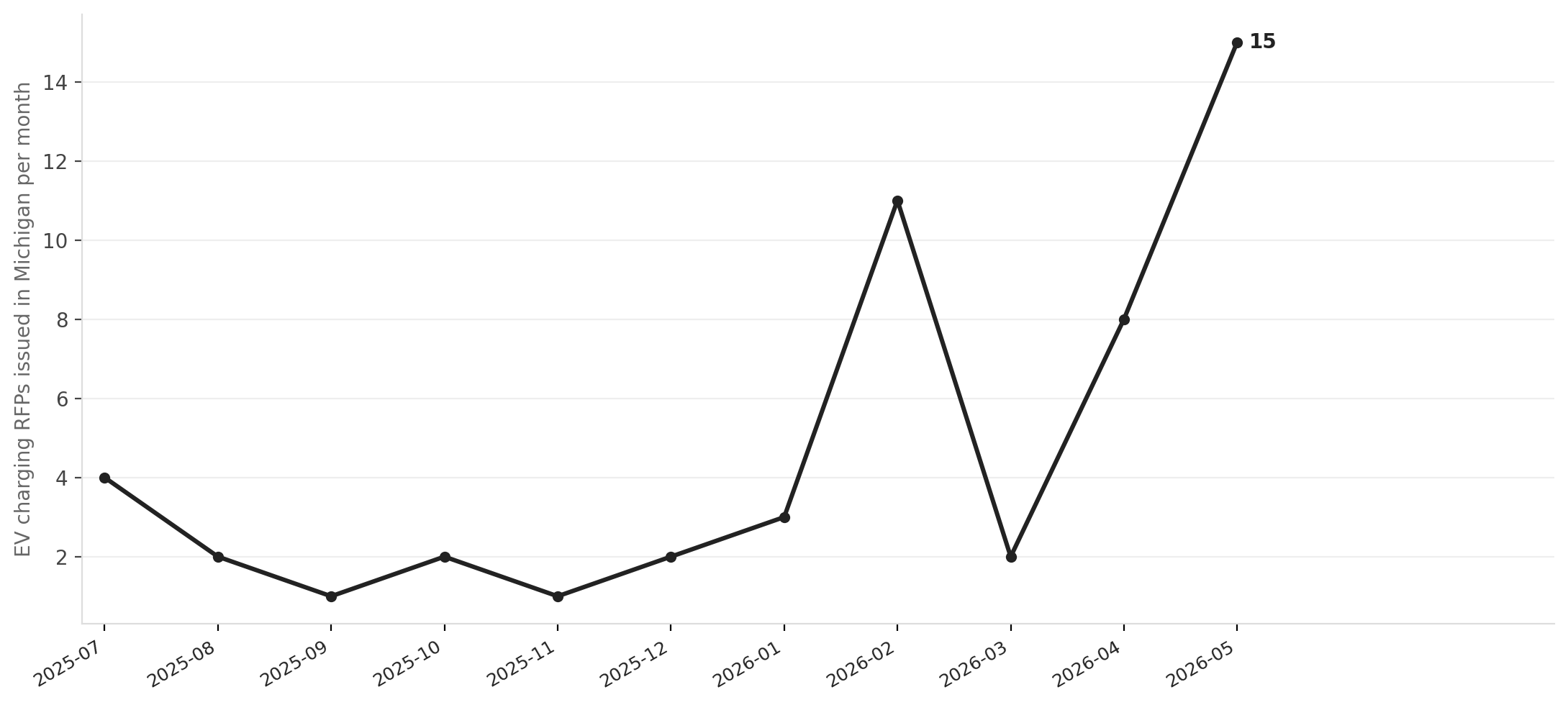
Michigan logged 15 EV charging RFPs in the trailing 30 days through late May 2026, against a monthly average of roughly 4 over the prior year. That 3.8x spike did not build gradually. It snapped on after a single event: the Federal Highway Administration's April 6, 2026 approval of Michigan's FY2026 Electric Vehicle Infrastructure Deployment Plan, which unlocked $51 million in NEVI formula funds the state had been unable to access for months.
The freeze that preceded this moment was real. Monthly RFP counts collapsed to between one and three from August 2025 through March 2026, a stretch when the Trump administration's policy review had effectively halted the National Electric Vehicle Infrastructure program nationwide. Local governments and agencies that had been drawing up charging station plans held them. There was nothing to bid against. Then the approval came through, and the queue emptied at once.
MDOT Transportation Director Bradley C. Wieferich described the April 6 certification in a state press release as Michigan achieving "fully built out" status on NEVI highway corridors, meaning the remaining $51 million shifts toward a qualitatively different layer of infrastructure: smaller communities, school districts, public facilities, and fleet operators rather than highway rest stops. That distinction matters for what the procurement surge actually looks like on the ground.
Source: NationGraph.
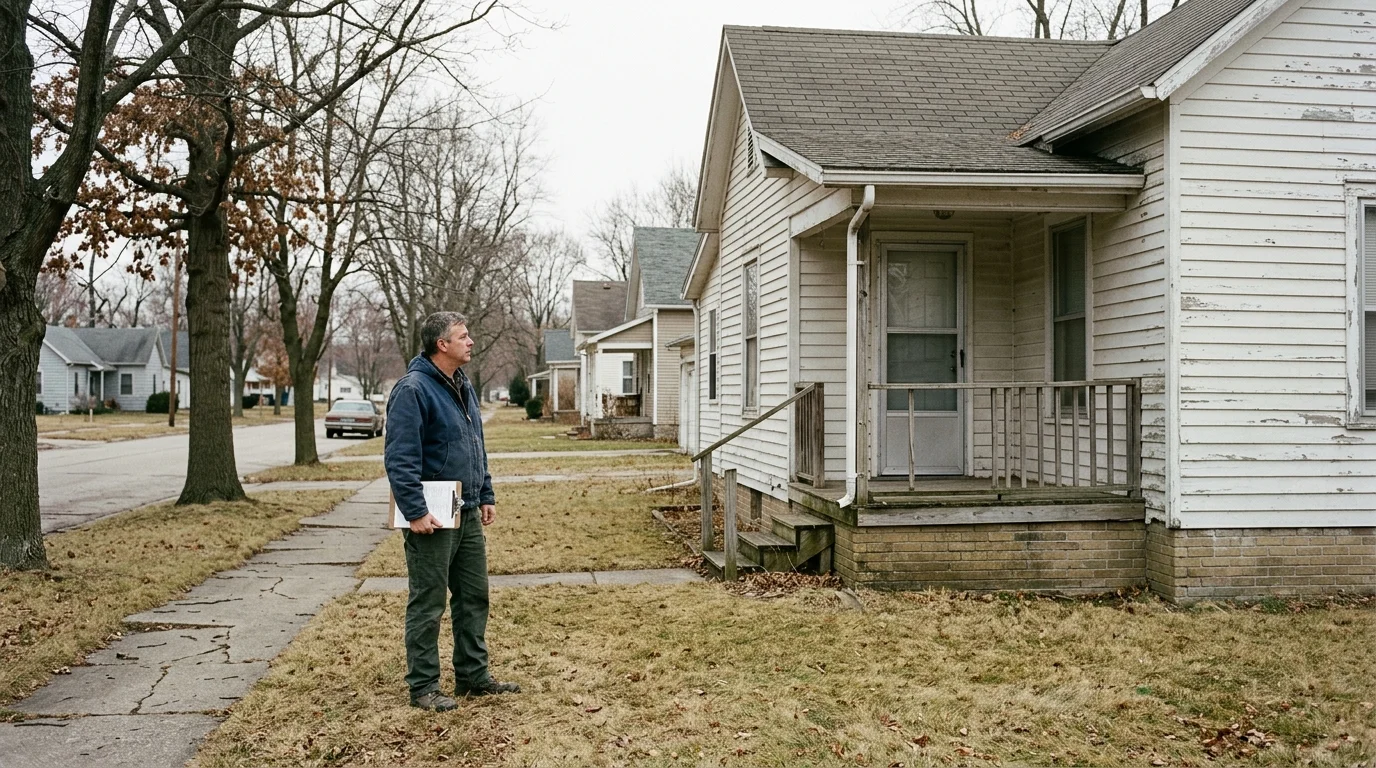
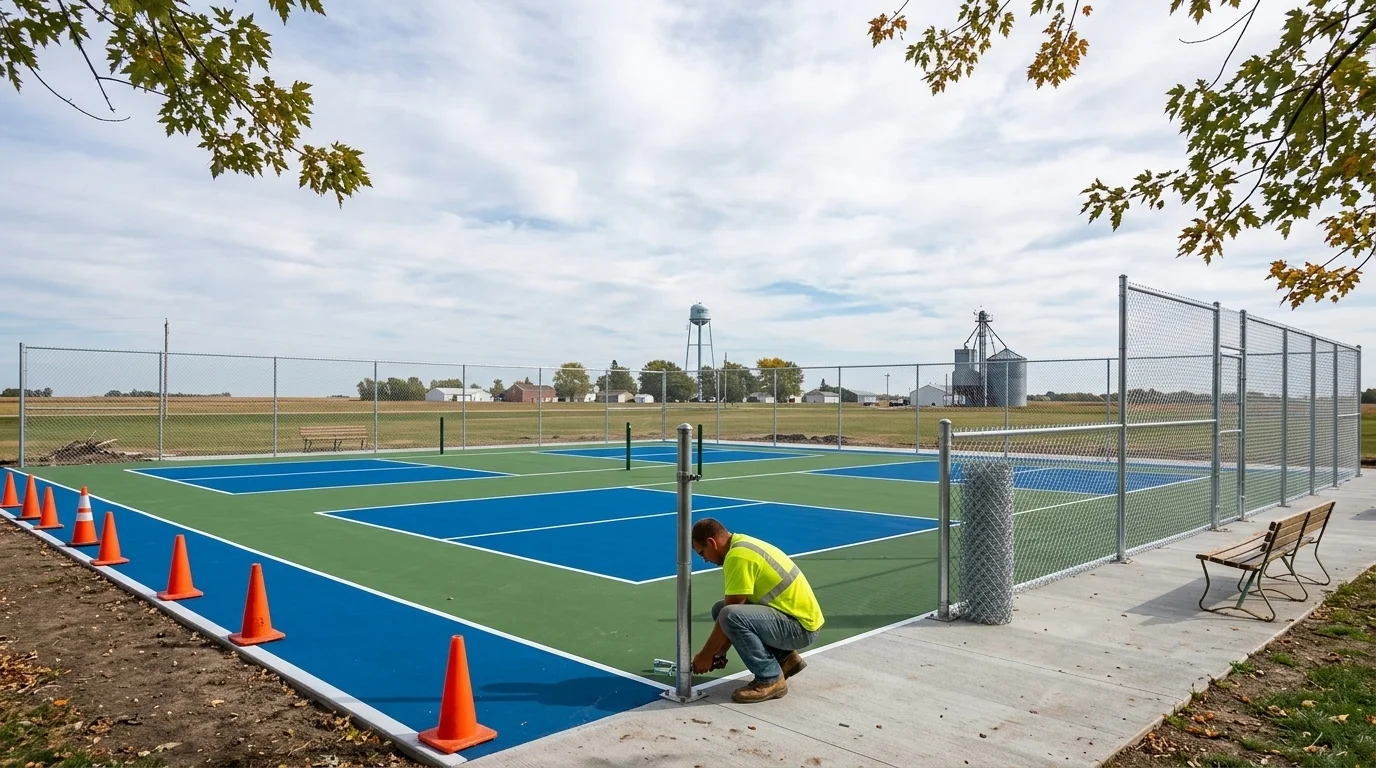
The issuer list reflects it. Ann Arbor has an open procurement for design and construction management of new charging stations. Ann Arbor Public Schools is out to bid on Phase 2 of its Transportation South Lot EV conversion. Bedford Township in Calhoun County is seeking Level 2 chargers for its public library. A Charlevoix County entity is also in the market. These are not highway interchange operators. They are a school district's bus yard, a township library, a county agency, the kinds of local institutions that had been waiting on federal clarity before committing staff time and budget to procurement documents they weren't sure they could fund.
The geographic spread is notable. Washtenaw County and Charlevoix County are not adjacent; one anchors southeast Michigan and the other sits at the top of the Lower Peninsula. A freeze-and-release dynamic that only showed up in one metro would suggest local budget cycles or a single municipality's planning calendar. The fact that it is showing up across regions, and in institutions as different as a public school system and a rural township, points to the federal unlock as the common cause.
Michigan is not alone. Ohio recorded 23 EV charging RFPs in the same 30-day window, according to procurement data, suggesting the NEVI reactivation is a Midwest-wide phenomenon driven by the same federal policy shift rather than anything specific to Michigan's own programs. As Electrek reported on the day of the announcement, the approval resolved uncertainty that had stalled not just state-level planning but the local procurement layers that depend on knowing federal dollars are coming.
The stakes underneath this activity are large. Michigan currently has 2,102 charging locations statewide. Its 2030 goal calls for roughly 10,000 DC fast chargers and 90,000 Level 2 chargers, a gap of approximately 50x on fast charging alone. The 83 stations being deployed from NEVI Rounds 1 and 2 are a start. MDOT is now preparing Round 3 applications targeting geographic gaps, fleet and medium-duty vehicles, and charger reliability, which means the procurement volume visible today is likely a leading indicator of a larger wave, not the wave itself.
The political context is specific to Michigan in a way it is not to any other state. The state that built the American auto industry around the internal combustion engine is now visibly behind on the infrastructure its own automakers need to sell EVs at volume. Ford, GM, and Stellantis all have significant EV commitments tied to Michigan operations. A charging network that cannot keep pace with vehicle deployment is not just a public convenience problem; it is a competitive problem for the manufacturers headquartered here.
For residents and local officials, the immediate signal is that procurement windows are open now in a way they were not six months ago. For anyone watching the broader NEVI rollout, the next marker is MDOT's Round 3 application, which will show how the state prioritizes the remaining geographic and fleet gaps once the accumulated backlog of local bids begins to clear.