Seventeen California institutions issued homelessness-response RFPs in the 30 days ending July 17, 2026, the highest single-month burst in over a year and more than double any peer state: Washington issued 8, Texas 3, Florida 2, New York 1. The spike is not a coincidence of timing. Governor Newsom signed AB 179 on July 13, releasing $900 million in HHAP Round 7 block grants, and attached conditions that effectively require cities to produce procurement activity before they can qualify. The RFPs followed within days.
The compliance clock is the story. AB 179 requires cities over 300,000 residents and their counties to achieve Prohousing designation and demonstrate encampment-policy alignment to receive HHAP funding directly. Only 60 of California's 541 cities and counties currently hold Prohousing status. For the hundreds that don't, issuing an RFP is among the fastest signals a jurisdiction can send that it is building the local infrastructure the state wants to see. The law doesn't wait for intent; it asks for paperwork.
Four institutions in the cohort had issued no homelessness RFP in the prior 12 months. Riverside, a city of 318,000 that sits squarely above the Prohousing accountability threshold, issued an encampment clean-up RFP within days of the signing. Chula Vista (274,000) followed with an encampment abatement solicitation. El Monte (102,000) put out an emergency lodging RFP. Oxnard Union High School District entered the market for youth and family homelessness services. These are not cities with continuous procurement cycles. Their sudden appearance in the RFP market is a direct read of the incentive AB 179 created.
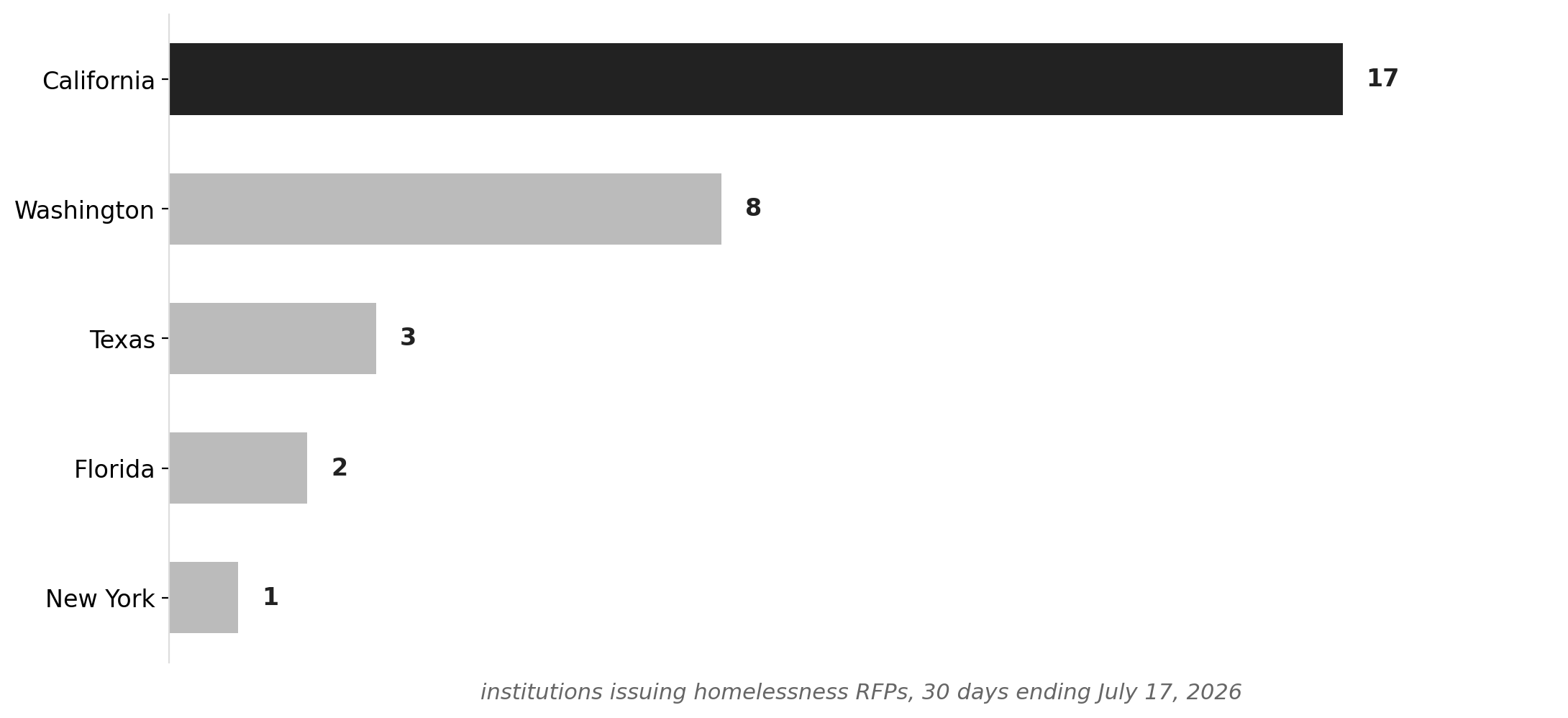
Source: NationGraph.
Riverside Mayor Patricia Lock Dawson, who chairs the California Big City Mayors Coalition, has pointed to 130 or more shelter beds and 100 permanent housing units created through prior HHAP rounds as proof the program produces results. Her city's encampment RFP, the first in over a year, lands in that context: Riverside already knows HHAP money works, and AB 179 just made clear that cities that don't show active procurement are less likely to get the next round.
The 17 institutions span the full range of what AB 179's accountability framework demands. Shasta County issued a Homekey+ permanent housing development RFP. Several jurisdictions moved on emergency shelter. The encampment abatement cluster in Southern California reflects a specific compliance test: the new law requires encampment-policy alignment, and an active abatement contract is easier to document than a policy position. LA, San Diego County, Oakland, and Sonoma County are also in the cohort; their July RFP volume already exceeds each of the five preceding months, suggesting the signing catalyzed action across all tiers at once, not just among the newcomers.
The ground for this moment was laid earlier in 2026. In January, the state announced $419 million in HHAP Round 6 disbursements to LA, San Diego, and San Francisco, and in April an additional $145.4 million went to eight regions including Orange, Sacramento, and Santa Clara counties. The pipeline from Sacramento to local governments was already moving; AB 179 widened it and added a gate. Active federal HHAP grants to California entities already exceed $500 million, with LA City holding $164 million, LA's Continuum of Care $102 million, and LA County $97 million, all running through 2029. For jurisdictions outside that established funding orbit, Round 7 represents one of the clearest opportunities in years, and the compliance conditions make early procurement activity part of the qualifying process.
The new California Housing and Homelessness Agency, which formally launched July 1, 2026, as a consolidated procurement-facing body, adds institutional weight to the urgency. Cities that had gone quiet on homelessness contracting now have a single state counterpart tracking whether they are building the local infrastructure the accountability framework expects.
For residents in Riverside, Chula Vista, or El Monte, the near-term change is visible: more active solicitation processes, more contractors bidding on local services, and a city hall more likely to be negotiating shelter and encampment contracts than it was six months ago. Whether that procurement activity translates into faster service delivery depends on how quickly cities can move from RFP to award to implementation, a sequence that historically takes several months even under pressure.
The next signal to watch is how many of the 17 institutions convert their RFPs into executed contracts before the Round 7 application window closes, and whether the remaining 481 cities and counties without Prohousing designation begin moving in the months ahead. AB 179 set the clock on July 13. The procurement scramble it produced is already measurable.