Researchers at NYU are building real-time defenses for the electric grid against AI-powered intrusions, paid for by the U.S. Department of Energy. Down the subway line, CUNY's Queens College is standing up a digital forensics research hub with Congressional earmarks championed by Rep. Grace Meng and Senators Schumer and Gillibrand. Across the state, SUNY campuses are absorbing NSF scholarships to train the next generation of government cybersecurity workers. The three programs share almost nothing mechanically, but they are all arriving at once, and New York's public universities are the ones collecting the checks.
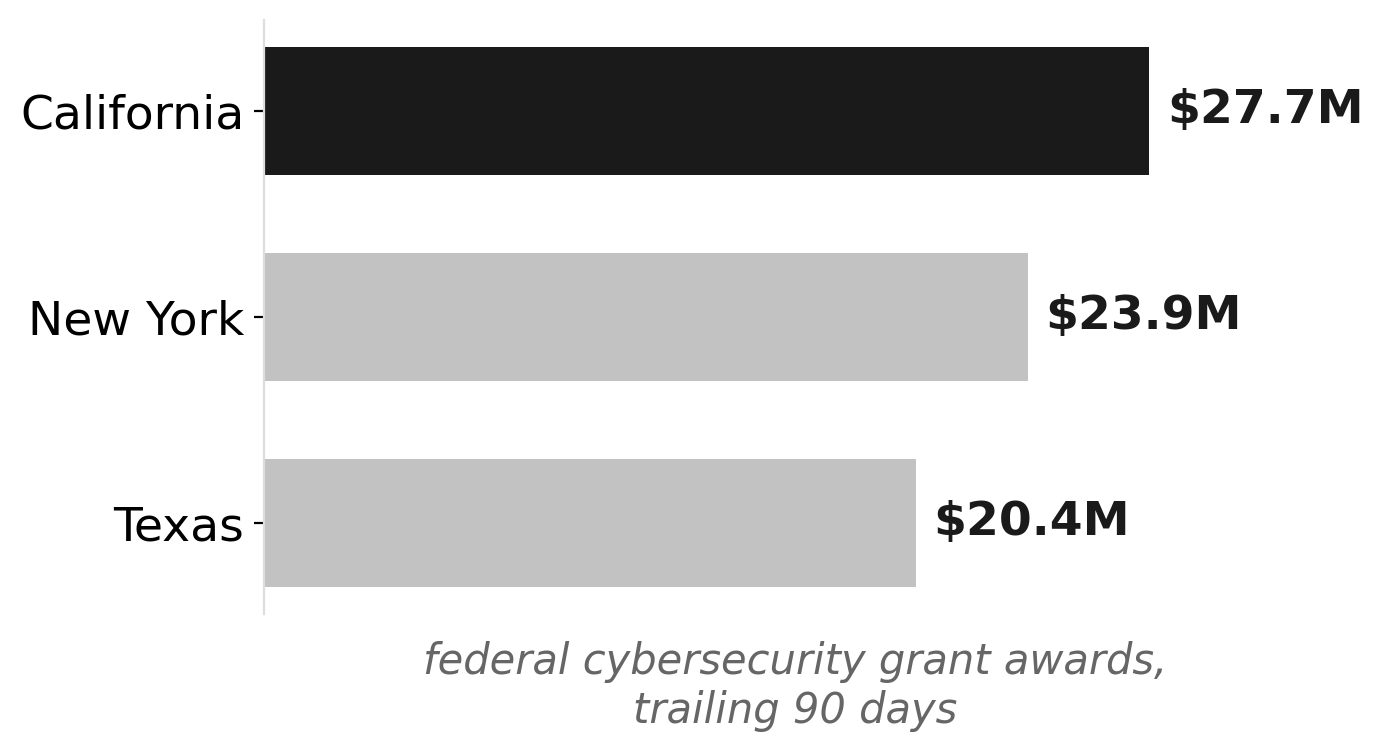
In the trailing 90 days, clearly scoped federal cybersecurity grants flowing through those university and research channels reached approximately $6.2 million in new awards, part of a broader $23.9 million in federal cybersecurity-coded grant activity in the state, up 78% from $13.5 million in the same window last year. That pace puts New York second nationally, behind California's $27.7 million and ahead of Texas at $20.4 million. The active NY cybersecurity portfolio running across all current federal commitments spans NSF ($26.9 million, 32 grants), DHS ($11.8 million), DOE ($11 million), and the Department of Commerce ($4.6 million).
The most technically specific of the three drivers is the DOE's Office of Cybersecurity, Energy Security, and Emergency Response, known as CESER. In October 2025, DOE announced nearly $23 million in grid security awards nationally, with NYU receiving $2.5 million to build a distributed anomaly detection framework for compromised grid-edge assets, the substations, smart meters, and sensor arrays that sit at the boundary between physical infrastructure and networked control systems. SUNY received $2.4 million from the same CESER round for a separate and distinct project: forecasting the spread of wildfires toward electrical infrastructure, a problem that has become inseparable from grid resilience in an era of climate-driven fire seasons. These are R&D grants; the deliverable is research and working tools, not trained workers. Both are funded under the Bipartisan Infrastructure Law's CESER allocation, which runs through FY2026.
Source: NationGraph.
The workforce track operates through a completely different pipeline. NSF's CyberAICorps Scholarship for Service program, launched in July 2026 as a direct evolution of the federal CyberCorps program that has run since 2001, now explicitly integrates AI into its cybersecurity training mandate. Awards fund universities to credential professionals who then fulfill government service obligations, a pipeline designed to address what ISC2 estimated as roughly 700,000 unfilled cybersecurity positions nationally, concentrated in healthcare, finance, and government. SUNY campuses received approximately $1.05 million in NSF awards in the trailing 90 days under this and related NSF STEM programs; RIT pulled in $1.5 million under NSF's Technology, Innovation, and Partnerships directorate in August 2026. CUNY's 25-campus system and SUNY's 64 campuses give New York an unusually dense base of grant-eligible institutions positioned to absorb future CyberAICorps rounds.
The third mechanism is the most explicitly political. The $3.1 million flowing to the CUNY Research Foundation for Queens College and York College came not from a competitive grant program but from Congressional FY2026 Departent of Commerce appropriations earmarks, line items negotiated by Meng, Schumer, and Gillibrand as part of what CUNY described as a record $25 million federal appropriations package for the system. The Queens College allocation funds a digital forensics research hub; York College receives support for a cybersecurity and AI STEM workforce program. These are capacity-building investments, labs, curriculum, faculty infrastructure, rather than scholarship stipends or R&D contracts.
A fourth stream runs parallel and separately: DHS and FEMA's State and Local Cybersecurity Grant Program, which in FY2025 allocated $91.75 million nationally with New York's statutory share set at $2.85 million. Governor Hochul separately announced $13.9 million in combined FY2022-2023 SLCGP funds in September 2025 to deploy multi-factor authentication tokens across state and local government systems, with state CIO Dru Rai overseeing the rollout. That program targets government IT systems directly, not universities, and 80% of its funds must pass through to local governments, a structure entirely separate from the university R&D and workforce tracks.
What ties the university-focused streams together is the underlying geography of New York's risk exposure. The state's financial system, its power grid corridors, and its municipal IT infrastructure make it both a high-value target and a natural argument for federal investment. CUNY and SUNY graduates disproportionately feed into the public-sector workforce that manages exactly those systems.
The next inflection point is the CyberAICorps SFS competition cycle. NSF has said it will support up to 25 projects per year at up to $2.5 million each, and with SUNY and CUNY both holding active NSF relationships and large pools of government-bound students, the question for the next 90 days is how many additional campuses convert that positioning into awards. The DOE CESER program's BIL funding window closes in FY2026, which means the NYU and SUNY grid-security grants are near the end of their authorized pipeline. Whether Congress extends or replaces that authority will determine whether the grid-hardening track continues at this pace or stalls while the workforce track accelerates.