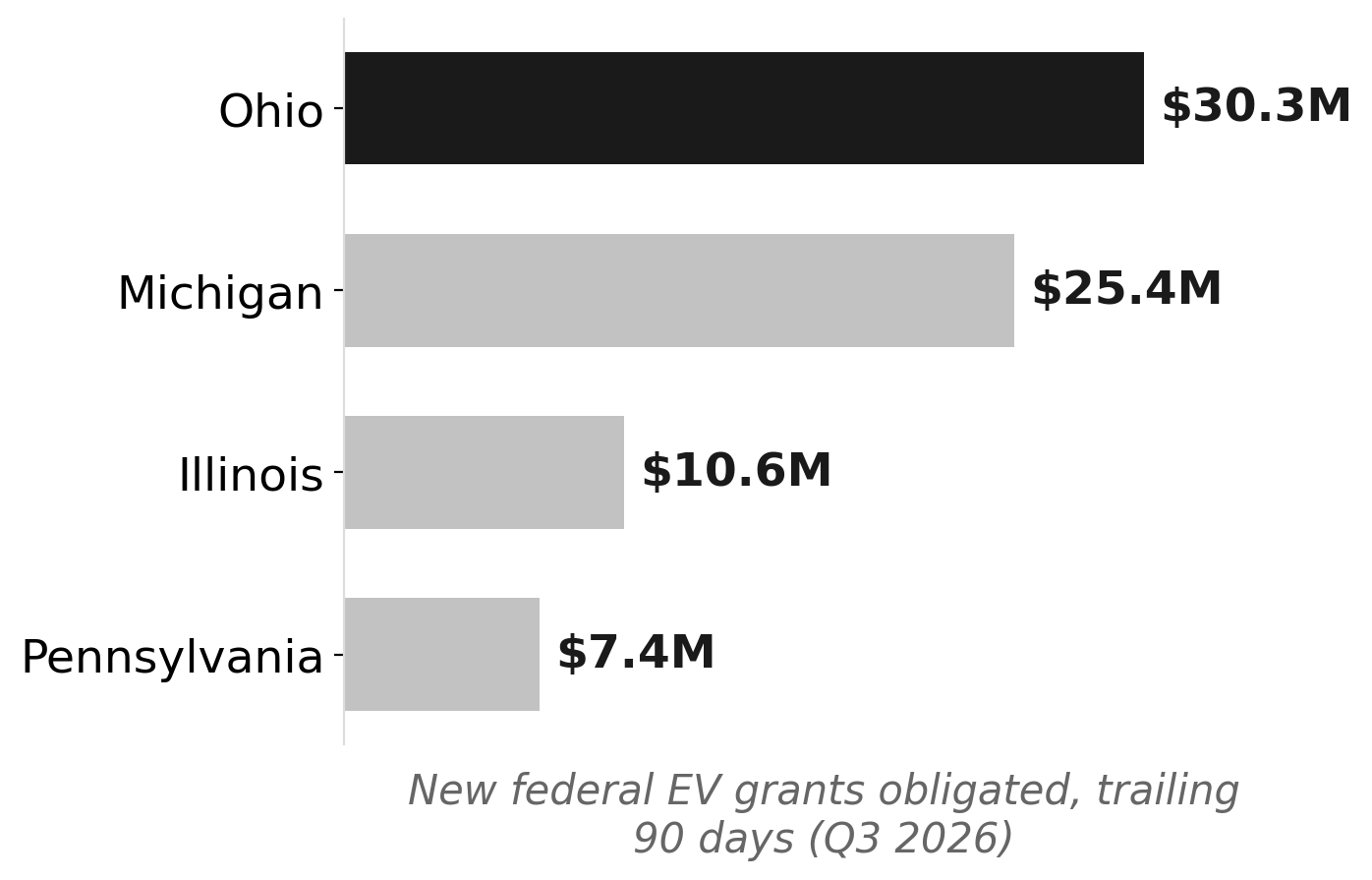
Ohio has obligated $30.3 million in federal electric vehicle grants in the trailing 90 days, a 136% increase over the $12.8 million recorded in the same window one year ago, and the state leads every Midwest peer by a wide margin. Michigan, the next closest, pulled in $25.4 million in the same period. Illinois received $10.6 million and Pennsylvania $7.4 million.
Nearly all of it flows through a single channel: 36 of the 37 new awards go directly to the Ohio Department of Transportation under the National Electric Vehicle Infrastructure Formula Program, the federal charging build-out enacted in the 2021 Infrastructure Investment and Jobs Act. The remaining award is a $50,000 NSF research grant to Ohio State University. This is not a sudden burst of state generosity. It is ODOT racing against two simultaneous federal deadlines that did not exist eighteen months ago.
The acceleration comes from compounding pressures, each distinct. The first is judicial. In January 2026, a federal district court issued a final judgment in Washington v. U.S. Department of Transportation, enjoining the Trump administration from blocking previously approved state NEVI deployment plans. Ohio's plan had been approved before the 2025 administrative freeze; as Eno Transportation Foundation reported, the injunction restored ODOT's ability to obligate funds that had been locked in bureaucratic limbo for months.
Source: NationGraph.
The second pressure is legislative and more permanent. The Consolidated Appropriations Act, 2026 repurposed $503.8 million in unobligated NEVI formula funds back into general FHWA highway programs, with the clawback calculated based on each state's unobligated FY2022 balances as of January 31, 2026. States that had delayed obligating their earliest NEVI apportionments lost money, proportionally and irrevocably. The court ruling and the budget law point in the same direction, use the money now, but they are structurally different levers: one restores access that was blocked, the other penalizes inaction that already occurred.
ODOT moved quickly once both constraints lifted. On April 10, 2026, ODOT Director Pamela Boratyn announced a Round 4 award of $51 million to 64 new fast-charging sites across the state, paired with more than $26 million in private developer matching funds for a total public-private commitment exceeding $77 million. Developers in the round include BP Products North America, Pilot Travel Centers, Sheetz, Tesla, Love's Travel Stops, Aldi, and United Dairy Farmers. Individual site-level federal grant obligations, ranging from roughly $800,000 to $1.4 million per location, are now flowing through the summer of 2026, producing the spike visible in the 90-day numbers.
Ohio's first-mover history matters here. The state broke ground on the country's first NEVI-funded station in October 2023 and opened it in December 2023. That head start meant Ohio's state deployment plan was fully approved and in the queue when the freeze-and-unfreeze cycle hit, allowing ODOT to re-enter the obligation pipeline faster than states still negotiating initial plan approvals. FHWA's certification that Ohio's interstate alternative fuel corridors were fully built out in fall 2025 added another advantage: Round 4 sites are not restricted to corridor boundaries, giving ODOT flexibility to place chargers in communities that could not have qualified in earlier rounds.
EV adoption in Ohio is keeping pace. September 2025 marked the first month in which 5% of new Ohio vehicle registrations were electric, with more than 126,000 EVs now registered statewide. The infrastructure being obligated now is calibrated for a fleet that is growing faster than any previous projection suggested.
The scale of unspent money underscores how much work remains. Ohio's full active EV grant portfolio across all currently running awards stands at $288.5 million in total obligated federal funds. Only $42.6 million has been disbursed. That gap, roughly $246 million between commitment and cash out the door, reflects the construction timeline for Round 4 sites, which are not expected to break ground until early 2027, but it also signals that the hard work of turning federal obligations into operating chargers is still largely ahead.
One friction point looms. FHWA proposed in February 2026 a 100% domestic sourcing requirement for EV charging equipment. As of the most recent Congressional Research Service analysis, no known equipment meets that standard. If the requirement takes effect without a waiver pathway, it could slow procurement for Round 4 installations even after the funding window closes.
The immediate question for Ohio is whether the 64 Round 4 sites can move from award to construction before any further federal program changes alter the terms. ODOT has the obligations in hand; the 2027 construction timeline is the next milestone to watch.