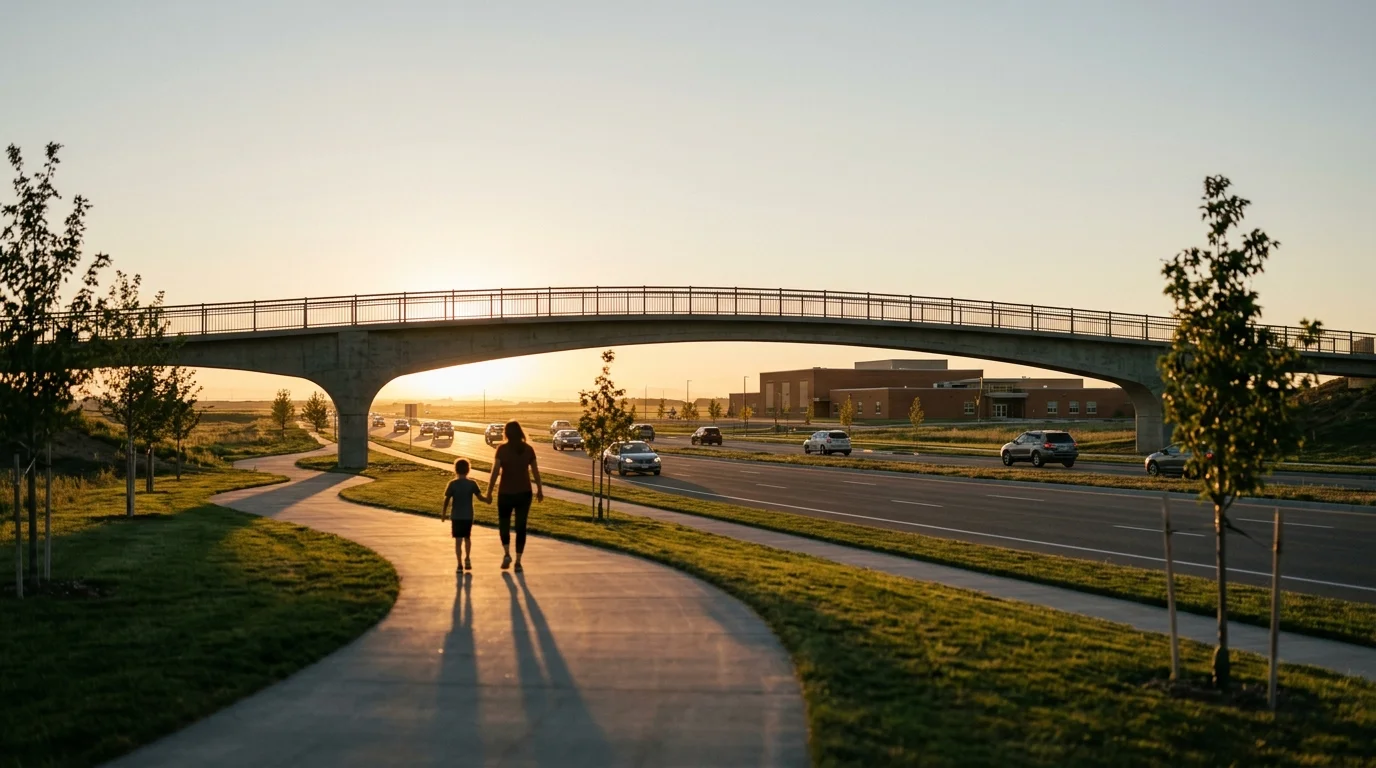
Commerce City, Colo., is building a pedestrian bridge and trail system to give schoolchildren safe walking routes through neighborhoods that have grown up on land once called the most contaminated site in the United States.
The project, framed under the federal Safe Routes to School program, targets the Reunion and North Range subdivisions built on former Rocky Mountain Arsenal land. Those neighborhoods have added thousands of households over the past decade, with schools in the Adams 14 and 27J school districts often separated from the homes they serve by wide arterials like Tower Road, 96th Avenue and E-470. Without a dedicated crossing, walking to school means navigating roads designed for traffic, not children.
The Arsenal's transformation from a Cold War chemical weapons manufacturing site to a Denver suburb is one of the more improbable urban stories in Colorado history. After being declared a Superfund site in 1987 following decades of mustard gas and nerve agent production, a $2.1 billion cleanup wrapped up its major phases around 2010. Most of the land became the Rocky Mountain Arsenal National Wildlife Refuge, a 15,000-acre federal preserve. The remaining parcels were handed over to Commerce City for redevelopment.
The result has been explosive growth. Commerce City's population has climbed roughly 40 percent since 2010, to more than 62,000 residents today, making it one of Colorado's fastest-growing municipalities. As Commerce City's infrastructure has strained to keep pace, pedestrian connectivity has lagged behind housing and school construction. A bridge that closes a gap between a neighborhood and a school is, for many families in a city where more than half of residents are Hispanic or Latino and median incomes run below the state average, the difference between a child walking and a parent taking time off work to drive.
The city posted the solicitation for contractors on July 31, 2026, through the Rocky Mountain Bid System. The total project cost, exact bridge location and construction timeline have not been publicly disclosed, and those details are expected to become clearer as the contracting process moves forward.