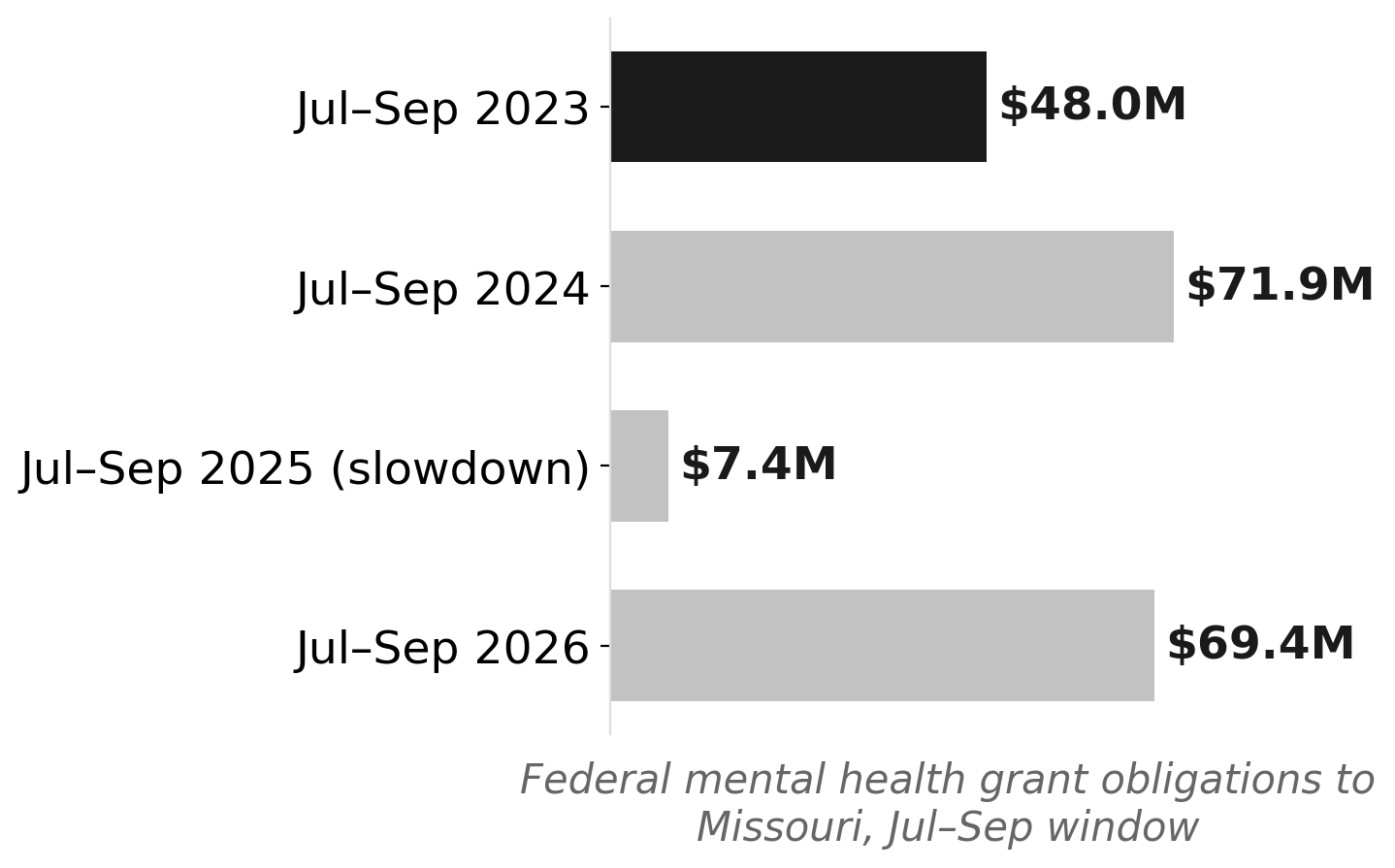
Missouri received $69.4 million in federal grants matching mental health programs in the 90 days ending September 30, 2026, up from $7.4 million in the same window a year earlier, a 842% increase that is real money but requires a split-screen explanation.
The two screens show almost nothing in common. On one side: Washington University in St. Louis captured $47.9 million across 64 NIH grants, the bulk of it basic and clinical biomedical research swept into the fiscal quarter because the federal government was roughly $1 billion behind its normal award pace entering the summer. On the other: the Missouri Department of Mental Health received $7.3 million in SAMHSA grants, including a $4.71 million cooperative agreement to build out the state's 988 Lifeline capacity over three years, alongside smaller awards funding rural substance-abuse treatment and criminal-justice diversion in the Ozarks. Both arrived in Missouri at the end of September. They reflect entirely different federal programs, different funding mechanisms, and different crises.
The NIH side of the ledger has a structural explanation. After a 43-day government shutdown and White House delays that stalled grant reviews for much of FY2026, NIH entered the summer having obligated only a fraction of its estimated $38 billion extramural budget. As Science reported, the agency faced an obligation cliff at September 30 and executed what amounted to a frenzy of year-end grantmaking, pushing more than $8 billion out the door in August and September alone. Washington University's psychiatry and neuroscience departments, which rank among the top ten NIMH-funded institutions nationally, were already in the awards pipeline. The September cluster of WashU grants is less a new investment decision than the delayed arrival of work already approved, compressed by calendar math into a single quarter. Of the $47.9 million to WashU, roughly $12.4 million carries explicitly NIMH mental health research titles; the remainder are cardiovascular, diabetes, and arthritis grants whose descriptions matched the federal grant search query.
Source: NationGraph.
The SAMHSA side reflects something more deliberate. In January 2026, SAMHSA announced a $231 million funding opportunity to administer the 988 Lifeline and distribute state-level capacity grants, with state awards landing on September 30. Missouri's $4.71 million cooperative agreement runs through September 2029 and targets workforce development, mobile crisis expansion, and quality improvement, with explicit attention to rural counties that currently route mental health emergencies through hospital emergency rooms for lack of alternatives.
That rural emphasis matters. Separate SAMHSA grants totaling $1.6 million went to Lincoln County Ambulance District, with additional awards of roughly $300,000 each to ambulance districts in Washington and Ste. Genevieve counties, non-traditional crisis providers that signal federal willingness to route behavioral health money outside hospital systems in low-density areas. A $650,000 SAMHSA grant to Missouri DMH funds the Southeast Missouri Early Diversion Initiative, targeting more than 1,300 adults at risk of criminal-justice involvement across seven rural counties over five years. Missouri's suicide prevention network has identified middle-aged rural men as the state's highest-risk population, giving these grants particular operational weight.
The urgency behind the SAMHSA awards is partly political. Missouri funds 988 from state general revenue rather than a dedicated telecommunications fee, leaving it more exposed than most states to federal appropriations uncertainty. Leaked HHS budget drafts earlier in 2026 proposed cuts to the Lifeline, accelerating the state's push to lock in multi-year federal commitments while they remained available. Missouri's own House budget proposal for FY2027 included $18.5 million for 988 operations and $22.3 million for associated crisis services from general revenue, an acknowledgment that the federal backstop may not hold.
The year-over-year comparison, while accurate, is partly a mirage. The July-through-September 2025 window was a statistical floor: only 27 grants totaling $11 million started that quarter, suppressed by the same federal slowdowns that created the 2026 backlog. The same quarter in 2024 produced $71.9 million. Missouri's current $69.4 million is, in the multi-year picture, a return to the normal range after an anomalously quiet year.
What changes for Missourians is more concrete on the crisis-services side than the research side. The 988 cooperative agreement gives Missouri DMH three years of dedicated federal funding to expand call center capacity and mobile crisis teams in counties where the nearest psychiatric bed can be hours away. The ambulance district grants put behavioral health resources in agencies that often arrive first at rural emergencies. Those investments build infrastructure that will outlast the fiscal year that produced them.
The open question is whether they outlast the next federal budget cycle. Missouri's 988 network will spend the next year hiring and expanding under the assumption that the $4.71 million is the floor, not the ceiling. Whether SAMHSA's next cooperative agreement cycle arrives on schedule, or gets compressed into another September 30 sprint, will determine how much of that infrastructure becomes permanent.