Five Virginia universities entered federal cybersecurity funding pipelines simultaneously this year, a concentration that has no precedent in any prior comparable window. George Mason, UVA, and VCU each received Innovation Track grants under NSF's newly launched CyberAICorps Scholarship for Service program in August and September 2026, placing them among the inaugural national cohort of 14 institutions chosen to redesign how the country trains its federal cyber workforce. Virginia State University, in Petersburg, received a separate $1.03M congressionally directed grant from the Department of Commerce in May 2026 to build a Center for Generative AI and Industrial Cybersecurity. Virginia Tech collected $1.5M from DOT in September 2026 to research cybersecurity for commercial motor vehicle fleets. That is five institutions, three federal agencies, and roughly $3.8M in new awards within a single academic year, none of them funding the same thing.
The simultaneity is not coincidence. It reflects two distinct federal programs reaching Virginia at the same moment, each operating through a different mechanism and targeting a different gap.
The first is the DHS State and Local Cybersecurity Grant Program, authorized by the Infrastructure Investment and Jobs Act of 2021. SLCGP is a formula-based grant that flows to state emergency management agencies and must pass through to local governments: at least 80 percent to municipalities and counties, at least 25 percent to rural areas. Virginia Emergency Management has been approved for every program year since 2022. Its current active portfolio holds two tranches totaling $8.69M: $6.55M awarded in December 2024 and $2.14M in September 2025, both running through 2028-2029, as CISA and FEMA have documented. The program is designed to harden the IT infrastructure of the 170-plus local government entities that lack the internal security capacity of a large agency. Virginia exceeded the rural pass-through floor, directing 62 percent of funds to rural localities.
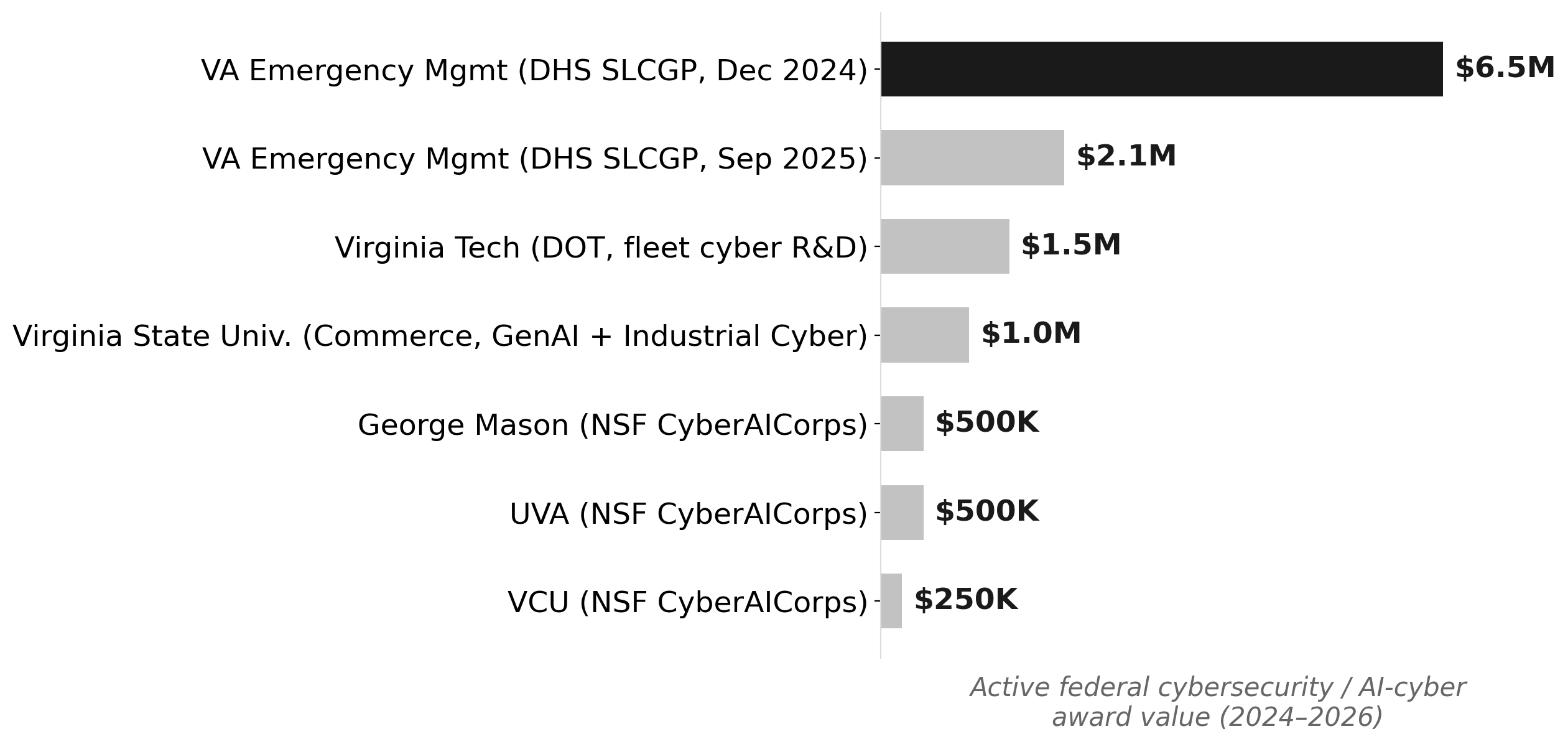
Source: NationGraph.
The second program is newer, and structurally different. NSF's CyberAICorps Scholarship for Service, issued under solicitation NSF 26-503 in July 2026, is a rebranding and expansion of the 25-year-old CyberCorps SFS program. The change is substantive: the new program explicitly requires institutions to integrate AI competency into cybersecurity training, treating the two as a single discipline rather than adjacent fields. Innovation Track grants of up to $500K fund curriculum and program development. Scholarship Track awards, available in future cycles, can reach $2.5M and fund student stipends for graduates who commit to federal service. George Mason and UVA each received $500K; VCU received $250K. HPCwire reported that the program represents the federal government's clearest signal yet that AI fluency is no longer optional for people entering federal cybersecurity roles.
The VSU award sits on a third track entirely. The $1.03M from the Department of Commerce is a congressionally directed community project grant, secured by Rep. Jennifer McClellan (D-VA-04), for physical research infrastructure: high-performance computing equipment, a cyber range platform, and a digital forensics lab. It is not a scholarship program and not a government IT hardening effort. It is a research center, at the first Virginia HBCU to hold such a designation, built to work specifically at the intersection of generative AI and industrial control system security.
The reason Virginia is landing in all three pipelines at once has a structural explanation. The Commonwealth Cyber Initiative, a state-funded consortium of more than 40 Virginia universities, created an institutional coordination layer that most states lack. Universities that might otherwise compete for the same faculty, the same grant officers, and the same industry partnerships instead share infrastructure and signal readiness collectively. When NSF designed the inaugural CyberAICorps cohort, Virginia institutions were already operating inside a state-level network built for exactly this kind of federal interface. Virginia's geographic position reinforces the effect: the Pentagon, CISA's Arlington offices, and a dense concentration of defense contractors mean that graduates who complete a federal-service obligation after a CyberAICorps scholarship have no shortage of placements within the Commonwealth.
For Virginia residents, the near-term change is visible at two levels. Local governments, particularly smaller counties without dedicated IT security staff, will see the SLCGP funds arrive through the state emergency management pipeline over the next three years, funding risk assessments, staff training, and infrastructure upgrades. At the university level, students entering cybersecurity programs at Mason, UVA, or VCU will encounter curricula that treat AI tools as foundational, not elective, and that carry a federal service pathway attached to scholarship funding.
The next signal to watch is whether any of Virginia's CyberAICorps Innovation Track recipients convert to Scholarship Track awards in the next competition cycle. That shift, from curriculum design grants to student stipend funding with federal service commitments, is when the workforce pipeline becomes operational rather than theoretical. NSF has not announced a timeline for Scholarship Track solicitations under the new program, but the Innovation Track window closes in late 2026.