Seventeen federal SAMHSA grants totaling $10.69 million landed in Oklahoma on September 30, 2026, the last day of the federal fiscal year, compared to $918,000 in the same window a year ago. The 1,064 percent jump looks dramatic, but it is mostly a calendar artifact: SAMHSA's Projects of Regional and National Significance (PRNS) program and its State/Tribal Opioid Response grants run on an annual competitive cycle that almost always closes out on September 30. Last year's window was an anomalous trough of four awards; FY2024's comparable batch was $72 million across 28 grants. What the new awards do reveal, once you look past the headline number, is the architecture Oklahoma has quietly assembled to fight fentanyl from three directions simultaneously.
The first pipeline is federal. SAMHSA's PRNS and Opioid STR programs flow directly to state agencies, cities, universities, and tribal health programs through HHS on a competitive basis. The new batch reflects that breadth: the Oklahoma Department of Mental Health and Substance Abuse Services (ODMHSAS) received the two largest awards, $2 million for prevention and $850,000 for treatment, while the City of Tulsa received $905,000 and the City of Norman $738,000. Seven of the 17 awards, totaling roughly $3.2 million, went directly to tribal nations, including the Wichita and Affiliated Tribes ($750,000), the Choctaw Nation ($740,000), and the Comanche Nation ($731,000). Those tribal grants do not pass through ODMHSAS; they land directly in tribal health programs operating under their own sovereignty.
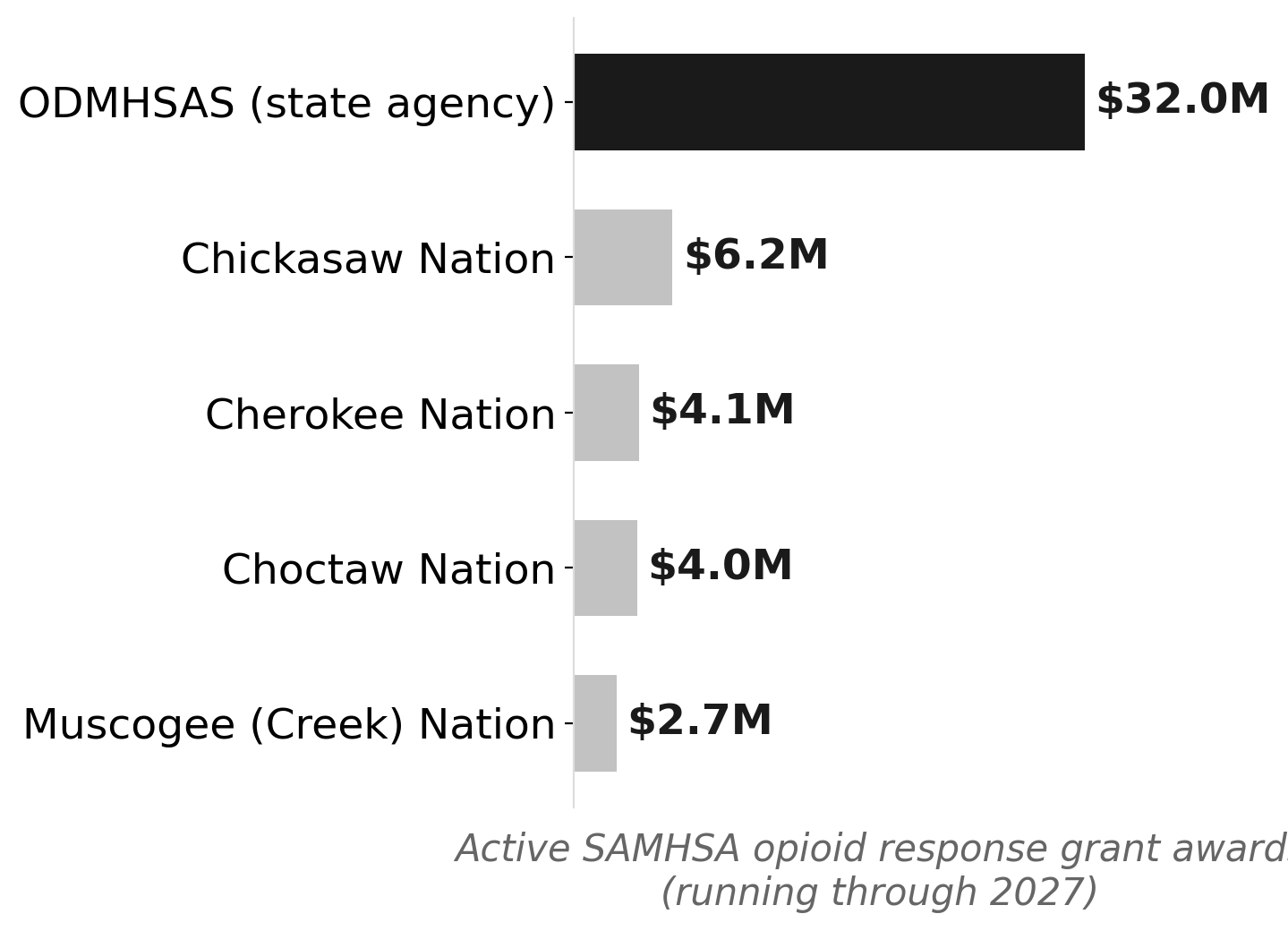
That distinction matters because of Oklahoma's structural position. The state has 39 federally recognized tribal nations, the largest concentration outside Alaska, and after the U.S. Supreme Court's 2020 McGirt ruling affirmed the legal footprint of tribal sovereignty across much of eastern Oklahoma, tribal health systems became more explicitly independent actors in state public health. Tribal nations here are eligible for federal SAMHSA Tribal Opioid Response grants, for direct distributions from the $590 million national tribal opioid settlement fund, and for the same competitive PRNS awards as any city or county. The active SAMHSA portfolio running through at least 2027 already includes $6.2 million to the Chickasaw Nation, $4.1 million to the Cherokee Nation, $4 million to the Choctaw Nation, and $2.7 million to the Muscogee (Creek) Nation, alongside $32 million to ODMHSAS. As NPR reported in 2023, the Cherokee Nation's harm reduction program in Tahlequah became the first tribal entity nationally to receive a SAMHSA public health grant that included a syringe services component, a marker of how far tribal programs have pushed into territory that state agencies have historically been slower to enter.
Source: NationGraph.
The urgency is not abstract. Oklahoma's fentanyl death toll rose roughly 1,300 percent from 2019 to 2023. Two counties within the Muscogee (Creek) Nation reservation ranked among the state's top five for opioid overdose deaths in 2023. The geography of the crisis and the geography of tribal sovereignty overlap directly.
The second pipeline runs through the Oklahoma Attorney General's office. AG Gentner Drummond's Opioid Abatement Board, constituted under HB 4138, awarded more than $12 million to Oklahoma communities in August 2026, its fourth competitive grant cycle, funded entirely from opioid manufacturer lawsuit settlements, not from federal appropriations. The board has now distributed more than $30 million since 2023. In the same month, Drummond announced a separate $12 million settlement with eight manufacturers, including Amneal, Hikma, and Indivior, replenishing the fund. This money is state-controlled, distributed through a competitive process the AG chairs, and flows to counties, municipalities, public trusts, and school districts, a recipient pool that does not overlap with the federal SAMHSA pipeline.
The third pipeline flows directly to tribes through national settlement distributions, entirely outside both the state ODMHSAS system and the AG's board. Oklahoma's 39 tribal nations each hold independent eligibility for a share of the $590 million national tribal opioid settlement allocation. The Oklahoma-specific tribal share has not been publicly itemized, but the structure means tribal communities can draw from federal grants, state settlement programs, and private settlement proceeds at the same time.
For Oklahomans living in or near tribal jurisdiction, which, post-McGirt, covers a substantial share of the state's geography, the practical effect is that opioid services may be delivered by a tribal health authority, a city health department, or a county program funded from any of these streams, or some combination of all three. The Oklahoma Opioid Abatement Board's grant application portal is currently open for its next cycle, and SAMHSA's annual PRNS competition will reopen when the federal fiscal year turns again on October 1.
The next signal to watch is whether ODMHSAS's $32 million Opioid STR grant, which runs through 2027, is renewed at a comparable level in the FY2027 SAMHSA cycle, and whether tribal recipients, now accounting for nearly half of the state's new PRNS awards by recipient count, continue to expand their share of competitive federal dollars relative to state and municipal grantees.