Wisconsin issued 17 opioid-related RFPs in the last 30 days, against a 12-month monthly average of roughly 1.7, a tenfold surge that looks, at first glance, like a system in crisis. The opposite is closer to the truth.
The procurement spike is the product of a deliberate batch deployment: Wisconsin DHS opened its entire SFY2026-2027 opioid settlement grant cycle in a single October window, with application deadlines for at least five distinct programs clustering between early and late October. The Overdose Prevention Supplies Program closed October 25. Room and Board Residential SUD funds closed October 9. Law Enforcement Opioid Abatement was due in July. Reentry Navigator and Peer Services Expansion in Opioid Treatment Programs are running on parallel tracks. Twelve of the 17 RFPs came from DHS alone, with Milwaukee County Health and Human Services and Rock County accounting for two each.
The engine behind all of it is money that took years to arrive. Wisconsin DHS announced a two-year, $31 million spending plan on April 9, 2026, drawing from the National Prescription Opiate Litigation settlement funds the state has been accumulating since the first pharmaceutical distributor agreements closed. By September 30, 2026, cumulative receipts had reached roughly $105 million. Then, in May 2026, AG Josh Kaul announced the Purdue Pharma and Sackler settlement had taken effect, adding approximately $80 million more and pushing Wisconsin's total opioid litigation recovery past $874 million. Settlement administrators had essentially handed DHS a fully loaded account at the same moment the agency's new grant cycle was ready to launch.
Three distinct funding streams are flowing simultaneously into the same county-level service ecosystem, and they should not be confused with one another. The NPOL settlement funds are state-managed litigation proceeds, disbursed by DHS through competitive grants under settlement-mandated use restrictions. SAMHSA's State Opioid Response grant is a separate federal formula grant that DHS braids with settlement dollars to amplify specific programs, particularly naloxone distribution. And the DOJ's Comprehensive Opioid, Stimulant, and Substance Use Program (COSSUP) awards are federal competitive grants running through an entirely different administrative channel: Wisconsin DOJ received $7 million in December 2024 to build the Wisconsin Deflection Initiative, a law-enforcement-to-treatment pipeline now being operationalized at the county level, with additional site-based COSSUP grants active in Milwaukee County, Madison, West Allis, and Fond du Lac County. Each stream has its own eligibility rules, reporting requirements, and contract timelines. All three are spending simultaneously.
What makes the current moment structurally unusual is the reason DHS is accelerating rather than pausing. Wisconsin recorded 817 opioid overdose deaths in 2024, down from 1,422 in 2023, a 42.5% decline in a single year. DHS Secretary Kirsten Johnson has cited the settlement investment directly as a driver of that drop. In most policy cycles, a dramatic improvement would prompt legislators to ask whether the spending is still necessary. Here, the success is the argument for maintaining pace: DHS is moving to lock in multi-year contracts before political winds shift or settlement proceeds get redirected to other priorities.
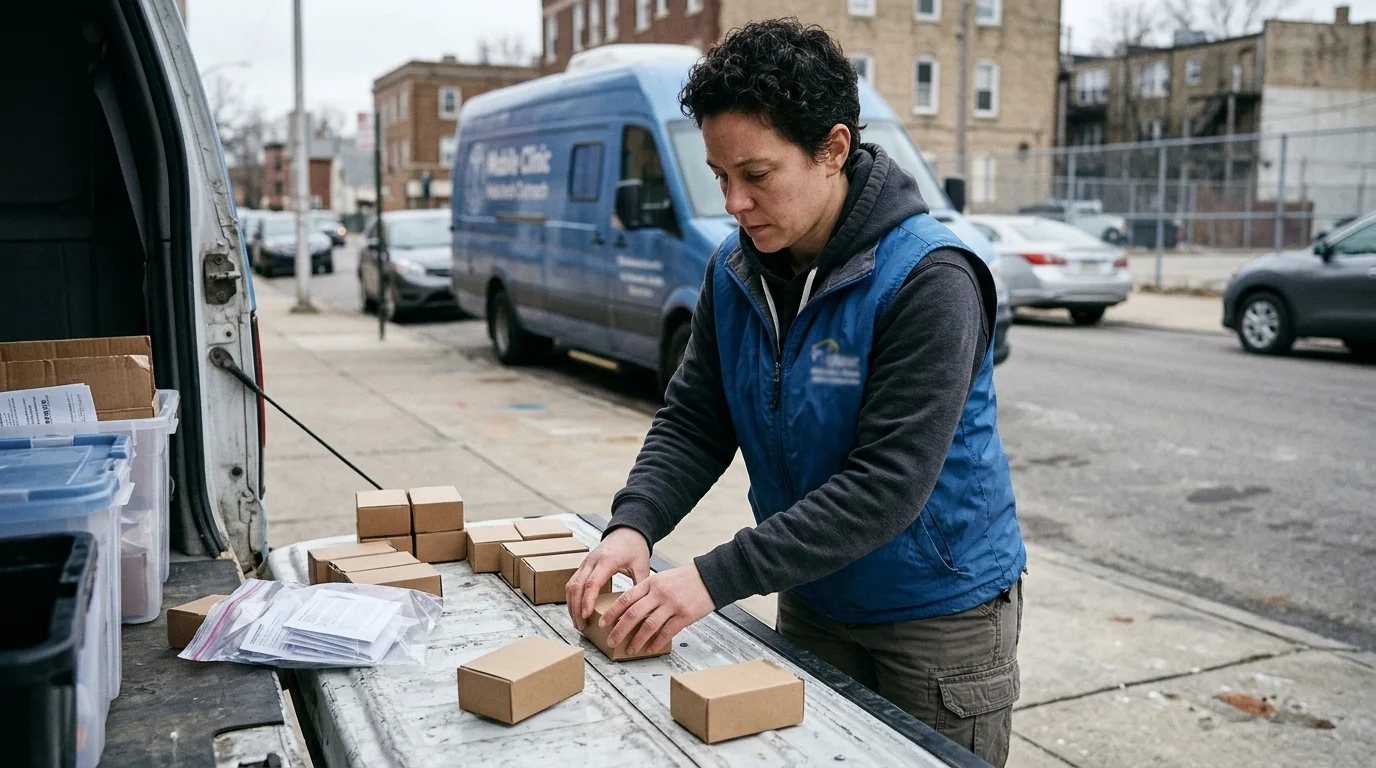
The procurement topics span the full continuum of care, which reflects how the $31 million plan was structured: $9 million for Tribal nations, $6.5 million for room-and-board residential treatment, $3.5 million for naloxone and overdose prevention supplies, $3 million for K-12 prevention, and $2 million for law enforcement opioid abatement. Milwaukee County's Mobile MAT Expression of Interest, seeking an operator for a fully outfitted mobile medication-assisted treatment van ready to deploy, is a first-of-kind procurement in the state, connecting low-barrier opioid treatment to people who cannot or do not access fixed-site clinics. It is a direct downstream product of both settlement and COSSUP funding reaching the county level.
That county dynamic is the part of this picture the statewide RFP database does not fully capture. Wisconsin's settlement framework directs 70% of litigation proceeds to counties and municipalities independently, with only 30% flowing through DHS centrally. The 17 RFPs visible in the trailing 30 days represent the DHS-managed share plus a handful of early-moving counties. As the remaining 70% works its way through local budget and procurement processes, county-level solicitations are likely to multiply well into 2027. Rock County, Columbia County, and Milwaukee County are already in the data; they are almost certainly not the last.
For residents and service providers across Wisconsin, the near-term signal to watch is whether county health departments, particularly in mid-size metros, post their own settlement-funded solicitations in Q1 2027 as local spending plans mature. The DHS opioid settlement funds page is publishing quarterly summaries as disbursements progress. The pace of that county wave will determine whether the tenfold surge in state-level procurement turns out to be a peak or a preview.