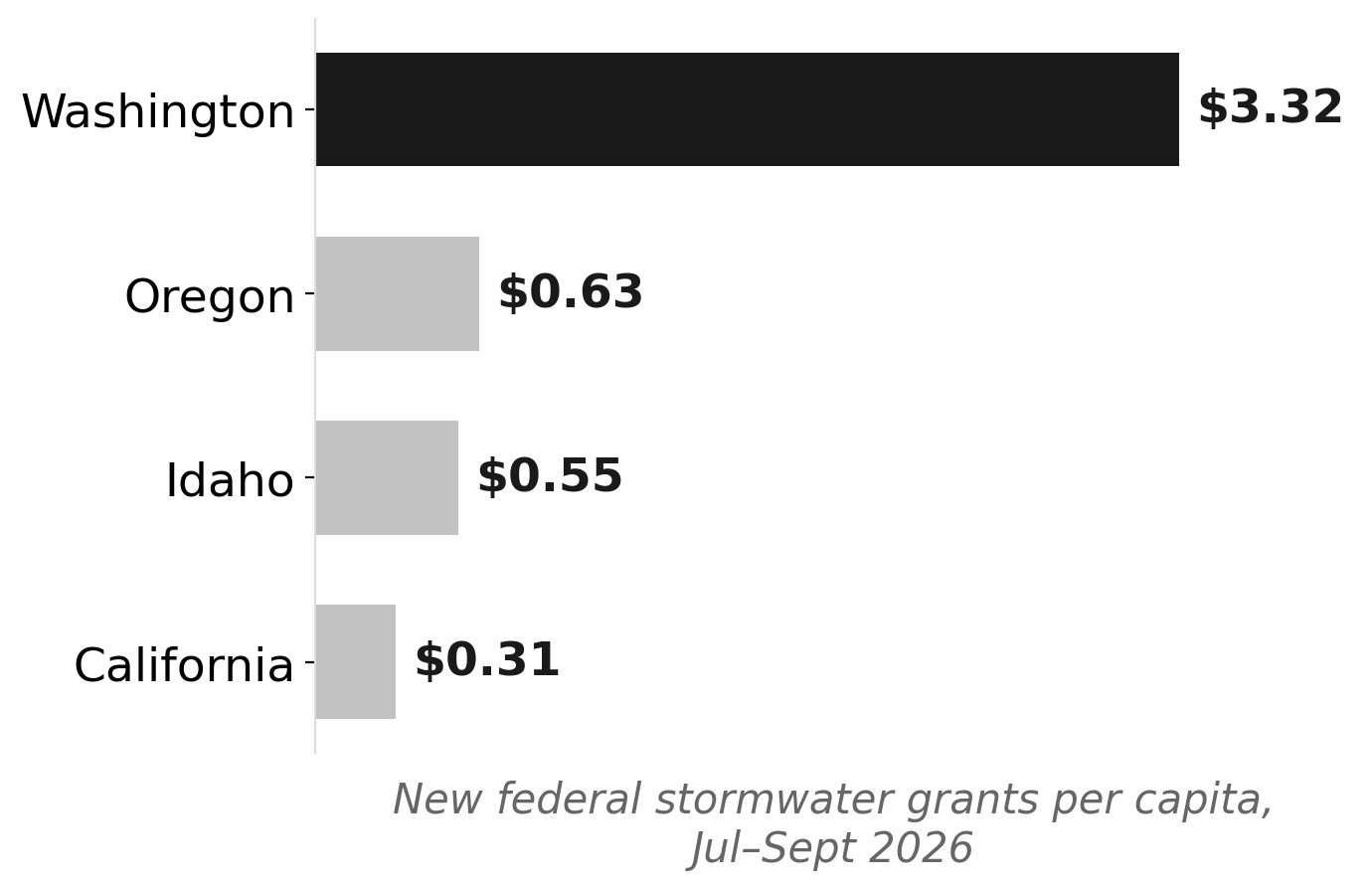
Washington state collected $25.9 million in new federal stormwater grants in the 90 days ending late September 2026, a 206% jump from $8.47 million in the same window a year earlier, and more than the combined 90-day totals for California, Oregon, and Idaho. The surge is not a coincidence of timing. It is the opening movement of a coordinated race between a hard regulatory deadline and a closing federal funding window.
The largest single check landed in Whatcom County: a $25 million DOT National Infrastructure Investments (INFRA) grant awarded September 15, 2026, running through October 2029. WSDOT collected a separate $934,200 Highway Planning and Construction grant the day before. Together they account for virtually all of the trailing-90-day total. But those awards sit on top of a much larger active portfolio: the State of Washington holds a $73.6 million NOAA Coastal Management grant, WSDOT holds $24.8 million more from the same Q4 2024 tranche, and Snohomish County holds $16.3 million, all running through 2029.
To understand why the money is moving this fast, you have to look at what Washington's Department of Ecology did on August 1, 2024. That is when the agency's reissued Phase I and Phase II Municipal Stormwater General Permits took effect, binding more than 80 cities and portions of six counties to a cascading compliance schedule. Outfall and tree canopy mapping is due December 31, 2026. Stormwater Management Action Plans for high-priority catchments are due March 31, 2027. Full MS4 system mapping follows by March 31, 2029. These are not aspirational goals; they are permit conditions with enforcement consequences.
Source: NationGraph.
The NPDES permit and the federal capital grants are distinct mechanisms doing different work. The permit is a state regulatory instrument: it mandates what permittees must do but does not pay for it. The DOT INFRA and NOAA Coastal Management grants are discretionary federal competitive awards that fund the physical infrastructure to meet those obligations. The Clean Water State Revolving Fund, a third channel capitalized by the Infrastructure Investment and Jobs Act, provides low-cost financing and some principal forgiveness administered by Ecology. All three are flowing simultaneously, which explains the volume, but they are not one program.
The federal side of that equation is under pressure. The IIJA added $11.7 billion to the Clean Water State Revolving Fund over fiscal years 2022 through 2026, and that authorization is now in its final year. The EPA's Sewer Overflow and Stormwater Reuse Municipal Grant program announced $80 million nationally in April 2026, but the entire Pacific Northwest, Alaska, Idaho, Oregon, and Washington combined, received just $3.8 million from that pool, underscoring how thin that particular channel runs relative to the infrastructure need. More urgently, Washington's Ecology department has warned publicly that the proposed federal FY2026 EPA budget would cut Clean Water Act program funding by more than 90% nationally, a reduction that would substantially shrink the state-administered grant pipeline in future years.
The result is a narrow band of time in which permit obligations are real and escalating, federal dollars are still arriving, and the next federal budget cycle could close the spigot. Local governments that move now can capture capital they may not be able to access in 2027 or 2028.
Whatcom County illustrates the stakes most clearly. It sits at the north end of Puget Sound, carries a phosphorus Total Maximum Daily Load compliance burden for Lake Whatcom, and launched a new Stormwater Source Control inspection program in 2026 under its Phase II permit obligations. The $25 million INFRA award gives the county capital to act on project commitments that the permit now requires it to complete on a specific schedule. Snohomish County, with $16.3 million already active from the NOAA tranche, faces parallel pressure across its urbanizing western tier.
The broader Puget Sound context makes the compliance stakes higher than a typical stormwater story. Urban runoff in this basin carries copper, phosphorus, PCBs, and 6PPD, a tire-derived chemical that is acutely toxic to coho salmon. The permit regime is designed in part to address those specific contaminants, which means the mapping and SMAP deadlines are not administrative formalities. They are milestones toward measurable water quality outcomes in a system with listed species and active TMDL obligations.
The signal to watch next is the federal FY2026 appropriations outcome, specifically whether the proposed EPA Clean Water Act cuts survive the congressional process. If they do, the grant pipeline supporting future permit compliance cycles shrinks sharply, and the obligations Ecology imposed in August 2024 remain on the books regardless. The counties and cities moving fastest right now are betting that the window is open today and may not be in 2027.